Jonathan, Son of King Saul
Who was Jonathan, Son of King Saul, in the Bible?
A prince of Israel and renowned warrior of the Tribe of Benjamin, famous for his profound covenantal friendship with David and his loyalty to God over his own royal succession.
This is one of 12 people named Jonathan in the Bible. See all 12 →
Jonathan was the eldest son of Saul, the first king of Israel, and a central figure during the United Monarchy. A member of the Tribe of Benjamin, he was not only a prince but also a distinguished military commander who displayed exceptional courage in the wars against the Philistines. Despite being the natural heir to the throne, Jonathan is best remembered for his selfless recognition of David as God’s chosen successor, leading to one of the most celebrated friendships in biblical literature.
His life was characterized by a difficult tension between his loyalty to his father, King Saul, and his devotion to his friend, David, whom Saul sought to destroy. Jonathan’s story is a tragic one, marked by his attempt to mediate between a jealous monarch and a rising hero, culminating in his death alongside his father and brothers on the heights of Mount Gilboa. His legacy survived through his son Mephibosheth and the eternal covenant he established with the house of David.
Background and Family
Jonathan was born into the Tribe of Benjamin as the son of Saul and Ahinoam. As the firstborn of the king, he occupied a position of high status and responsibility within the early Israelite monarchy. The biblical genealogies in 1 Samuel and 1 Chronicles list his siblings as Abinadab, Malchi-shua, Ish-bosheth (also called Esh-baal), Merab, and Michal. He also had half-brothers, Armoni and Mephibosheth, through his father’s concubine Rizpah.
Jonathan was a father himself; his son was also named Mephibosheth (referred to as Merib-baal in 1 Chronicles). This son was famously injured as a child when his nurse dropped him while fleeing after the news of Jonathan’s death arrived from Jezreel, leaving him lame in both feet. Jonathan lived during the transition of Israel from a loose confederation of tribes under judges to a centralized kingdom, a period defined by constant military friction with the Philistines.
Major Life Events
The Victory at Michmash
Jonathan first appears in the biblical narrative as a capable military leader. In 1 Samuel 13, he leads a thousand men in Gibeah and successfully attacks a Philistine outpost at Geba. His most famous military exploit occurs at the pass of Michmash. Demonstrating immense faith, Jonathan and his armor-bearer privately left the Israelite camp to confront the Philistine garrison. Jonathan’s philosophy was recorded as: “Nothing can hinder the LORD from saving, whether by many or by few” (1 Samuel 14:6).
After receiving a sign from God, the two men climbed the cliffs of Bozez and Seneh and struck down approximately twenty Philistines. This act of bravery sparked a panic in the Philistine camp and led to a general Israelite victory. During the pursuit, Jonathan unknowingly broke a rash fast imposed by Saul by eating wild honey. When Saul discovered this via lot, he intended to execute Jonathan to fulfill his oath, but the Israelite army intervened, refusing to allow their hero to be killed.
The Covenant with David
Following David’s victory over Goliath, 1 Samuel 18 records that the souls of Jonathan and David were "knit together." Jonathan loved David as his own soul and symbolized his recognition of David’s future kingship by stripping himself of his royal robe, tunic, sword, bow, and belt, and giving them to David. This was a significant political and personal act, effectively transferring his rights as heir to his friend.
As Saul’s jealousy of David grew into murderous intent, Jonathan acted as a protector. He warned David of Saul’s plans, advocated for David’s innocence before the king, and risked his own life to facilitate David’s escape. In 1 Samuel 20, the two devised a signal involving arrows to communicate Saul’s intent. When Saul realized Jonathan was aiding David, he insulted Jonathan’s mother and even hurled a spear at his own son in a fit of rage.
Death at Mount Gilboa
Jonathan’s life ended in battle against the Philistines. In a final stand on Mount Gilboa, the Philistines overtook the Israelite forces. Jonathan was killed alongside his brothers Abinadab and Malchi-shua. Saul also perished in the conflict. The Philistines desecrated their bodies, hanging them on the wall of Beth-shan, but the men of Jabesh-gilead eventually recovered the remains for a proper burial. David, upon hearing the news, composed a famous lament, praising Jonathan as "swifter than eagles" and "stronger than lions," mourning that Jonathan’s love was "extraordinary, surpassing the love of women" (2 Samuel 1:23-26).
Relationship to Other Biblical Figures
Jonathan’s primary relationship was his complex bond with his father, Saul. Despite Saul’s descent into madness and his attempts to kill Jonathan, Jonathan remained loyal to his father and the defense of Israel until the end. His relationship with David is the biblical archetype of platonic devotion and covenantal loyalty. He chose his spiritual conviction that David was God’s anointed over his own dynastic ambitions. Later, David honored this bond by showing extreme kindness to Jonathan’s son, Mephibosheth, restoring his lands and giving him a permanent place at the royal table.
Spiritual Significance
Jonathan serves as a model of faith and selflessness. His actions at Michmash demonstrate a theology of divine sovereignty—believing that God does not require large numbers to achieve victory. More significantly, Jonathan represents the rare virtue of a man who willingly steps aside from power because he recognizes the hand of God on another. In the biblical narrative of the United Monarchy, Jonathan is the bridge between the failed house of Saul and the rising house of David, ensuring that the transition of the kingdom was marked not by civil war between the two friends, but by a holy covenant that David would respect for generations.
Jonathan is theologically significant as a figure of 'covenantal loyalty' (hesed). He represents the ideal of the 'faithful remnant' within the house of Saul, choosing to align himself with the will of God regarding the messianic line of David rather than pursuing his own legal claim to the throne. His self-divestment of his royal regalia to David is often seen by scholars as a symbolic recognition of the shift in the divine mandate from the Tribe of Benjamin to the Tribe of Judah.
Furthermore, Jonathan’s character provides a moral foil to Saul; where Saul is paranoid and disobedient, Jonathan is courageous and trusting. His death on Mount Gilboa is portrayed as a national tragedy, highlighting the high cost of Saul's failures while simultaneously clearing the way for David’s undisputed reign. The lasting nature of his covenant, which protected his descendants even after his death, underscores the biblical theme of the enduring power of oaths made before the LORD.
Frequently Asked Questions
Why did Jonathan give his clothes and weapons to David?
Jonathan gave David his robe, tunic, sword, bow, and belt to symbolize a covenant of friendship and his recognition that David, not himself, was the rightful future king of Israel. It was a formal act of transferring his status as the heir apparent to David.
How did Jonathan die?
Jonathan died in battle against the Philistines on Mount Gilboa. He was killed alongside his father, King Saul, and his brothers Abinadab and Malchi-shua, as recorded in 1 Samuel 31 and 1 Chronicles 10.
Did Jonathan ever become king?
No, Jonathan never became king. Although he was King Saul's eldest son and the natural heir, he recognized that God had chosen David to lead Israel. He died while his father was still reigning or at the moment the reign ended.
What happened to Jonathan's children?
Jonathan had a son named Mephibosheth (also called Merib-baal). After Jonathan's death, Mephibosheth was cared for by a nurse and later brought into King David's court, where he was treated with great honor and restored to his family's lands due to David's oath to Jonathan.
Family & Relationships
Parents
 Ahinoam, Wife of SaulMother1 Samuel 14:50
Inferred
Reconstructed through Saul: 1 Samuel 13:22 ties Jonathan to Saul; 1 Samuel 14:50 ties Saul to Ahinoam. No verse states the mother link between Jonathan and Ahinoam directly.Evidence: 1 Samuel 14:50; 1 Samuel 13:22; 1 Samuel 14:1; 1 Samuel 14:49; 1 Samuel 19:1
 SaulFather1 Samuel 13:22Stated
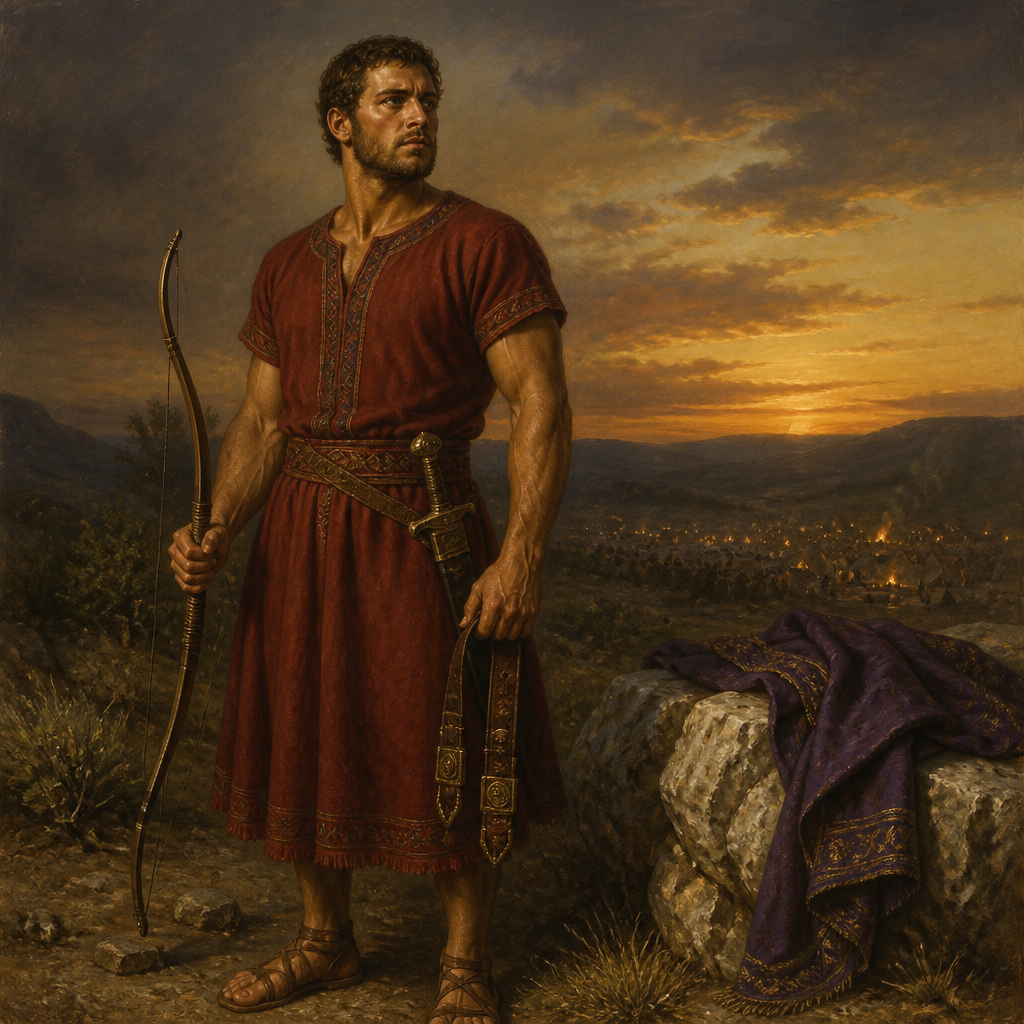 Jonathan, Son of King SaulThis page
 Abinadab, Son of King SaulBrother1 Samuel 13:22
Inferred
1 Chronicles 8:33 names Abinadab and Jonathan in the same verse but does not state a brother tie between them; the link rests on the surrounding narrative.Evidence: 1 Samuel 13:22; 1 Chronicles 8:33
 MalchishuaBrother1 Samuel 14:49Stated
 MerabSister1 Samuel 14:49Stated
 MichalSister1 Samuel 14:49Stated
 ArmoniBrother1 Samuel 14:49
Inferred
Reconstructed through Saul: 2 Samuel 21:8 ties Armoni to Saul; 1 Samuel 13:22 ties Saul to Jonathan. No verse states the brother link between Armoni and Jonathan directly.Evidence: 1 Samuel 14:49
 Ish-boshethBrother1 Samuel 14:49Stated
 Mephibosheth, Son of Saul and RizpahBrother1 Samuel 13:22
Inferred
2 Samuel 9:6 names Mephibosheth and Jonathan in the same verse but does not state a brother tie between them; the link rests on the surrounding narrative.Evidence: 1 Samuel 13:22; 2 Samuel 9:6
Children
 Mephibosheth, Son of JonathanSon2 Samuel 9:6Stated
Connected Figures
Family
Mother · 1 Samuel 14:50
Ahinoam was the daughter of Ahimaaz and the queen consort of Saul, the first king of Israel.
United MonarchyFirst: 1 Samuel 14:5010 versesQueen of Israel
Father · 1 Samuel 13:22
Saul was the first king of Israel, anointed by Samuel from the tribe of Benjamin to lead the United Monarchy against the Philistine threat.
United MonarchyFirst: 1 Samuel 9:2339 versesFirst King of IsraelBenjamin
Son · 2 Samuel 9:6
The grandson of King Saul and son of Jonathan who was crippled in childhood and later restored to royal honor by King David.
United MonarchyFirst: 2 Samuel 4:417 versesRoyal courtierBenjamin
Brother · 1 Samuel 13:22
A prince of the tribe of Benjamin and son of King Saul who died alongside his father and brothers during the Battle of Mount Gilboa.
United MonarchyFirst: 1 Samuel 14:4911 versesPrince of Israel / SoldierBenjamin
Brother · 1 Samuel 14:49
A prince of the United Monarchy and son of King Saul who died alongside his father and brothers during the Battle of Mount Gilboa.
United MonarchyFirst: 1 Samuel 14:498 versesPrince of IsraelBenjamin
Sister · 1 Samuel 14:49
Merab was the eldest daughter of King Saul, originally promised to David as a wife but ultimately married to Adriel of Meholah.
United MonarchyFirst: 1 Samuel 14:497 versesPrincess of IsraelBenjamin
Sister · 1 Samuel 14:49
The daughter of King Saul and the first wife of King David, Michal is a complex figure who navigated the political and personal tensions of Israel's early monarchy.
United MonarchyFirst: 1 Samuel 14:4921 versesPrincess of Israel, Queen ConsortBenjamin
Brother · 1 Samuel 14:49
Armoni was a son of King Saul and his concubine Rizpah, who was surrendered to the Gibeonites for execution during the United Monarchy.
United MonarchyFirst: 2 Samuel 21:84 versesPrince of IsraelBenjamin
Brother · 1 Samuel 14:49
The youngest son of King Saul who reigned as the second king over Israel for two years during a period of civil war with the house of David.
United MonarchyFirst: 2 Samuel 2:816 versesKing of IsraelBenjamin
Brother · 1 Samuel 13:22
A son of King Saul and his concubine Rizpah who was executed by the Gibeonites during the reign of King David.
United MonarchyFirst: 2 Samuel 21:87 versesPrince of IsraelBenjamin
Categories
Mentions by Book
- 1 Samuel61
- 2 Samuel18
- 1 Chronicles5
Scripture References
All 84 indexed verses, in canonical order, from the Berean Standard Bible.
- 1 Samuel 13:2
He chose for himself three thousand men of Israel: Two thousand were with Saul at Michmash and in the hill country of Bethel, and a thousand were with Jonathan in Gibeah of Benjamin. And the rest of the troops he sent away, each to his own home.
- 1 Samuel 13:3
Then Jonathan attacked the Philistine outpost at Geba, and the Philistines heard about it. So Saul blew the ram’s horn throughout the land, saying, “Let the Hebrews hear!”
- 1 Samuel 13:16
Now Saul and Jonathan his son and the troops with them were staying in Geba of Benjamin, while the Philistines camped at Michmash.
- 1 Samuel 13:22Partial
So on the day of battle not a sword or spear could be found in the hands of the troops with Saul and Jonathan; only Saul and his son Jonathan had weapons.
- 1 Samuel 14:1
One day Jonathan son of Saul said to the young man bearing his armor, “Come, let us cross over to the Philistine outpost on the other side.” But Jonathan did not tell his father.
- 1 Samuel 14:3
including Ahijah, who was wearing an ephod. He was the son of Ichabod’s brother Ahitub son of Phinehas, the son of Eli the priest of the LORD in Shiloh. But the troops did not know that Jonathan had left.
- 1 Samuel 14:4
Now there were cliffs on both sides of the pass that Jonathan intended to cross to reach the Philistine outpost. One was named Bozez and the other Seneh.
- 1 Samuel 14:6
Jonathan said to the young man bearing his armor, “Come, let us cross over to the outpost of these uncircumcised men. Perhaps the LORD will work on our behalf. Nothing can hinder the LORD from saving, whether by many or by few.”
- 1 Samuel 14:8
“Very well,” said Jonathan, “we will cross over toward these men and show ourselves to them.
- 1 Samuel 14:12Partial
So the men of the outpost called out to Jonathan and his armor-bearer, “Come on up, and we will teach you a lesson!” “Follow me,” Jonathan told his armor-bearer, “for the LORD has delivered them into the hand of Israel.”
- 1 Samuel 14:13Partial
So Jonathan climbed up on his hands and feet, with his armor-bearer behind him. And the Philistines fell before Jonathan, and his armor-bearer followed and finished them off.
- 1 Samuel 14:14
In that first assault, Jonathan and his armor-bearer struck down about twenty men in about half an acre of land.
- 1 Samuel 14:17
Saul said to the troops who were with him, “Call the roll and see who has left us.” And when they had called the roll, they saw that Jonathan and his armor-bearer were not there.
- 1 Samuel 14:21
And the Hebrews who had previously gone up into the surrounding camps to join the Philistines now went over to the Israelites who were with Saul and Jonathan.
- 1 Samuel 14:27
Jonathan, however, had not heard that his father had bound the people with the oath. So he reached out the end of the staff in his hand, dipped it into the honeycomb, and put his hand to his mouth, and his eyes brightened.
- 1 Samuel 14:29
“My father has brought trouble to the land,” Jonathan replied. “Just look at how my eyes have brightened because I tasted a little of this honey.
- 1 Samuel 14:39
As surely as the LORD who saves Israel lives, even if it is my son Jonathan, he must die!” But not one of the troops said a word.
- 1 Samuel 14:40
Then Saul said to all Israel, “You stand on one side, and I and my son Jonathan will stand on the other side.” “Do what seems good to you,” the troops replied.
- 1 Samuel 14:41
So Saul said to the LORD, the God of Israel, “Why have You not answered Your servant this day? If the fault is with me or my son Jonathan, respond with Urim, but if the fault is with the men of Israel, respond with Thummim.” And Jonathan and Saul were selected, but the people were cleared of the charge.
- 1 Samuel 14:42Partial
Then Saul said, “Cast the lot between me and my son Jonathan.” And Jonathan was selected.
- 1 Samuel 14:43Partial
“Tell me what you have done,” Saul commanded him. So Jonathan told him, “I only tasted a little honey with the end of the staff that was in my hand. And now I must die?”
- 1 Samuel 14:44
And Saul declared, “May God punish me, and ever so severely, if you, Jonathan, do not surely die!”
- 1 Samuel 14:45Partial
But the people said to Saul, “Must Jonathan die—he who accomplished such a great deliverance for Israel? Never! As surely as the LORD lives, not a hair of his head will fall to the ground, for with God’s help he has accomplished this today.” So the people rescued Jonathan, and he did not die.
- 1 Samuel 14:49
Now the sons of Saul were Jonathan, Ishvi, and Malchishua. His two daughters were named Merab (his firstborn) and Michal (his younger daughter).
- 1 Samuel 14:50Partial
His wife’s name was Ahinoam daughter of Ahimaaz. The name of the commander of his army was Abner, the son of Saul’s uncle Ner.
Cited as evidence on a family card; added so References, Key Verses and Mentions by Book share one index.
- 1 Samuel 18:1Partial
After David had finished speaking with Saul, the souls of Jonathan and David were knit together, and Jonathan loved him as himself.
- 1 Samuel 18:3
Then Jonathan made a covenant with David because he loved him as himself.
- 1 Samuel 18:4
And Jonathan removed the robe he was wearing and gave it to David, along with his tunic, his sword, his bow, and his belt.
- 1 Samuel 19:1
Then Saul ordered his son Jonathan and all his servants to kill David. But Jonathan delighted greatly in David,
- 1 Samuel 19:2
so he warned David, saying, “My father Saul intends to kill you. Be on your guard in the morning; find a secret place and hide there.
- 1 Samuel 19:4
Then Jonathan spoke well of David to his father Saul and said to him, “The king should not sin against his servant David; he has not sinned against you. In fact, his actions have been highly beneficial to you.
- 1 Samuel 19:6
Saul listened to the voice of Jonathan and swore an oath: “As surely as the LORD lives, David will not be put to death.”
- 1 Samuel 19:7Partial
So Jonathan summoned David and told him all these things. Then Jonathan brought David to Saul, and David was with Saul as before.
- 1 Samuel 20:1
Then David fled from Naioth in Ramah. He came to Jonathan and asked, “What have I done? What is my iniquity? How have I sinned against your father, that he wants to take my life?”
- 1 Samuel 20:3
But David again vowed, “Your father knows very well that I have found favor in your eyes, and he has said, ‘Jonathan must not know of this, or he will be grieved.’ As surely as the LORD lives and as you yourself live, there is but a step between me and death.”
- 1 Samuel 20:4
Then Jonathan said to David, “Whatever you desire, I will do for you.”
- 1 Samuel 20:5
So David told him, “Look, tomorrow is the New Moon, and I am supposed to dine with the king. Instead, let me go and hide in the field until the third evening from now.
- 1 Samuel 20:9
“Never!” Jonathan replied. “If I ever found out that my father had evil intentions against you, would I not tell you?”
- 1 Samuel 20:10
Then David asked Jonathan, “Who will tell me if your father answers you harshly?”
- 1 Samuel 20:11
“Come,” he replied, “let us go out to the field.” So the two of them went out into the field,
- 1 Samuel 20:12
and Jonathan said, “By the LORD, the God of Israel, I will sound out my father by this time tomorrow or the next day. If he is favorable toward you, will I not send for you and tell you?
- 1 Samuel 20:13
But if my father intends to bring evil on you, then may the LORD punish me, and ever so severely, if I do not tell you and send you on your way in safety. May the LORD be with you, just as He has been with my father.
- 1 Samuel 20:16
So Jonathan made a covenant with the house of David, saying, “May the LORD hold David’s enemies accountable.”
- 1 Samuel 20:17
And Jonathan had David reaffirm his vow out of love for him, for Jonathan loved David as he loved himself.
- 1 Samuel 20:18
Then Jonathan said to David, “Tomorrow is the New Moon, and you will be missed, because your seat will be empty.
- 1 Samuel 20:25
He sat in his usual place by the wall, opposite Jonathan and beside Abner, but David’s place was empty.
- 1 Samuel 20:27
But on the day after the New Moon, the second day, David’s place was still empty, and Saul asked his son Jonathan, “Why hasn’t the son of Jesse come to the meal either yesterday or today?”
- 1 Samuel 20:28
Jonathan answered, “David urgently requested my permission to go to Bethlehem,
- 1 Samuel 20:30
Then Saul’s anger burned against Jonathan, and he said to him, “You son of a perverse and rebellious woman! Do I not know that you have chosen the son of Jesse to your own shame and to the shame of the mother who bore you?
- 1 Samuel 20:32
“Why must he be put to death?” Jonathan replied. “What has he done?”
- 1 Samuel 20:33
Then Saul hurled his spear at Jonathan to kill him. So Jonathan knew that his father was determined to kill David.
- 1 Samuel 20:34
Jonathan got up from the table in fierce anger and did not eat any food that second day of the month, for he was grieved by his father’s shameful treatment of David.
- 1 Samuel 20:35
In the morning Jonathan went out to the field for the appointment with David, and a small boy was with him.
- 1 Samuel 20:37Partial
When the boy reached the place where Jonathan’s arrow had fallen, Jonathan called to him, “Isn’t the arrow beyond you?”
- 1 Samuel 20:38Partial
Then Jonathan cried out, “Hurry! Make haste! Do not delay!” So the boy picked up the arrow and returned to his master.
- 1 Samuel 20:39
But the boy did not know anything; only Jonathan and David knew the arrangement.
- 1 Samuel 20:40
Then Jonathan gave his equipment to the boy and said, “Go, take it back to the city.”
- 1 Samuel 20:42Partial
And Jonathan said to David, “Go in peace, for the two of us have sworn in the name of the LORD, saying, ‘May the LORD be a witness between you and me, and between your descendants and mine forever.’” Then David got up and departed, and Jonathan went back into the city.
- 1 Samuel 23:16
And Saul’s son Jonathan came to David in Horesh and strengthened his hand in God,
- 1 Samuel 23:18
So the two of them made a covenant before the LORD. And David remained in Horesh, while Jonathan went home.
- 1 Samuel 31:2
The Philistines hotly pursued Saul and his sons, and they killed Saul’s sons Jonathan, Abinadab, and Malchishua.
- 2 Samuel 1:4
“What was the outcome?” David asked. “Please tell me.” “The troops fled from the battle,” he replied. “Many of them fell and died. And Saul and his son Jonathan are also dead.”
- 2 Samuel 1:5
Then David asked the young man who had brought him the report, “How do you know that Saul and his son Jonathan are dead?”
- 2 Samuel 1:12
They mourned and wept and fasted until evening for Saul and his son Jonathan, and for the people of the LORD and the house of Israel, because they had fallen by the sword.
- 2 Samuel 1:17
Then David took up this lament for Saul and his son Jonathan,
- 2 Samuel 1:22
From the blood of the slain, from the fat of the mighty, the bow of Jonathan did not retreat, and the sword of Saul did not return empty.
- 2 Samuel 1:23
Saul and Jonathan, beloved and delightful in life, were not divided in death. They were swifter than eagles; they were stronger than lions.
- 2 Samuel 1:25
How the mighty have fallen in the thick of battle! Jonathan lies slain on your heights.
- 2 Samuel 1:26
I grieve for you, Jonathan, my brother. You were delightful to me; your love to me was extraordinary, surpassing the love of women.
- 2 Samuel 4:4Partial
And Jonathan son of Saul had a son who was lame in his feet. He was five years old when the report about Saul and Jonathan came from Jezreel. His nurse picked him up and fled, but as she was hurrying to escape, he fell and became lame. His name was Mephibosheth.
- 2 Samuel 9:1
Then David asked, “Is there anyone left from the house of Saul to whom I can show kindness for the sake of Jonathan?”
- 2 Samuel 9:3
So the king asked, “Is there anyone left of the house of Saul to whom I can show the kindness of God?” Ziba answered, “There is still Jonathan’s son, who is lame in both feet.”
- 2 Samuel 9:6
And when Mephibosheth son of Jonathan, the son of Saul, came to David, he fell facedown in reverence. Then David said, “Mephibosheth!” “I am your servant,” he replied.
- 2 Samuel 9:7
“Do not be afraid,” said David, “for surely I will show you kindness for the sake of your father Jonathan. I will restore to you all the land of your grandfather Saul, and you will always eat at my table.”
- 2 Samuel 21:7Partial
Now the king spared Mephibosheth son of Jonathan, the son of Saul, because of the oath before the LORD between David and Jonathan son of Saul.
- 2 Samuel 21:8Partial
But the king took Armoni and Mephibosheth, the two sons whom Rizpah daughter of Aiah had borne to Saul, as well as the five sons whom Merab daughter of Saul had borne to Adriel son of Barzillai the Meholathite.
Cited as evidence on a family card; added so References, Key Verses and Mentions by Book share one index.
- 2 Samuel 21:12
he went and took the bones of Saul and his son Jonathan from the men of Jabesh-gilead, who had stolen them from the public square of Beth-shan where the Philistines had hung the bodies after they had struck down Saul at Gilboa.
- 2 Samuel 21:13
So David had the bones of Saul and his son Jonathan brought from there, and they also gathered the bones of those who had been hanged.
- 2 Samuel 21:14
And they buried the bones of Saul and his son Jonathan in Zela in the land of Benjamin, in the tomb of Saul’s father Kish. After they had done everything the king had commanded, God answered their prayers for the land.
- 1 Chronicles 8:33
Ner was the father of Kish, Kish was the father of Saul, and Saul was the father of Jonathan, Malchishua, Abinadab, and Esh-baal.
- 1 Chronicles 8:34
The son of Jonathan: Merib-baal, and Merib-baal was the father of Micah.
- 1 Chronicles 9:39
Ner was the father of Kish, Kish was the father of Saul, and Saul was the father of Jonathan, Malchishua, Abinadab, and Esh-baal.
- 1 Chronicles 9:40
The son of Jonathan: Merib-baal, who was the father of Micah.
- 1 Chronicles 10:2
The Philistines followed hard after Saul and his sons, and they killed Saul’s sons Jonathan, Abinadab, and Malchishua.
Others Named Jonathan
Compare all 12 bearers →Jonathan, Son of Shammah2 Samuel 23:32
An elite Judean warrior and one of King David's 'Mighty Men' who achieved high military distinction during the United Monarchy.
Jonathan of the MalluchiNehemiah 12:14
A member of the house of Malluchi who served during the Post-Exilic Period during the reorganization of the priesthood under Nehemiah.
Jonathan, Priest to the Tribe of DanJudges 18:30
A Levite during the Period of the Judges who established a hereditary priesthood for an idolatrous shrine in the northern territory of Dan.
Jonathan, Son of Abiathar the Priest2 Samuel 15:27
A loyal priest of the tribe of Levi who served as a courier and intelligence agent for King David during the rebellions of Absalom and Adonijah.
Jonathan, Father of EbedEzra 8:6
A descendant of Adin during the Post-Exilic Period whose son, Ebed, led a group of fifty men back to Jerusalem under the leadership of Ezra.
Jonathan, Son of Uzziah1 Chronicles 27:25
An administrator during the United Monarchy who managed the royal agricultural and strategic storehouses for the Davidic kingdom.
Jonathan, Son of AsahelEzra 10:15
A Judean man during the post-exilic period who formally opposed Ezra’s specific procedure for dissolving foreign marriages.
Jonathan, Son of ShemaiahNehemiah 12:35
A Levite of the post-exilic period and a descendant of Asaph whose lineage was instrumental in the musical and liturgical restoration of Jerusalem.
Jonathan, Son of Jada1 Chronicles 2:32
A descendant of Jerahmeel within the Tribe of Judah, known for his inclusion in the post-exilic genealogical records of the era of the conquest and the judges.
Jonathan, Son of KareahJeremiah 40:8
Jonathan, son of Kareah, was a Judean military officer who joined the governor Gedaliah at Mizpah after the fall of Jerusalem to the Babylonians.
Jonathan the ScribeJeremiah 37:15
A government official in Jerusalem during the reign of King Zedekiah who converted his private residence into a dungeon for the prophet Jeremiah.