Rizpah
Who was Rizpah in the Bible?
A concubine of King Saul whose grief-stricken vigil over her executed sons prompted King David to show mercy and grant the house of Saul a proper burial.
Rizpah, the daughter of Aiah, was a woman of the United Monarchy era who served as a concubine to Israel’s first king, Saul. While her social status was secondary to that of a wife, her presence in the biblical narrative marks two critical turning points in the political stability of Israel. She first appears during the power struggle between Saul’s general, Abner, and Saul’s son, Ish-bosheth, following the king's death.
Later in the narrative of 2 Samuel, Rizpah becomes a central figure of tragic devotion. After two of her sons are executed to atone for Saul’s past sins against the Gibeonites, she performs a grueling months-long vigil to protect their bodies from scavengers. Her actions eventually move King David to intervene, leading to a resolution of a national famine and the respectful re-interment of the remains of Saul and his lineage.
Background and Family
Rizpah is identified as the daughter of Aiah. While her tribal affiliation is not explicitly stated in the Masoretic Text, her role as a concubine to King Saul placed her within the royal household of Gibeah during the late 11th century BC. As a concubine, Rizpah held a legal status that provided her with protection and recognition within the palace, though she did not possess the full standing of a primary wife. Through her union with Saul, she bore two sons: Armoni and Mephibosheth (not to be confused with Jonathan’s son of the same name).
Major Life Events
The Conflict Between Abner and Ish-bosheth
After the death of Saul at Mount Gilboa, a fractured Israel saw Saul’s son Ish-bosheth take the throne in the north while David reigned in Judah. During this period, 2 Samuel 3:7 records a sharp dispute between Ish-bosheth and his commander-in-chief, Abner. Ish-bosheth accused Abner of sleeping with Rizpah. In the Ancient Near East, taking a deceased king’s concubine was often viewed as a claim to the throne itself. Whether the accusation was true or a paranoid political maneuver by Ish-bosheth, the fallout was significant. Abner reacted with such fury that he defected to David, effectively ending the house of Saul’s viability as a ruling dynasty.
The Execution of Her Sons
Years later, during the reign of David, Israel suffered a three-year famine. Seeking the Lord, David was told the famine was due to the "blood-stained house of Saul" because Saul had attempted to annihilate the Gibeonites, breaking a sacred oath. To make restitution, the Gibeonites demanded seven of Saul’s male descendants to be executed. David spared Mephibosheth (son of Jonathan) but handed over five sons of Merab and both of Rizpah’s sons, Armoni and Mephibosheth. The men were executed and their bodies left exposed on a hill at Gibeah.
The Vigil of Rizpah
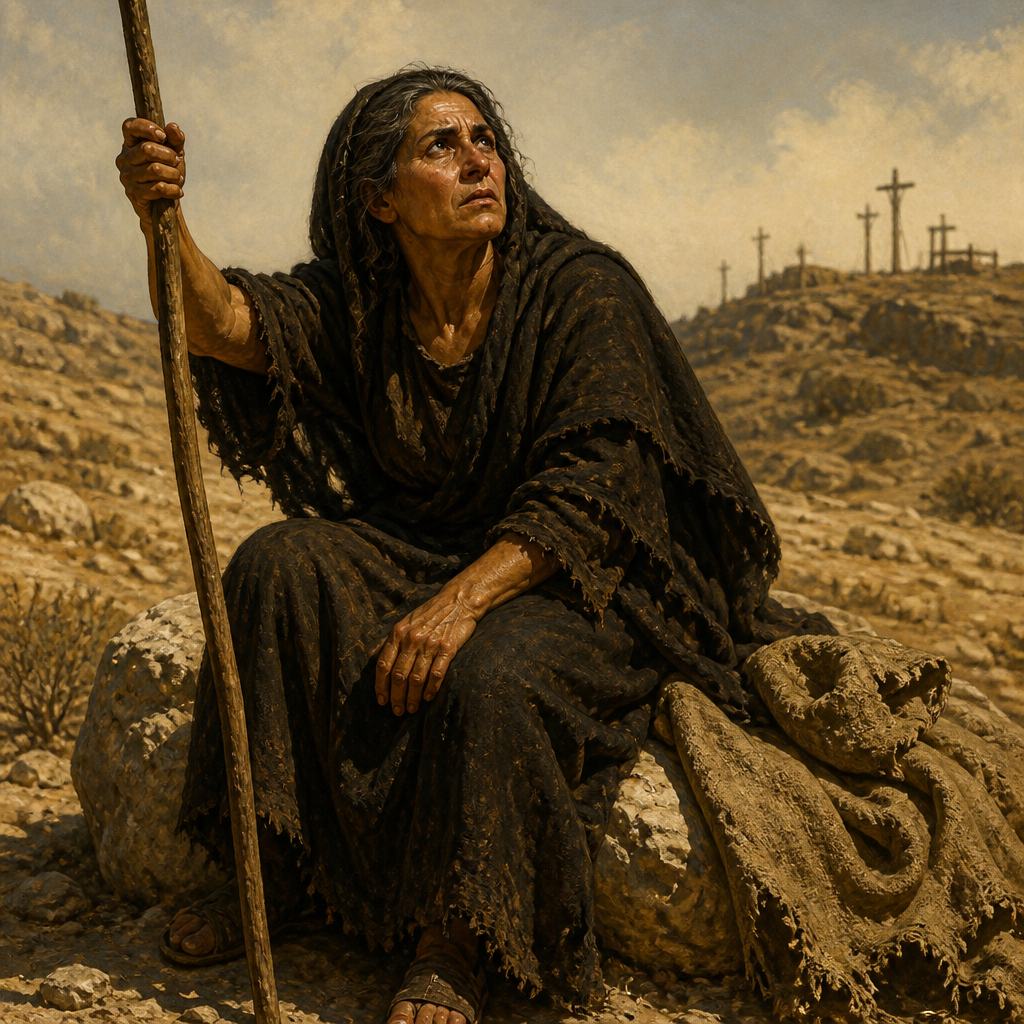
What followed is one of the most poignant displays of mourning in the Old Testament. Rizpah took sackcloth and spread it for herself on a rock near the bodies. From the beginning of the barley harvest in April until the autumn rains began in October, she remained on the hill. The text states that "she did not allow the birds of the air to rest on them by day, nor the beasts of the field by night" (2 Samuel 21:10). Her refusal to allow the bodies to be desecrated by scavengers was a silent, powerful protest against their exposure.
Relationship to Other Biblical Figures
Rizpah’s life was defined by her proximity to the tragic decline of the house of Saul. As Saul’s partner, she was caught in the middle of the feud between Abner and Ish-bosheth. Her most significant interaction, however, is indirect: her actions moved King David. When David was told of Rizpah’s devotion, he was shamed into action. He gathered the bones of Saul and Jonathan from Jabesh-gilead and the remains of the seven executed men, providing them all with an honorable burial in the tomb of Kish. Only after this act of dignity did God respond to the prayers for the land and end the famine.
Spiritual Significance
Rizpah stands as a symbol of maternal devotion and the power of the marginalized to impact national policy. In a patriarchal society where she had no legal power to stop the executions, her physical presence and endurance forced the king to recognize the humanity of those who had been discarded. Theologically, her story emphasizes that even divinely sanctioned justice (the atonement for the Gibeonites) requires human compassion and dignity in its execution.
Rizpah is significant for her role as a catalyst for political and spiritual reconciliation in Israel. Her presence in 2 Samuel 3 serves as the friction point that causes the collapse of Ish-bosheth's reign, leading to a unified kingdom under David. More importantly, her mourning ritual in 2 Samuel 21 highlights the tension between national judgment and individual suffering.
Theologically, her story demonstrates that God’s favor—manifested as the ending of a famine—was linked not only to the legalistic satisfaction of a debt (the execution) but also to the proper, dignified treatment of the dead (the burial). Rizpah’s silent vigil represents the ethical voice that demands mercy and respect even in the midst of judgment, ultimately influencing the behavior of the most powerful king in Israel's history.
Frequently Asked Questions
Who was Rizpah's father?
Rizpah was the daughter of Aiah, as noted in 2 Samuel 3:7 and 2 Samuel 21:11.
What happened to Rizpah's sons?
Her two sons, Armoni and Mephibosheth, were handed over by King David to the Gibeonites, who executed them as atonement for King Saul's past crimes against their people.
How long did Rizpah stay with the bodies of her sons?
She remained on the rock from the beginning of the barley harvest until the autumn rains fell, a period lasting approximately five to six months (roughly April to October).
Why did Abner's relationship with Rizpah matter?
Ish-bosheth accused Abner of sleeping with her. In that culture, such an act by a general toward a former king's concubine was interpreted as an attempt to seize the throne.
What was the result of Rizpah's vigil?
When King David heard of her devotion, he collected the remains of the executed men along with the bones of Saul and Jonathan and gave them a proper burial in the family tomb. Following this, the famine in Israel ended.
Family & Relationships
Parents
 Aiah, Father of RizpahFather2 Samuel 3:7Stated
 SaulPartner2 Samuel 21:11Stated
 RizpahThis page
Children
 ArmoniSon2 Samuel 21:8Stated
 Mephibosheth, Son of Saul and RizpahSon2 Samuel 21:8Stated
Connected Figures
Family
Father · 2 Samuel 3:7
Aiah was a man of the United Monarchy period whose legacy is defined through the resilience and loyalty of his daughter, Rizpah.
Partner · 2 Samuel 21:11
Saul was the first king of Israel, anointed by Samuel from the tribe of Benjamin to lead the United Monarchy against the Philistine threat.
United MonarchyFirst: 1 Samuel 9:2339 versesFirst King of IsraelBenjamin
Son · 2 Samuel 21:8
Armoni was a son of King Saul and his concubine Rizpah, who was surrendered to the Gibeonites for execution during the United Monarchy.
United MonarchyFirst: 2 Samuel 21:84 versesPrince of IsraelBenjamin
Son · 2 Samuel 21:8
A son of King Saul and his concubine Rizpah who was executed by the Gibeonites during the reign of King David.
United MonarchyFirst: 2 Samuel 21:87 versesPrince of IsraelBenjamin
Categories
Mentions by Book
- 2 Samuel4
Scripture References
All 4 indexed verses, in canonical order, from the Berean Standard Bible.
2 Samuel · 4
- 2 Samuel 3:7
Now Saul had a concubine named Rizpah, the daughter of Aiah. So Ish-bosheth questioned Abner, “Why did you sleep with my father’s concubine?”
- 2 Samuel 21:8
But the king took Armoni and Mephibosheth, the two sons whom Rizpah daughter of Aiah had borne to Saul, as well as the five sons whom Merab daughter of Saul had borne to Adriel son of Barzillai the Meholathite.
- 2 Samuel 21:10
And Rizpah the daughter of Aiah took sackcloth and spread it out for herself on a rock. From the beginning of the harvest until the rain from heaven poured down on the bodies, she did not allow the birds of the air to rest on them by day, nor the beasts of the field by night.
- 2 Samuel 21:11
When David was told what Saul’s concubine Rizpah, daughter of Aiah, had done,