Jeroboam son of Nebat
Who was Jeroboam son of Nebat in the Bible?
The first king of the Northern Kingdom of Israel who led the ten tribes in a secession from the house of David and established a separate religious system.
This is one of 2 people named Jeroboam in the Bible. See all 2 →
Jeroboam son of Nebat was a pivotal figure in the history of the United Monarchy, serving as the catalyst for the permanent division of the nation of Israel. Originally an industrious official under King Solomon, he rose from the status of a widow's son to become the architect of the Northern Kingdom. His life was defined by a tension between divine promise and personal insecurity, as he was granted the kingship by a prophetic word yet chose to secure his throne through illicit religious innovations.
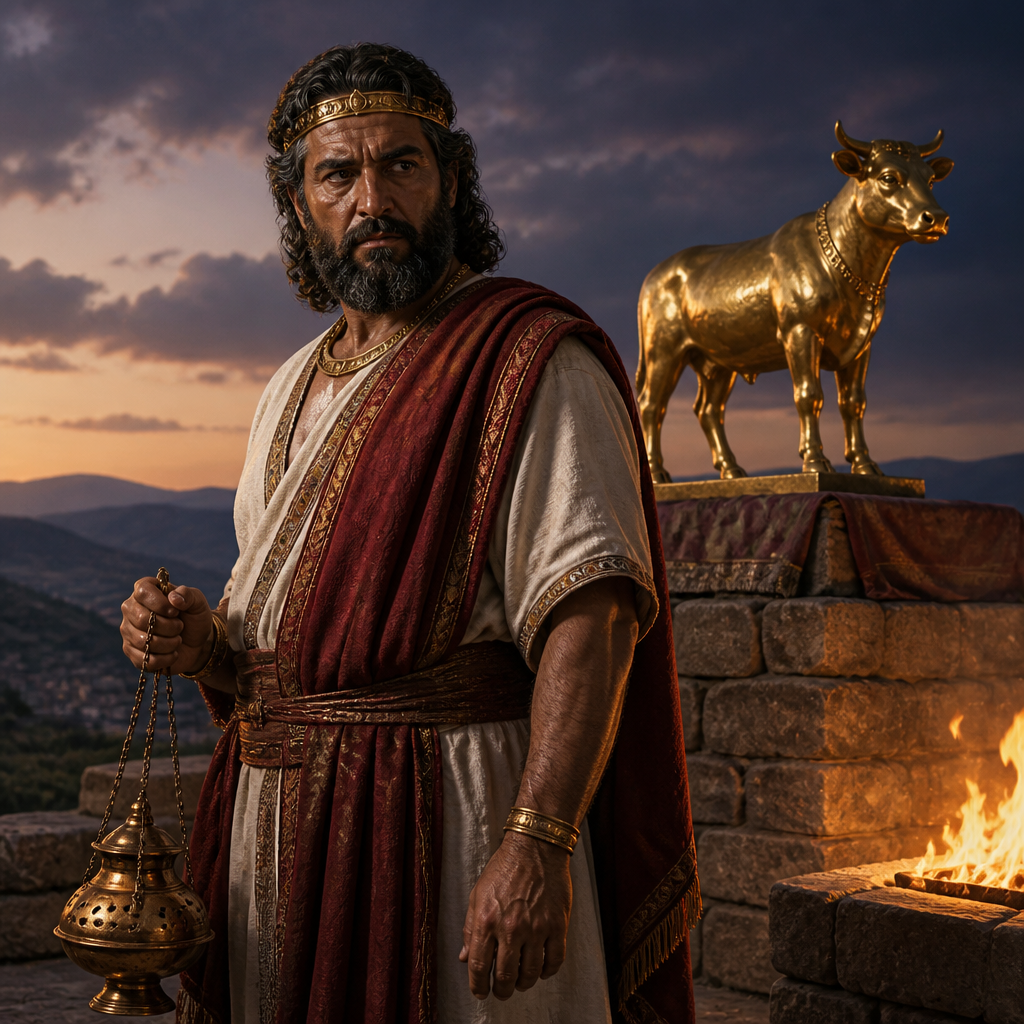
His reign lasted twenty-two years, during which he established a new capital and a rival priesthood to prevent his subjects from returning to the Temple in Jerusalem. In the biblical record, Jeroboam is most frequently remembered for the 'sin of Jeroboam'—the institution of golden calf worship at Bethel and Dan. This act is cited repeatedly throughout the books of Kings as the primary cause for the eventual spiritual and political downfall of the northern tribes. His story serves as a cautionary tale regarding the corruption of legitimate political authority through the manipulation of religious practice.
Background and Family
Jeroboam was an Ephraimite from Zeredah, the son of Nebat and a widow named Zeruah. He first appears in the biblical narrative as a 'mighty man of valor' during the latter years of King Solomon's reign. His industrious nature caught the attention of Solomon, who appointed him as the overseer of the forced labor of the house of Joseph (the tribes of Ephraim and Manasseh). This position likely gave him significant influence over the northern tribes, who were increasingly dissatisfied with the heavy taxation and labor demands of the Davidic court in Jerusalem.
Jeroboam’s family life was marked by tragedy and political intrigue. He had a wife (whose name is not recorded in the Hebrew Masoretic text) and at least two sons, Abijah and Nadab. The health and fate of his children were deeply intertwined with the spiritual status of his household; the death of his son Abijah served as a divine sign of the impending judgment upon his dynasty.
Major Life Events
The Prophetic Call and Exile
The transition of Jeroboam from a royal servant to a rebel leader began when he was met by the prophet Ahijah the Shilonite on a road outside Jerusalem. Ahijah performed a symbolic act, tearing a new cloak into twelve pieces and giving ten to Jeroboam, signifying that God would rend the kingdom from Solomon and give ten tribes to Jeroboam (1 Kings 11:31). This promise was conditional upon Jeroboam’s obedience to the Law of Moses. When Solomon learned of Jeroboam’s rising influence or the prophecy, he sought to kill him, forcing Jeroboam to flee to Egypt, where he was protected by Shishak, the Pharaoh.
The Secession of Israel
Following the death of Solomon, Jeroboam returned from Egypt to lead a delegation of the northern tribes in a negotiation with Solomon’s son, Rehoboam. When Rehoboam foolishly rejected the people’s request for a lighter yoke and threatened harsher treatment, the ten northern tribes revolted, shouting, "To your tents, O Israel!" (1 Kings 12:16). They subsequently crowned Jeroboam as king over Israel, leaving only the tribes of Judah and Benjamin under the Davidic crown.
The Sin of Jeroboam
Once established at Shechem, Jeroboam feared that if his subjects continued to travel to the Temple in Jerusalem for the annual feasts, their hearts would return to the house of David. To prevent this, he crafted two golden calves, placing one in Bethel and the other in Dan. He proclaimed, "It is too much for you to go up to Jerusalem. Here are your gods, O Israel, who brought you up out of Egypt" (1 Kings 12:28). He further consolidated this rival system by appointing non-Levitical priests and changing the dates of the sacred festivals. This action is characterized in scripture as the foundational sin that led the nation into apostasy.
Divine Confrontation and Decline
Jeroboam’s reign was marked by direct warnings from God. While he was standing at the altar in Bethel, a man of God from Judah arrived to prophesy against the altar, foretelling its future destruction by a king named Josiah. When Jeroboam reached out to order the man’s arrest, his hand withered, and the altar split apart. Though his hand was restored through the prophet's prayer, Jeroboam did not repent. His reign ended after twenty-two years, having faced significant military defeats at the hands of Abijah of Judah, who captured several of his cities including Bethel.
Relationship to Other Biblical Figures
Jeroboam’s career was defined by his opposition to the House of David, specifically Solomon and Rehoboam. His rebellion fulfilled the word of the Lord delivered by Ahijah the Shilonite, yet he later alienated Ahijah by his idolatry. When Jeroboam sent his wife in disguise to ask the now-blind Ahijah about their sick son, the prophet immediately recognized her and delivered a scathing oracle of judgment, decreeing that the house of Jeroboam would be swept away like dung.
Spiritual Significance
In the biblical tradition, Jeroboam represents the archetypal corrupt leader who sacrifices spiritual integrity for political security. He is not accused of abandoning the God of Israel for foreign deities like Baal (which occurred later), but rather of corrupting the way God was worshiped. By creating a religion of convenience and political utility, he established a precedent for all subsequent kings of Israel. The phrase "the way of Jeroboam son of Nebat" becomes a recurring theological metric in the books of Kings and Chronicles, used to evaluate every northern king who followed him. His legacy was the spiritual alienation of the northern tribes, which the biblical authors view as the ultimate cause of their eventual exile to Assyria.
Jeroboam son of Nebat is historically significant as the founder of the Northern Kingdom of Israel and the first to institutionalize state-sponsored idolatry in the post-Solomonic era. Theologically, he serves as the primary foil to the 'Davidic ideal,' demonstrating how political expediency can lead to the systemic corruption of a nation's faith. His decision to create golden calves at Dan and Bethel is presented as the 'original sin' of the Northern Kingdom, a transgression that remained unresolved for two centuries until the kingdom's destruction.
The biblical assessment of Jeroboam is overwhelmingly negative, not because he lacked talent or a divine mandate—both of which he possessed—but because he failed to trust the very God who raised him to the throne. His story emphasizes that a leader's legacy is determined by their fidelity to God's commands rather than their military or administrative successes. By rejecting the Levitical priesthood and the Jerusalem Temple, he severed the northern tribes from the covenantal center of the faith, leading to a permanent spiritual schism.
Frequently Asked Questions
Why did Jeroboam make the golden calves?
Jeroboam feared that if his subjects went to the Temple in Jerusalem to worship, their political loyalty would return to the house of David (Rehoboam). He created the calves at Bethel and Dan as a political-religious strategy to keep the northern tribes within his own borders.
Which tribes followed Jeroboam?
Ten of the twelve tribes of Israel followed Jeroboam to form the Northern Kingdom (often called Israel or Ephraim), while only Judah and Benjamin remained loyal to the house of David.
What happened to Jeroboam's family?
Due to his idolatry, God decreed the total destruction of his household. His son Abijah died in childhood, and his other son Nadab was assassinated by Baasha after reigning only two years, after which Baasha wiped out every living member of Jeroboam's family.
Who was the prophet that predicted Jeroboam's rise to power?
Ahijah the Shilonite met Jeroboam and used a torn cloak to symbolize that God was giving him ten tribes of Israel.
Where did Jeroboam live before becoming king?
He was an official in Solomon's administration, but after Solomon tried to kill him, he lived as an exile in Egypt under the protection of Pharaoh Shishak until Solomon died.
Family & Relationships
Parents
 Jeroboam son of NebatThis page
Children
 Abijah, Son of JeroboamSon1 Kings 14:1Stated
 Nadab, Son of JeroboamSon1 Kings 14:20Stated
Connected Figures
Family

Father · 1 Kings 11:26
An Ephraimite from Zeredah and the father of Jeroboam I, the first king of the northern kingdom of Israel.

Mother · 1 Kings 11:26
The mother of King Jeroboam I and the widow of Nebat, identified as an Ephraimite from Zeredah during the reign of King Solomon.
United MonarchyFirst: 1 Kings 11:261 versesMatriarchEphraim
Son · 1 Kings 14:1
The young son of King Jeroboam I of Israel whose illness and subsequent death served as a divine judgment against his father's dynasty.
Divided MonarchyFirst: 1 Kings 14:14 versesPrince of IsraelEphraim
Son · 1 Kings 14:20
The second king of the northern kingdom of Israel, Nadab was the son of Jeroboam I and was assassinated by Baasha during the siege of Gibbethon.
Divided MonarchyFirst: 1 Kings 14:206 versesKing of IsraelEphraim
Categories
Mentions by Book
- 1 Kings49
- 2 Kings15
- 2 Chronicles18
Scripture References
All 82 indexed verses, in canonical order, from the Berean Standard Bible.
- 1 Kings 11:26
Now Jeroboam son of Nebat was an Ephraimite from Zeredah whose mother was a widow named Zeruah. Jeroboam was a servant of Solomon, but he rebelled against the king,
- 1 Kings 11:28
Now Jeroboam was a mighty man of valor. So when Solomon noticed that the young man was industrious, he put him in charge of the whole labor force of the house of Joseph.
- 1 Kings 11:29
During that time, the prophet Ahijah the Shilonite met Jeroboam on the road as he was going out of Jerusalem. Now Ahijah had wrapped himself in a new cloak, and the two of them were alone in the open field.
- 1 Kings 11:31
and said to Jeroboam, “Take ten pieces for yourself, for this is what the LORD, the God of Israel, says: ‘Behold, I will tear the kingdom out of the hand of Solomon, and I will give you ten tribes.
- 1 Kings 11:40Partial
Solomon therefore sought to kill Jeroboam. But Jeroboam arose and fled to Egypt, to Shishak king of Egypt, where he remained until the death of Solomon.
- 1 Kings 12:2Partial
When Jeroboam son of Nebat heard about this, he was still in Egypt where he had fled from King Solomon and had been living ever since.
- 1 Kings 12:3
So they sent for Jeroboam, and he and the whole assembly of Israel came to Rehoboam and said,
- 1 Kings 12:12
After three days, Jeroboam and all the people returned to Rehoboam, since the king had said, “Come back to me on the third day.”
- 1 Kings 12:15
So the king did not listen to the people, and indeed this turn of events was from the LORD, to fulfill the word He had spoken to Jeroboam son of Nebat through Ahijah the Shilonite.
- 1 Kings 12:20
When all Israel heard that Jeroboam had returned, they summoned him to the assembly and made him king over all Israel. Only the tribe of Judah followed the house of David.
- 1 Kings 12:25
Then Jeroboam built Shechem in the hill country of Ephraim and lived there. And from there he went out and built Penuel.
- 1 Kings 12:26
Jeroboam said in his heart, “Now the kingdom might revert to the house of David.
- 1 Kings 12:28Partial
After seeking advice, the king made two golden calves and said to the people, “Going up to Jerusalem is too much for you. Here, O Israel, are your gods, who brought you up out of the land of Egypt.”
Cited as a key verse; added so References, Key Verses and Mentions by Book share one index.
- 1 Kings 12:32
And Jeroboam ordained a feast on the fifteenth day of the eighth month, like the feast that was in Judah, and he offered sacrifices on the altar; he made this offering in Bethel to sacrifice to the calves he had set up, and he installed priests in Bethel for the high places he had set up.
- 1 Kings 13:1
Suddenly, as Jeroboam was standing beside the altar to burn incense, there came a man of God from Judah to Bethel by the word of the LORD.
- 1 Kings 13:4
Now when King Jeroboam, who was at the altar in Bethel, heard the word that the man of God had cried out against it, he stretched out his hand and said, “Seize him!” But the hand he stretched out toward him withered, so that he could not pull it back.
- 1 Kings 13:33
Even after these events, Jeroboam did not repent of his evil ways, but again he appointed priests for the high places from every class of people. He ordained anyone who desired to be a priest of the high places.
- 1 Kings 13:34
And this was the sin of the house of Jeroboam that led to its extermination and destruction from the face of the earth.
- 1 Kings 14:1
At that time Abijah son of Jeroboam became ill,
- 1 Kings 14:2Partial
and Jeroboam said to his wife, “Now get up, disguise yourself so they will not recognize you as my wife, and go to Shiloh. For Ahijah the prophet is there; it was he who spoke about my kingship over this people.
- 1 Kings 14:4
Jeroboam’s wife did as instructed; she arose and went to Shiloh and arrived at Ahijah’s house. Now Ahijah could not see, for his eyes were dim because of his age.
- 1 Kings 14:5
But the LORD had said to Ahijah, “Behold, the wife of Jeroboam is coming to ask you about her son, for he is ill. You are to say such and such to her, because when she arrives, she will be disguised.”
- 1 Kings 14:6
So when Ahijah heard the sound of her feet entering the door, he said, “Come in, wife of Jeroboam! Why are you disguised? For I have been sent to you with bad news.
- 1 Kings 14:7
Go, tell Jeroboam that this is what the LORD, the God of Israel, says: ‘I raised you up from among the people and appointed you ruler over My people Israel.
- 1 Kings 14:10Partial
Because of all this, behold, I am bringing disaster on the house of Jeroboam: I will cut off from Jeroboam every male, both slave and free, in Israel; I will burn up the house of Jeroboam as one burns up dung until it is gone!
- 1 Kings 14:11
Anyone belonging to Jeroboam who dies in the city will be eaten by dogs, and anyone who dies in the field will be eaten by the birds of the air.’ For the LORD has spoken.
- 1 Kings 14:13Partial
All Israel will mourn for him and bury him. For this is the only one belonging to Jeroboam who will receive a proper burial, because only in him has the LORD, the God of Israel, found any good in the house of Jeroboam.
- 1 Kings 14:14
Moreover, the LORD will raise up for Himself a king over Israel who will cut off the house of Jeroboam. This is the day—yes, even today!
- 1 Kings 14:16
So He will give Israel over on account of the sins Jeroboam has committed and has caused Israel to commit.”
- 1 Kings 14:17
Then Jeroboam’s wife got up and departed for Tirzah, and as soon as she stepped over the threshold of the house, the boy died.
- 1 Kings 14:19
As for the rest of the acts of Jeroboam, how he waged war and how he reigned, they are indeed written in the Book of the Chronicles of the Kings of Israel.
- 1 Kings 14:20
And the length of Jeroboam’s reign was twenty-two years, and he rested with his fathers, and his son Nadab reigned in his place.
- 1 Kings 14:30
There was war between Rehoboam and Jeroboam throughout their days.
- 1 Kings 15:1
In the eighteenth year of the reign of Jeroboam son of Nebat, Abijam became king of Judah,
- 1 Kings 15:6
And there was war between the houses of Rehoboam and Jeroboam all the days of Abijam’s life.
- 1 Kings 15:7
As for the rest of the acts of Abijam, along with all his accomplishments, are they not written in the Book of the Chronicles of the Kings of Judah? And there was war between Abijam and Jeroboam.
- 1 Kings 15:9
In the twentieth year of Jeroboam’s reign over Israel, Asa became king of Judah,
- 1 Kings 15:25
In the second year of Asa’s reign over Judah, Nadab son of Jeroboam became king of Israel, and he reigned two years.
- 1 Kings 15:29Partial
As soon as Baasha became king, he struck down the entire household of Jeroboam. He did not leave to Jeroboam anyone who breathed, but destroyed them all according to the word that the LORD had spoken through His servant Ahijah the Shilonite,
- 1 Kings 15:30
because of the sins Jeroboam had committed and had caused Israel to commit, and because he had provoked the LORD, the God of Israel, to anger.
- 1 Kings 15:34
And Baasha did evil in the sight of the LORD and walked in the way of Jeroboam and in his sin, which he had caused Israel to commit.
- 1 Kings 16:2
“Even though I lifted you out of the dust and made you ruler over My people Israel, you have walked in the way of Jeroboam and have caused My people Israel to sin and to provoke Me to anger by their sins.
- 1 Kings 16:3
So now I will consume Baasha and his house, and I will make your house like that of Jeroboam son of Nebat:
- 1 Kings 16:7
Moreover, the word of the LORD came through the prophet Jehu son of Hanani against Baasha and his house, because of all the evil he had done in the sight of the LORD, provoking Him to anger with the work of his hands and becoming like the house of Jeroboam, and also because Baasha had struck down the house of Jeroboam.
- 1 Kings 16:19
because of the sins he had committed, doing evil in the sight of the LORD and following the example of Jeroboam and the sin he had committed and had caused Israel to commit.
- 1 Kings 16:26
For he walked in all the ways of Jeroboam son of Nebat and in his sins, which he caused Israel to commit, provoking the LORD, the God of Israel, to anger with their worthless idols.
- 1 Kings 16:31
And as if it were not enough for him to walk in the sins of Jeroboam son of Nebat, he even married Jezebel the daughter of Ethbaal king of the Sidonians, and he then proceeded to serve and worship Baal.
- 1 Kings 21:22
I will make your house like that of Jeroboam son of Nebat and like that of Baasha son of Ahijah, because you have provoked My anger and caused Israel to sin.’
- 1 Kings 22:52
And he did evil in the sight of the LORD and walked in the ways of his father and mother and of Jeroboam son of Nebat, who had caused Israel to sin.
- 2 Kings 3:3
Nevertheless, he clung to the sins that Jeroboam son of Nebat had caused Israel to commit; he did not turn away from them.
- 2 Kings 9:9
I will make the house of Ahab like the houses of Jeroboam son of Nebat and Baasha son of Ahijah.
- 2 Kings 10:29
but he did not turn away from the sins that Jeroboam son of Nebat had caused Israel to commit—the worship of the golden calves at Bethel and Dan.
- 2 Kings 10:31
Yet Jehu was not careful to follow the instruction of the LORD, the God of Israel, with all his heart. He did not turn away from the sins that Jeroboam had caused Israel to commit.
- 2 Kings 13:2
And he did evil in the sight of the LORD and followed the sins that Jeroboam son of Nebat had caused Israel to commit; he did not turn away from them.
- 2 Kings 13:6
Nevertheless, they did not turn away from the sins that the house of Jeroboam had caused Israel to commit, but they continued to walk in them. The Asherah pole even remained standing in Samaria.
- 2 Kings 13:11
And he did evil in the sight of the LORD and did not turn away from all the sins that Jeroboam son of Nebat had caused Israel to commit, but he walked in them.
- 2 Kings 14:24
And he did evil in the sight of the LORD and did not turn away from all the sins that Jeroboam son of Nebat had caused Israel to commit.
- 2 Kings 15:9
And he did evil in the sight of the LORD, as his fathers had done. He did not turn away from the sins that Jeroboam son of Nebat had caused Israel to commit.
- 2 Kings 15:18
And he did evil in the sight of the LORD, and throughout his reign he did not turn away from the sins that Jeroboam son of Nebat had caused Israel to commit.
- 2 Kings 15:24
And he did evil in the sight of the LORD and did not turn away from the sins that Jeroboam son of Nebat had caused Israel to commit.
- 2 Kings 15:28
And he did evil in the sight of the LORD and did not turn away from the sins that Jeroboam son of Nebat had caused Israel to commit.
- 2 Kings 17:21Partial
When the LORD had torn Israel away from the house of David, they made Jeroboam son of Nebat king, and Jeroboam led Israel away from following the LORD and caused them to commit a great sin.
- 2 Kings 17:22
The Israelites persisted in all the sins that Jeroboam had committed and did not turn away from them.
- 2 Kings 23:15
He even pulled down the altar at Bethel, the high place set up by Jeroboam son of Nebat, who had caused Israel to sin. Then he burned the high place, ground it to powder, and burned the Asherah pole.
- 2 Chronicles 9:29
As for the rest of the acts of Solomon, from beginning to end, are they not written in the Records of Nathan the Prophet, in the Prophecy of Ahijah the Shilonite, and in the Visions of Iddo the Seer concerning Jeroboam son of Nebat?
- 2 Chronicles 10:2Partial
When Jeroboam son of Nebat heard about this, he returned from Egypt, where he had fled from King Solomon.
- 2 Chronicles 10:3
So they sent for Jeroboam, and he and all Israel came to Rehoboam and said,
- 2 Chronicles 10:12
After three days, Jeroboam and all the people returned to Rehoboam, since the king had said, “Come back to me on the third day.”
- 2 Chronicles 10:15
So the king did not listen to the people, and indeed this turn of events was from God, in order that the LORD might fulfill the word that He had spoken through Ahijah the Shilonite to Jeroboam son of Nebat.
- 2 Chronicles 11:4
that this is what the LORD says: ‘You are not to go up and fight against your brothers. Each of you must return home, for this is My doing.’” So they listened to the words of the LORD and turned back from going against Jeroboam.
- 2 Chronicles 11:14
For the Levites left their pasturelands and their possessions and went to Judah and Jerusalem, because Jeroboam and his sons had rejected them as priests of the LORD.
- 2 Chronicles 12:15
Now the acts of Rehoboam, from first to last, are they not written in the records of Shemaiah the Prophet and of Iddo the Seer concerning the genealogies? There was war between Rehoboam and Jeroboam throughout their days.
- 2 Chronicles 13:1
In the eighteenth year of Jeroboam’s reign, Abijah became king of Judah,
- 2 Chronicles 13:2
and he reigned in Jerusalem three years. His mother’s name was Micaiah daughter of Uriel; she was from Gibeah. And there was war between Abijah and Jeroboam.
- 2 Chronicles 13:3
Abijah went into battle with an army of 400,000 chosen men, while Jeroboam drew up in formation against him with 800,000 chosen and mighty men of valor.
- 2 Chronicles 13:4
Then Abijah stood on Mount Zemaraim in the hill country of Ephraim and said, “Hear me, O Jeroboam and all Israel!
- 2 Chronicles 13:6
Yet Jeroboam son of Nebat, a servant of Solomon son of David, rose up and rebelled against his master.
- 2 Chronicles 13:8
And now you think you can resist the kingdom of the LORD, which is in the hands of David’s descendants. You are indeed a vast army, and you have with you the golden calves that Jeroboam made for you as gods.
- 2 Chronicles 13:13
Now Jeroboam had sent troops around to ambush from the rear, so that while he was in front of Judah, the ambush was behind them.
- 2 Chronicles 13:15
and the men of Judah raised the battle cry. And when they raised the cry, God routed Jeroboam and all Israel before Abijah and Judah.
- 2 Chronicles 13:19
Abijah pursued Jeroboam and captured some cities from him: Bethel, Jeshanah, and Ephron, along with their villages.
- 2 Chronicles 13:20
Jeroboam did not again recover his power during the days of Abijah, and the LORD struck him down and he died.
Others Named Jeroboam son of Nebat
Compare all 2 bearers →Jeroboam son of Jehoash, King of Israel2 Kings 13:13
The son of Jehoash and a long-reigning king of the Northern Kingdom of Israel who presided over a period of significant territorial expansion and national prosperity.