Meshullam, Gatekeeper of the Return
A Levite gatekeeper during the post-exilic period who was responsible for guarding the storerooms at the gates of Jerusalem.
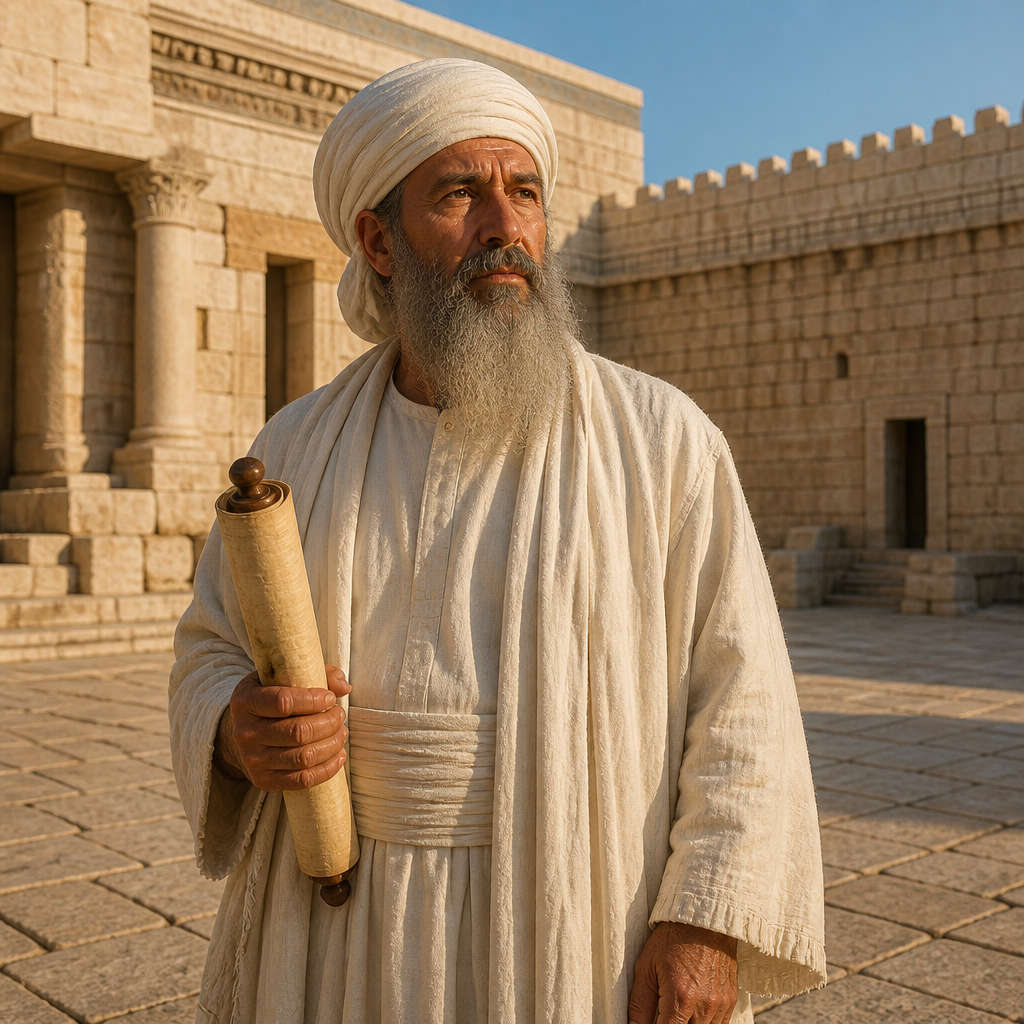
Meshullam was a Levite official who served in Jerusalem during the Second Temple period following the return of the Jewish people from the Babylonian exile. Mentioned in the historical records of the book of Nehemiah, he held the specialized office of a gatekeeper (or porter). This role was not merely one of physical security but was a sacred duty involving the protection of the sanctity of the temple precincts and the management of the resources brought by the community.
His service coincided with the leadership of High Priest Joiakim and the subsequent reforms of Nehemiah. Meshullam's specific station was at the gates, where he and his associates were tasked with guarding the storerooms. This indicates he was a man of proven integrity, entrusted with the logistical heart of the temple's daily operations and the community's offerings.
Background and Family
The biblical record concerning Meshullam, the gatekeeper, is found within the genealogical and administrative lists of Nehemiah 12. This chapter serves to document the transition of leadership and the organization of the Levites during the high priesthood of Joiakim, the son of Jeshua. While the text does not provide the specific parentage or tribal lineage of this particular Meshullam, he is explicitly identified as a member of the Levites who served in a specialized capacity.
During the post-exilic era, the identity of the Levites was paramount for the re-establishment of the religious life of Israel. Those returning from Babylon had to prove their ancestry to serve in the temple. Meshullam's inclusion in the register of Nehemiah 12:25 confirms his status as a legitimate Levite authorized to handle the sacred duties of the temple treasury and gate maintenance.
Major Life Events
Meshullam lived during the crucial period of the 'Exile and Return,' specifically when the Jewish community was settling into the restored Jerusalem. His primary recorded contribution was his service as a gatekeeper. Unlike the gatekeepers of the pre-exilic period who primarily guarded the entrance to the royal palace or the outer temple courts, the gatekeepers in Meshullam’s time had the added responsibility of guarding the 'storerooms at the gates' (Nehemiah 12:25).
These storerooms, or treasuries, were essential to the survival of the post-exilic community. They held the tithes of grain, new wine, and oil, as well as the contributions for the priests and Levites. Meshullam, alongside his colleagues Mattaniah, Bakbukiah, Obadiah, Talmon, and Akkub, functioned as a guardian of the community’s shared religious and economic life. Their vigilance ensured that the supplies necessary for the daily sacrifices were secure and that the temple staff remained supported.
Relationship to Other Biblical Figures
Meshullam is listed in a collaborative context with five other gatekeepers: Mattaniah, Bakbukiah, Obadiah, Talmon, and Akkub. The text notes that these men were 'gatekeepers who guarded the storerooms at the gates' during the days of Joiakim (the son of Jeshua and grandson of Jozadak) and during the days of Nehemiah the governor and Ezra the priest.
His role placed him under the ecclesiastical authority of the high priestly line and the civil authority of Nehemiah. While he is one of many mentioned in the lists of the returnees, his specific grouping with Talmon and Akkub—names frequently associated with the traditional families of gatekeepers dating back to the time of David—suggests he was part of a professional guild that maintained the continuity of the Davidic liturgical order in the Second Temple.
Spiritual Significance
The spiritual significance of Meshullam’s life lies in the theology of 'faithful service in the mundane.' In the biblical worldview, the position of a gatekeeper was considered a place of high honor despite its seemingly utilitarian nature. Psalm 84:10 famously states, 'I would rather be a doorkeeper in the house of my God than dwell in the tents of the wicked.'
Meshullam embodies this sentiment. By guarding the storerooms, he protected the physical means by which the people of Israel expressed their devotion to Yahweh through tithes. His presence in the biblical text, though limited to a single verse, highlights the importance of every individual in the restoration of the covenant community. He represents the silent, steadfast workers who ensured that the spiritual reforms of Ezra and the physical reconstructions of Nehemiah could be sustained through orderly administration and security.
Spiritual Significance
Meshullam represents the vital role of the Levite gatekeepers in the post-exilic period. His primary significance lies in his responsibility for the 'storerooms at the gates,' a position that required absolute trust and administrative precision. His inclusion in the official registers of Nehemiah 12 ensures that his contribution to the security and maintenance of the Second Temple is recognized as part of the broader restoration of Israel's worship.
Theologically, Meshullam’s life illustrates the biblical principle that all service within the household of God—whether priestly or administrative—is holy. By guarding the resources of the temple, he enabled the sacrificial system to function, proving that the success of the spiritual leaders depended upon the faithfulness of those who served at the gates.
Frequently Asked Questions
What was Meshullam's specific job in Jerusalem?
Meshullam was a gatekeeper who specifically guarded the storerooms (or treasuries) located at the gates of the temple area.
Which biblical book mentions this specific Meshullam?
This Meshullam is mentioned in Nehemiah 12:25.
Who were the people that served alongside Meshullam?
He served with other gatekeepers including Mattaniah, Bakbukiah, Obadiah, Talmon, and Akkub.
During which historical period did Meshullam live?
He lived during the Post-Exilic period (Exile and Return), serving while Joiakim was the High Priest and Nehemiah was governor.
Connected Figures
Nehemiah
Governor during his service
Ezra
Priest and scribe during his service
Mattaniah
Fellow gatekeeper
Joiakim
High Priest during his service
Categories
Mentions by Book
- Nehemiah1
Others Named Meshullam
Meshullam, Signer of the CovenantNehemiah 10:20
A Jewish leader during the Post-Exilic period who joined Nehemiah in signing the firm covenant to follow God's Law.
Meshullam, Grandfather of Shaphan2 Kings 22:3
A man of the Divided Monarchy period known solely as the grandfather of Shaphan the scribe during King Josiah's reign.
Meshullam, son of JoedNehemiah 11:7
A Benjamite whose descendants settled in Jerusalem during the Post-Exilic period after the return from Babylon.
Meshullam, Priest of the ReturnNehemiah 10:7
A priest during the Post-Exilic period who signed the covenant with Nehemiah and participated in the dedication of the rebuilt walls of Jerusalem.
Meshullam, Levite of the Return1 Chronicles 9:12
A Levite priest during the Post-Exilic period who served in the priestly lineage of Immer, contributing to the re-establishment of Jerusalem.
Meshullam, Son of Abihail1 Chronicles 5:13
A prominent head of a household within the tribe of Gad who lived during the era of the Divided Monarchy.
Meshullam, Son of Shephatiah1 Chronicles 9:8
A descendant of Reuel and son of Shephatiah who was among the heads of households to settle in Jerusalem following the return from the Babylonian exile.
Meshullam, Son of Zerubbabel1 Chronicles 3:19
A member of the Davidic line and the eldest son of Zerubbabel, the governor of Judah during the restoration period.
Meshullam, Levite of the Divided Monarchy2 Chronicles 34:12
A Levite of the Kohathite family who served as a faithful overseer during King Josiah’s restoration of the Temple in Jerusalem.
Meshullam, Son of Hodaviah1 Chronicles 9:7
A Benjamite who returned from the Babylonian exile and settled in Jerusalem as a head of a household.
Meshullam, Leader of the ReturnEzra 8:16
A prominent Jewish leader summoned by Ezra at the Ahava Canal to assist in recruiting Levites for the return to Jerusalem in 458 BC.
Meshullam, son of BesodeiahNehemiah 3:6
A Jewish returnee who collaborated with Joiada to repair the Old Gate of Jerusalem's wall during the governorship of Nehemiah.
Meshullam, Son of BaniEzra 10:29
A descendant of Bani who lived during the return from the Babylonian exile and was recorded for having taken a foreign wife.
Meshullam, Head of the House of GinnethonNehemiah 12:16
A Jewish priest and head of the ancestral house of Ginnethon during the post-exilic high priesthood of Joiakim.
Meshullam, Son of Elpaal1 Chronicles 8:17
A member of the tribe of Benjamin and son of Elpaal mentioned within the genealogical records of the Divided Monarchy.
Meshullam, Supporter of Ezra’s AssemblyNehemiah 8:4
A prominent Jewish leader who stood at the left hand of Ezra the scribe during the public reading of the Law in Jerusalem.
Meshullam, Son of BerechiahNehemiah 3:4
A prominent wall-rebuilder under Nehemiah who maintained a complex, controversial alliance with the Ammonite official Tobiah.
Meshullam, Priest of Ezra's LineageNehemiah 12:13
A prominent post-exilic priest and head of the ancestral house of Ezra during the high priesthood of Joiakim.
Meshullam, Supporter of Jonathan son of AsahelEzra 10:15
A man who supported the opposition led by Jonathan son of Asahel regarding Ezra's plan for investigating foreign marriages in the post-exilic community.