Meshullam, Son of Berechiah
Who was Meshullam, Son of Berechiah, in the Bible?
A prominent wall-rebuilder under Nehemiah who maintained a complex, controversial alliance with the Ammonite official Tobiah.
This is one of 20 people named Meshullam in the Bible. See all 20 →
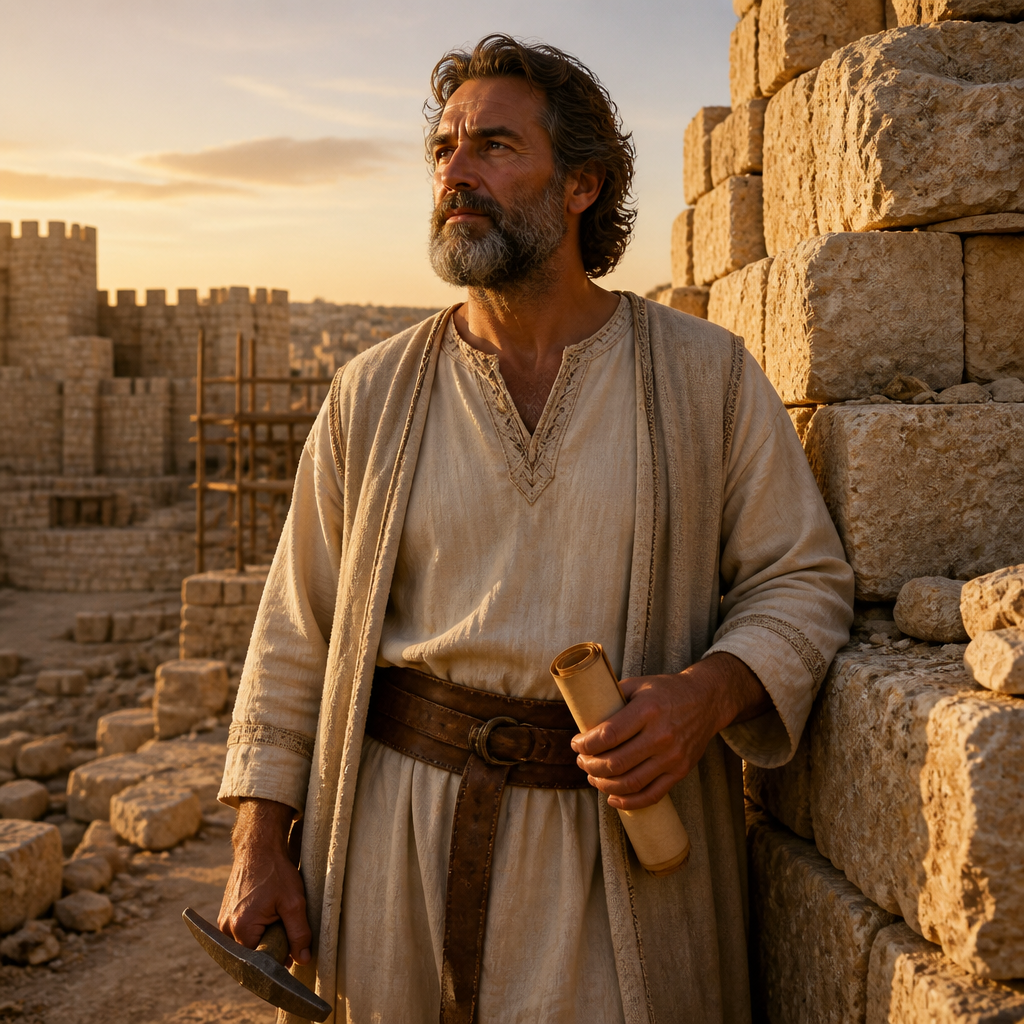
Meshullam, son of Berechiah, was a significant figure during the post-exilic period of Jewish history, specifically during the governorship of Nehemiah. As a member of the returnee community in Jerusalem, he is distinguished by his active participation in the monumental task of rebuilding the city's walls following the Babylonian destruction. His commitment to the physical restoration of Jerusalem was evident in his willingness to repair multiple sections of the fortification.
Despite his architectural contributions, Meshullam occupied a complex social and political position. He belonged to a family of high social standing, which facilitated a controversial marital alliance with Tobiah the Ammonite, one of Nehemiah’s primary antagonists. This dual identity—as a builder of the wall and a relative of the enemies of the state—makes him a compelling case study in the internal political tensions of the Persian-era Jewish community.
Background and Family
Meshullam was the son of Berechiah and the grandson of Meshezabel (Nehemiah 3:4). The inclusion of his grandfather's name suggests that his family was well-known or possessed a specific lineage that warranted detailed record-keeping in the post-exilic census. While his specific tribe is not explicitly mentioned in the text, his residency within Jerusalem and his involvement in the inner workings of the city’s social elite suggest he was likely from the tribe of Judah or Benjamin.
His social status is further evidenced by his family's marriage alliances. Nehemiah 6:18 records that Meshullam’s daughter was married to Jehohanan, the son of Tobiah the Ammonite. Tobiah was a powerful official who, along with Sanballat, sought to hinder the Jewish restoration. This marriage linked Meshullam to the Ammonite aristocracy, creating a conflict of interest that Nehemiah viewed with significant suspicion.
Major Life Events
Meshullam is primarily recognized for his labor during the reconstruction of the Jerusalem wall in approximately 444 BC. According to Nehemiah 3:4, he worked alongside Meremoth and Zadok, taking responsibility for a specific section of the wall. His dedication was such that he is one of the few individuals mentioned as repairing a second portion of the wall. Nehemiah 3:30 notes that he "repaired another section opposite his own quarters." This detail suggests he was a man of property, as he had a private residence or chamber (nishkah) within the city limits.
However, Meshullam's legacy is complicated by the events described in Nehemiah 6. While the walls were being completed, Nehemiah’s enemies, including Tobiah, attempted to intimidate the governor and subvert his authority. The text reveals that many in Judah were "bound by oath" to Tobiah because of his marriage to the daughter of Shecaniah and his son’s marriage to Meshullam’s daughter. This suggests that Meshullam was part of a pro-Tobiah faction within Jerusalem that maintained communication with the city's enemies, likely seeing these international alliances as beneficial for trade or political stability, despite the religious and nationalistic concerns of Nehemiah.
Relationship to Other Biblical Figures
Meshullam’s most significant relationship was with Nehemiah, though it was likely one of tension. While Meshullam followed Nehemiah’s orders to build the wall, his familial tie to Tobiah placed him in a camp that Nehemiah deeply distrusted. The text notes that these nobles of Judah frequently sent letters to Tobiah and received them in return, and they would speak of Tobiah’s "good deeds" in Nehemiah’s presence while reporting Nehemiah's words back to the enemy (Nehemiah 6:17-19). As the father-in-law of Tobiah’s son, Meshullam was at the heart of this intelligence network.
Spiritual Significance
Meshullam represents the "divided heart" of the post-exilic community. On one hand, he was a laborer for the kingdom of God, literally putting his hands to the work of restoring the Holy City. On the other hand, he sought security through worldly alliances with those who opposed God's purposes. His life illustrates the difficulty of maintaining spiritual purity in a politically interconnected world. He serves as a reminder that external service to God—such as building a wall—does not always equate to total internal alignment with God’s chosen leadership and vision.
Meshullam son of Berechiah is a study in the complexity of the post-exilic restoration. He proves that even those actively engaged in the work of God can be compromised by worldly entanglements and familial loyalties that run contrary to the community's spiritual health. His presence in the text highlights the internal opposition Nehemiah faced from the 'nobles of Judah' who prioritized social and political standing over the strict separation Nehemiah demanded.
His inclusion in the list of builders despite his questionable alliances also demonstrates the pragmatic nature of the restoration; Nehemiah needed the help of all able-bodied men, even those whose loyalties were divided. Meshullam's life underscores the biblical theme that the greatest threats to God's people often come from within the community through compromise rather than from without through direct military assault.
Frequently Asked Questions
What part of the Jerusalem wall did Meshullam repair?
Meshullam repaired two sections: one mentioned near the Fish Gate (Nehemiah 3:4) and another section located directly opposite his own living quarters or chamber (Nehemiah 3:30).
How was Meshullam related to Tobiah the Ammonite?
Meshullam was the father-in-law of Tobiah’s son, Jehohanan. His daughter married Jehohanan, creating a familial bond between Meshullam’s family and one of Nehemiah’s chief enemies.
Why is Meshullam mentioned twice in the list of builders?
He is one of the few individuals noted for repairing a second section of the wall, indicating either his great zeal for the physical work or his significant wealth and resources.
Was Meshullam considered a villain in the Bible?
The Bible does not explicitly label him a 'villain,' but it portrays his family alliances as a source of grief and danger to Nehemiah’s mission, as these ties allowed enemies to influence the Jewish leadership.
Who was Meshullam's father?
His father was Berechiah, and his grandfather was Meshezabel.
Family & Relationships
Parents
 Berechiah, Father of MeshullamFatherNehemiah 3:4Stated
 Meshullam, Son of BerechiahThis page
Children
 Daughter of MeshullamDaughterNehemiah 6:18Stated
Connected Figures
Family
Father · Nehemiah 3:4
A prominent Jewish man in Jerusalem during the Post-Exilic Period whose son, Meshullam, assisted Nehemiah in rebuilding the city walls.
Daughter · Nehemiah 6:18
A Jewish woman whose marriage to Jehohanan, son of Tobiah the Ammonite, served as a strategic political alliance during the reconstruction of Jerusalem.
Categories
Mentions by Book
- Nehemiah3
Scripture References
All 3 indexed verses, in canonical order, from the Berean Standard Bible.
Nehemiah · 3
- Nehemiah 3:4
Next to them, Meremoth son of Uriah, the son of Hakkoz, made repairs. Next to him, Meshullam son of Berechiah, the son of Meshezabel, made repairs; and next to him, Zadok son of Baana made repairs as well.
- Nehemiah 3:30
Next to him, Hananiah son of Shelemiah, as well as Hanun the sixth son of Zalaph, repaired another section. Next to them, Meshullam son of Berechiah made repairs opposite his own quarters.
- Nehemiah 6:18
For many in Judah were bound by oath to him, since he was a son-in-law of Shecaniah son of Arah, and his son Jehohanan had married the daughter of Meshullam son of Berechiah.
Others Named Meshullam
Compare all 20 bearers →Meshullam, Signer of the CovenantNehemiah 10:20
A Jewish leader during the Post-Exilic period who joined Nehemiah in signing the firm covenant to follow God's Law.
Meshullam, Grandfather of Shaphan2 Kings 22:3
A man of the Divided Monarchy period known solely as the grandfather of Shaphan the scribe during King Josiah's reign.
Meshullam, son of JoedNehemiah 11:7
A Benjamite whose descendants settled in Jerusalem during the Post-Exilic period after the return from Babylon.
Meshullam, Priest of the ReturnNehemiah 10:7
A priest during the Post-Exilic period who signed the covenant with Nehemiah and participated in the dedication of the rebuilt walls of Jerusalem.
Meshullam, Levite of the Return1 Chronicles 9:12
A Levite priest during the Post-Exilic period who served in the priestly lineage of Immer, contributing to the re-establishment of Jerusalem.
Meshullam, Son of Abihail1 Chronicles 5:13
A prominent head of a household within the tribe of Gad who lived during the era of the Divided Monarchy.
Meshullam, Son of Shephatiah1 Chronicles 9:8
A descendant of Reuel and son of Shephatiah who was among the heads of households to settle in Jerusalem following the return from the Babylonian exile.
Meshullam, Son of Zerubbabel1 Chronicles 3:19
A member of the Davidic line and the eldest son of Zerubbabel, the governor of Judah during the restoration period.
Meshullam, Levite of the Divided Monarchy2 Chronicles 34:12
A Levite of the Kohathite family who served as a faithful overseer during King Josiah’s restoration of the Temple in Jerusalem.
Meshullam, Son of Hodaviah1 Chronicles 9:7
A Benjamite who returned from the Babylonian exile and settled in Jerusalem as a head of a household.
Meshullam, Leader of the ReturnEzra 8:16
A prominent Jewish leader summoned by Ezra at the Ahava Canal to assist in recruiting Levites for the return to Jerusalem in 458 BC.
Meshullam, son of BesodeiahNehemiah 3:6
A Jewish returnee who collaborated with Jehoiada to repair the Old Gate of Jerusalem's wall during the governorship of Nehemiah.
Meshullam, Son of BaniEzra 10:29
A descendant of Bani who lived during the return from the Babylonian exile and was recorded for having taken a foreign wife.
Meshullam, Head of the House of GinnethonNehemiah 12:16
A Jewish priest and head of the ancestral house of Ginnethon during the post-exilic high priesthood of Joiakim.
Meshullam, Son of Elpaal1 Chronicles 8:17
A member of the tribe of Benjamin and son of Elpaal mentioned within the genealogical records of the Divided Monarchy.
Meshullam, Supporter of Ezra’s AssemblyNehemiah 8:4
A prominent Jewish leader who stood at the left hand of Ezra the scribe during the public reading of the Law in Jerusalem.
Meshullam, Gatekeeper of the ReturnNehemiah 12:25
A Levite gatekeeper during the post-exilic period who was responsible for guarding the storerooms at the gates of Jerusalem.
Meshullam, Priest of Ezra's LineageNehemiah 12:13
A prominent post-exilic priest and head of the ancestral house of Ezra during the high priesthood of Joiakim.
Meshullam, Supporter of Jonathan son of AsahelEzra 10:15
A man who supported the opposition led by Jonathan son of Asahel regarding Ezra's plan for investigating foreign marriages in the post-exilic community.