Jehu, King of Israel
Who was Jehu, King of Israel, in the Bible?
The tenth king of the northern kingdom of Israel who executed the house of Ahab, destroyed the cult of Baal, and founded the longest-lasting dynasty in Israel's history.
This is one of 5 people named Jehu in the Bible. See all 5 →
Jehu was a military commander in the army of the northern kingdom of Israel who rose to power through a violent and divinely mandated coup against the house of Omri. According to the biblical narrative, he was anointed by a disciple of Elisha at Ramoth-gilead to fulfill the prophecy of Elijah regarding the total destruction of the house of Ahab. His rise to the throne marked a turning point in Israelite history, characterized by a swift and brutal eradication of Baal worship and the execution of the royal families of both Israel and Judah.
His reign lasted twenty-eight years in Samaria (c. 841–814 BC). While Jehu was credited for his zeal in eliminating the idolatry introduced by Jezebel, the biblical record provides a nuanced evaluation of his spiritual legacy. Although he received a divine promise that his descendants would sit on the throne for four generations, he ultimately failed to return the nation to the worship of the LORD alone, maintaining the state-sponsored golden calf cult established by Jeroboam I. His actions at Jezreel remained a point of prophetic contention, later referenced by the prophet Hosea as a symbol of impending judgment.
Background and Family
Jehu is identified in the biblical text as the son of Jehoshaphat and the grandson of Nimshi. He first appears in the scriptural record as a high-ranking military officer serving under Joram (Jehoram), the son of Ahab. His social and political standing was significant enough that when the prophet Elisha sent a young messenger to anoint him, Jehu was found sitting among the other army commanders.
His rise to power was not a spontaneous rebellion but the culmination of a divine decree issued years earlier to Elijah the Tishbite. In 1 Kings 19:16, the LORD commanded Elijah to anoint Jehu as king over Israel, alongside the anointing of Hazael over Aram and Elisha as a prophet. This triad of figures was designated to serve as instruments of judgment against the apostasy of the northern kingdom. Jehu was specifically selected as the sword that would excise the cancerous influence of the Omride dynasty.
Major Life Events
The Anointing and Coup
The decisive moment of Jehu's life occurred while he was defending Ramoth-gilead against the Arameans. A servant of Elisha arrived, pulled Jehu into an inner room, and poured oil on his head, declaring him king and commissioning him to strike down the house of Ahab to avenge the blood of the prophets. Upon hearing this, Jehu's fellow officers immediately pledged their loyalty, spreading their garments on the steps and proclaiming, "Jehu is king!" (2 Kings 9:13).
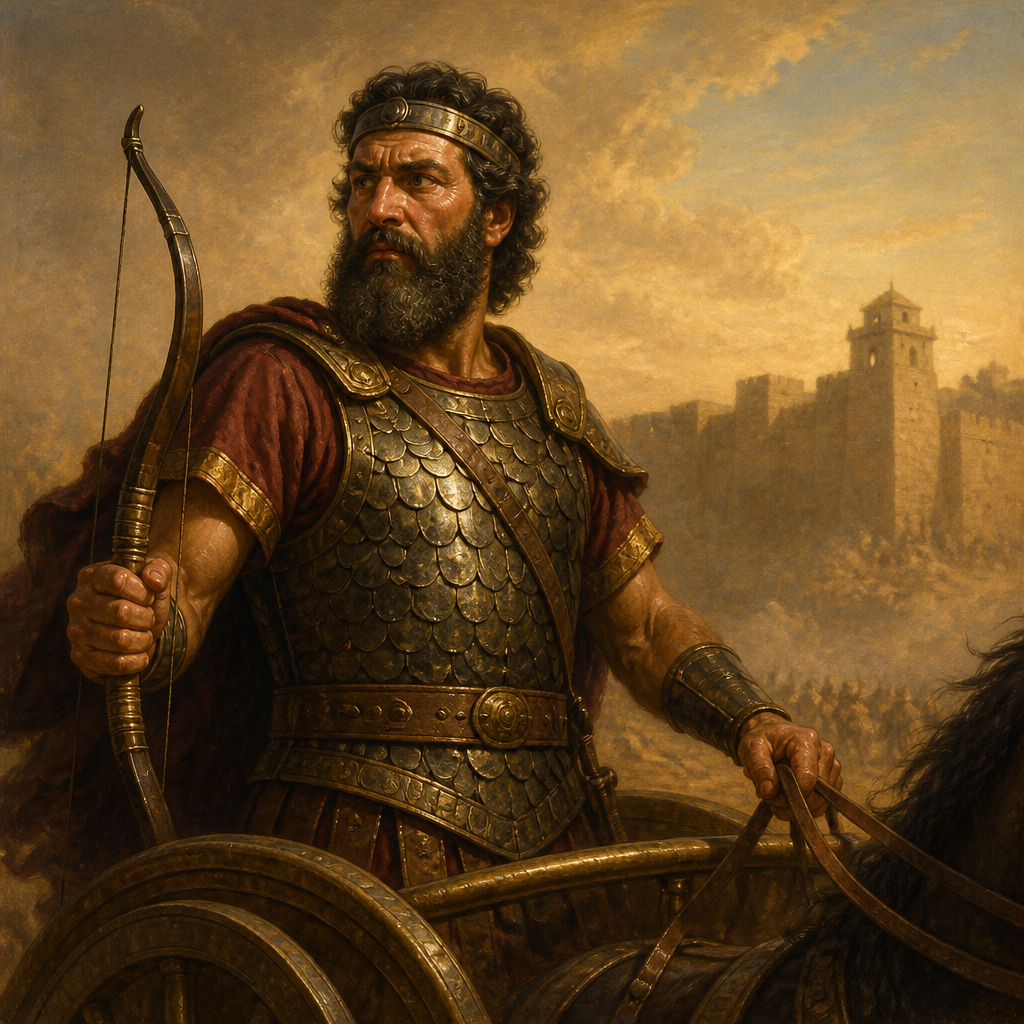
Jehu acted with characteristic speed and aggression—a trait noted by the Jezreel watchman who observed that Jehu drove his chariot "like a madman" (2 Kings 9:20). He traveled to Jezreel, where King Joram was recovering from war wounds. When Joram and his ally, King Ahaziah of Judah, rode out to meet him, Jehu personally executed Joram with an arrow through the heart on the property of Naboth the Jezreelite, symbolically reclaiming the land Ahab had stolen.
The Purge of Jezreel and Samaria
Jehu’s campaign of violence extended to the Queen Mother, Jezebel, whom he ordered to be thrown from a window by her own eunuchs. Following her death, he manipulated the elders of Samaria into executing Ahab’s seventy sons, effectively decapitating the royal line. His purge included the execution of Ahaziah of Judah and forty-two of his relatives, as well as the "great men" and friends of Ahab’s house.
The Destruction of Baalism
Jehu’s most famous religious reform involved a deceptive trap set for the followers of Baal. Claiming he would serve Baal even more than Ahab had, he summoned all the prophets and priests of Baal to a grand assembly in the temple of Baal. Once they were gathered and the doors secured, he commanded eighty guards to slaughter every individual inside. He then demolished the temple of Baal and turned the site into a latrine, successfully eradicating the Phoenician deity's cult from the land of Israel.
Relationship to Other Biblical Figures
Jehu’s life was inextricably linked to the prophetic ministries of Elijah and Elisha. He was the fulfillment of Elijah’s vision and the instrument of Elisha’s immediate command. His interactions with Jehonadab son of Rechab demonstrate a search for legitimization among the strictly pious segments of society; Jehu invited Jehonadab to join him in his chariot to witness his "zeal for the LORD" (2 Kings 10:16).
Politically, his relationship with the house of David (Judah) was catastrophic. By killing King Ahaziah and his kinsmen, Jehu nearly extinguished the southern kingdom’s leadership, an act that allowed the usurper Athaliah to seize power in Jerusalem. This bloodshed created a deep rift between the two nations and eventually drew the condemnation of the prophet Hosea.
Spiritual Significance
The biblical evaluation of Jehu is twofold. On one hand, he is praised for his obedience in destroying the house of Ahab. The LORD rewarded his house with four generations of kings—the longest dynasty in Israel’s history (Jehoahaz, Jehoash, Jeroboam II, and Zechariah).
On the other hand, Jehu is presented as a tragic figure who stopped short of full devotion. He did not "turn away from the sins of Jeroboam," continuing the worship of the golden calves at Bethel and Dan. The author of 2 Kings 10:31 laments that Jehu was "not careful to follow the instruction of the LORD, the God of Israel, with all his heart." Consequently, his reign saw the shrinking of Israel's borders as the LORD began to "reduce the size of Israel" under pressure from Hazael of Aram. In the broader biblical canon, Hosea 1:4 records a sobering postscript: the "bloodshed of Jezreel" would eventually be visited upon the house of Jehu, indicating that even divinely sanctioned judgment can be tainted by the motives and excessive cruelty of the human instrument.
Jehu occupies a unique space as a 'righteous' reformer who remained an idolater. He is the only king of the northern kingdom to be anointed by a prophet of the LORD, and he successfully ended the state-sponsored worship of Baal. His life illustrates the theological tension between divine sovereignty and human responsibility; he was an instrument of God's judgment, yet he was ultimately held accountable for the spirit and limits of his reforms.
Theologically, Jehu represents the danger of partial obedience. While he was zealous for the external removal of Phoenician paganism, he lacked the internal devotion required to restore true covenantal worship. His legacy is one of violent transition, ending a century of Omride influence but failing to secure the spiritual future of Israel, leading to the eventual decline of the northern kingdom as foretold by the prophets.
Frequently Asked Questions
Why was Jehu known for his driving?
A watchman in Jezreel identified Jehu from a distance because he drove his chariot 'like a madman' (or 'furiously'). This description highlights his aggressive, determined, and impulsive personality, which characterized his entire military coup.
Did Jehu follow God completely?
No. Although Jehu destroyed the cult of Baal, he did not remove the golden calves at Bethel and Dan. The Bible states he was not careful to follow the Law of the LORD with all his heart, continuing the political-religious cult established by Jeroboam I.
How did Jehu die?
After reigning for twenty-eight years, Jehu died of natural causes. He 'rested with his fathers' and was buried in Samaria, the capital of Israel. He was succeeded by his son, Jehoahaz.
Why did the prophet Hosea condemn the 'bloodshed of Jezreel'?
While Jehu's actions were initially sanctioned to judge Ahab's house, the extreme violence and the motives behind his purge eventually came under divine scrutiny. Hosea 1:4 indicates that the house of Jehu would be punished for the massacres at Jezreel, suggesting that Jehu's zeal had crossed into sinful bloodlust.
Which kings did Jehu kill?
Jehu killed two reigning monarchs: King Joram of Israel (Ahab's son) and King Ahaziah of Judah. He also oversaw the execution of Jezebel and the seventy sons of Ahab.
Family & Relationships
Parents
 Jehoshaphat, Father of King JehuFather2 Kings 9:2Stated
 Jehu, King of IsraelThis page
Children
 Jehoahaz, Son of JehuSon2 Kings 10:35Stated
Connected Figures
Family
Father · 2 Kings 9:2
A man of the tribe of Israel during the Divided Monarchy, known primarily as the son of Nimshi and the father of King Jehu.
Son · 2 Kings 10:35
The eleventh king of the northern kingdom of Israel, Jehoahaz reigned during a period of severe military decline and Aramean oppression.
Divided MonarchyFirst: 2 Kings 10:3515 versesKing of Israel
Categories
Mentions by Book
- 1 Kings2
- 2 Kings39
- 2 Chronicles4
- Hosea1
Scripture References
All 46 indexed verses, in canonical order, from the Berean Standard Bible.
- 1 Kings 19:16
You are also to anoint Jehu son of Nimshi as king over Israel and Elisha son of Shaphat from Abel-meholah to succeed you as prophet.
- 1 Kings 19:17Partial
Then Jehu will put to death whoever escapes the sword of Hazael, and Elisha will put to death whoever escapes the sword of Jehu.
- 2 Kings 9:2
When you arrive, look for Jehu son of Jehoshaphat, the son of Nimshi. Go in, get him away from his companions, and take him to an inner room.
- 2 Kings 9:5
and when he arrived, the army commanders were sitting there. “I have a message for you, commander,” he said. “For which of us?” asked Jehu. “For you, commander,” he replied.
- 2 Kings 9:11
When Jehu went out to the servants of his master, they asked, “Is everything all right? Why did this madman come to you?” “You know his kind and their babble,” he replied.
- 2 Kings 9:13
Quickly, each man took his garment and put it under Jehu on the bare steps. Then they blew the ram’s horn and proclaimed, “Jehu is king!”
- 2 Kings 9:14
Thus Jehu son of Jehoshaphat, the son of Nimshi, conspired against Joram. (Now Joram and all Israel had been defending Ramoth-gilead against Hazael king of Aram,
- 2 Kings 9:15
but King Joram had returned to Jezreel to recover from the wounds he had suffered at the hands of the Arameans in the battle against Hazael their king.) So Jehu said, “If you commanders wish to make me king, then do not let anyone escape from the city to go and tell it in Jezreel.”
- 2 Kings 9:16
Then Jehu got into his chariot and went to Jezreel, because Joram was laid up there. And Ahaziah king of Judah had gone down to see him.
- 2 Kings 9:17
Now the watchman standing on the tower in Jezreel saw Jehu’s troops approaching, and he called out, “I see a company of troops!” “Choose a rider,” Joram commanded. “Send him out to meet them and ask, ‘Have you come in peace?’”
- 2 Kings 9:18
So a horseman rode off to meet Jehu and said, “This is what the king asks: ‘Have you come in peace?’” “What do you know about peace?” Jehu replied. “Fall in behind me.” And the watchman reported, “The messenger reached them, but he is not coming back.”
- 2 Kings 9:19
So the king sent out a second horseman, who went to them and said, “This is what the king asks: ‘Have you come in peace?’” “What do you know about peace?” Jehu replied. “Fall in behind me.”
- 2 Kings 9:20
Again the watchman reported, “He reached them, but he is not coming back. And the charioteer is driving like Jehu son of Nimshi—he is driving like a madman!”
- 2 Kings 9:21
“Harness!” Joram shouted, and they harnessed his chariot. Then Joram king of Israel and Ahaziah king of Judah set out, each in his own chariot, and met Jehu on the property of Naboth the Jezreelite.
- 2 Kings 9:22Partial
When Joram saw Jehu, he asked, “Have you come in peace, Jehu?” “How can there be peace,” he replied, “as long as the idolatry and witchcraft of your mother Jezebel abound?”
- 2 Kings 9:24
Then Jehu drew his bow and shot Joram between the shoulders. The arrow pierced his heart, and he slumped down in his chariot.
- 2 Kings 9:27
When King Ahaziah of Judah saw this, he fled up the road toward Beth-haggan. And Jehu pursued him, shouting, “Shoot him too!” So they shot Ahaziah in his chariot on the Ascent of Gur, near Ibleam, and he fled to Megiddo and died there.
- 2 Kings 9:30
Now when Jehu arrived in Jezreel, Jezebel heard of it. So she painted her eyes, adorned her head, and looked down from a window.
- 2 Kings 9:31
And as Jehu entered the gate, she asked, “Have you come in peace, O Zimri, murderer of your master?”
- 2 Kings 10:1
Now Ahab had seventy sons in Samaria. So Jehu wrote letters and sent them to Samaria to the officials of Jezreel, to the elders, and to the guardians of the sons of Ahab, saying:
- 2 Kings 10:5
So the palace administrator, the overseer of the city, the elders, and the guardians sent a message to Jehu: “We are your servants, and we will do whatever you say. We will not make anyone king. Do whatever is good in your sight.”
- 2 Kings 10:11
So Jehu killed everyone in Jezreel who remained of the house of Ahab, as well as all his great men and close friends and priests, leaving him without a single survivor.
- 2 Kings 10:13
Jehu met some relatives of Ahaziah king of Judah and asked, “Who are you?” “We are relatives of Ahaziah,” they answered, “and we have come down to greet the sons of the king and of the queen mother.”
- 2 Kings 10:18Partial
Then Jehu brought all the people together and said, “Ahab served Baal a little, but Jehu will serve him a lot.
- 2 Kings 10:19
Now, therefore, summon to me all the prophets of Baal, all his servants, and all his priests. See that no one is missing, for I have a great sacrifice for Baal. Whoever is missing will not live.” But Jehu was acting deceptively in order to destroy the servants of Baal.
- 2 Kings 10:20
And Jehu commanded, “Proclaim a solemn assembly for Baal.” So they announced it.
- 2 Kings 10:21
Then Jehu sent word throughout Israel, and all the servants of Baal came; there was not a man who failed to show. They entered the temple of Baal, and it was filled from end to end.
- 2 Kings 10:23
Next, Jehu and Jehonadab son of Rechab entered the temple of Baal, and Jehu said to the servants of Baal, “Look around to see that there are no servants of the LORD here among you—only servants of Baal.”
- 2 Kings 10:24
And they went in to offer sacrifices and burnt offerings. Now Jehu had stationed eighty men outside and warned them, “If anyone allows one of the men I am delivering into your hands to escape, he will forfeit his life for theirs.”
- 2 Kings 10:25
When he had finished making the burnt offering, Jehu said to the guards and officers, “Go in and kill them. Do not let anyone out.” So the guards and officers put them to the sword, threw the bodies out, and went into the inner room of the temple of Baal.
- 2 Kings 10:28
Thus Jehu eradicated Baal from Israel,
- 2 Kings 10:29
but he did not turn away from the sins that Jeroboam son of Nebat had caused Israel to commit—the worship of the golden calves at Bethel and Dan.
- 2 Kings 10:30
Nevertheless, the LORD said to Jehu, “Because you have done well in carrying out what is right in My sight and have done to the house of Ahab all that was in My heart, four generations of your sons will sit on the throne of Israel.”
- 2 Kings 10:31
Yet Jehu was not careful to follow the instruction of the LORD, the God of Israel, with all his heart. He did not turn away from the sins that Jeroboam had caused Israel to commit.
- 2 Kings 10:34
As for the rest of the acts of Jehu, along with all his accomplishments and all his might, are they not written in the Book of the Chronicles of the Kings of Israel?
- 2 Kings 10:35
And Jehu rested with his fathers and was buried in Samaria, and his son Jehoahaz reigned in his place.
- 2 Kings 10:36
So the duration of Jehu’s reign over Israel in Samaria was twenty-eight years.
- 2 Kings 12:1
In the seventh year of Jehu, Joash became king, and he reigned in Jerusalem forty years. His mother’s name was Zibiah; she was from Beersheba.
- 2 Kings 13:1
In the twenty-third year of the reign of Joash son of Ahaziah over Judah, Jehoahaz son of Jehu became king of Israel, and he reigned in Samaria seventeen years.
- 2 Kings 14:8
Then Amaziah sent messengers to the king of Israel Jehoash son of Jehoahaz, the son of Jehu. “Come, let us meet face to face,” he said.
- 2 Kings 15:12
So the word of the LORD spoken to Jehu was fulfilled: “Four generations of your sons will sit on the throne of Israel.”
- 2 Chronicles 22:7
Ahaziah’s downfall came from God when he went to visit Joram. When Ahaziah arrived, he went out with Joram to meet Jehu son of Nimshi, whom the LORD had anointed to destroy the house of Ahab.
- 2 Chronicles 22:8
So while Jehu was executing judgment on the house of Ahab, he found the rulers of Judah and the sons of Ahaziah’s brothers who were serving Ahaziah, and he killed them.
- 2 Chronicles 22:9
Then Jehu looked for Ahaziah, and Jehu’s soldiers captured him while he was hiding in Samaria. So Ahaziah was brought to Jehu and put to death. They buried him, for they said, “He is the grandson of Jehoshaphat, who sought the LORD with all his heart.” So no one was left from the house of Ahaziah with the strength to rule the kingdom.
- 2 Chronicles 25:17
Then Amaziah king of Judah took counsel and sent word to the king of Israel Jehoash son of Jehoahaz, the son of Jehu. “Come, let us meet face to face,” he said.
- Hosea 1:4
Then the LORD said to Hosea, “Name him Jezreel, for soon I will bring the bloodshed of Jezreel upon the house of Jehu, and I will put an end to the kingdom of Israel.
Others Named Jehu
Compare all 5 bearers →Jehu, son of Hanani1 Kings 16:1
A prophet and seer of the Divided Monarchy who delivered divine rebukes to King Baasha of Israel and King Jehoshaphat of Judah.
Jehu, Son of Obed1 Chronicles 2:38
Jehu was a member of the Tribe of Judah and a descendant of Sheshan, appearing in the genealogical records of the Divided Monarchy.
Jehu, son of Joshibiah1 Chronicles 4:35
A leader and descendant of the tribe of Simeon recorded in the genealogies of the Divided Monarchy during the reign of King Hezekiah.
Jehu the Anathothite1 Chronicles 12:3
A Benjamite warrior from Anathoth who joined David’s elite force at Ziklag during the United Monarchy of Saul's pursuit.