Heman the Singer
A prominent Levite singer, musician, and king's seer during the United Monarchy, appointed by David to lead the worship in the house of the LORD.
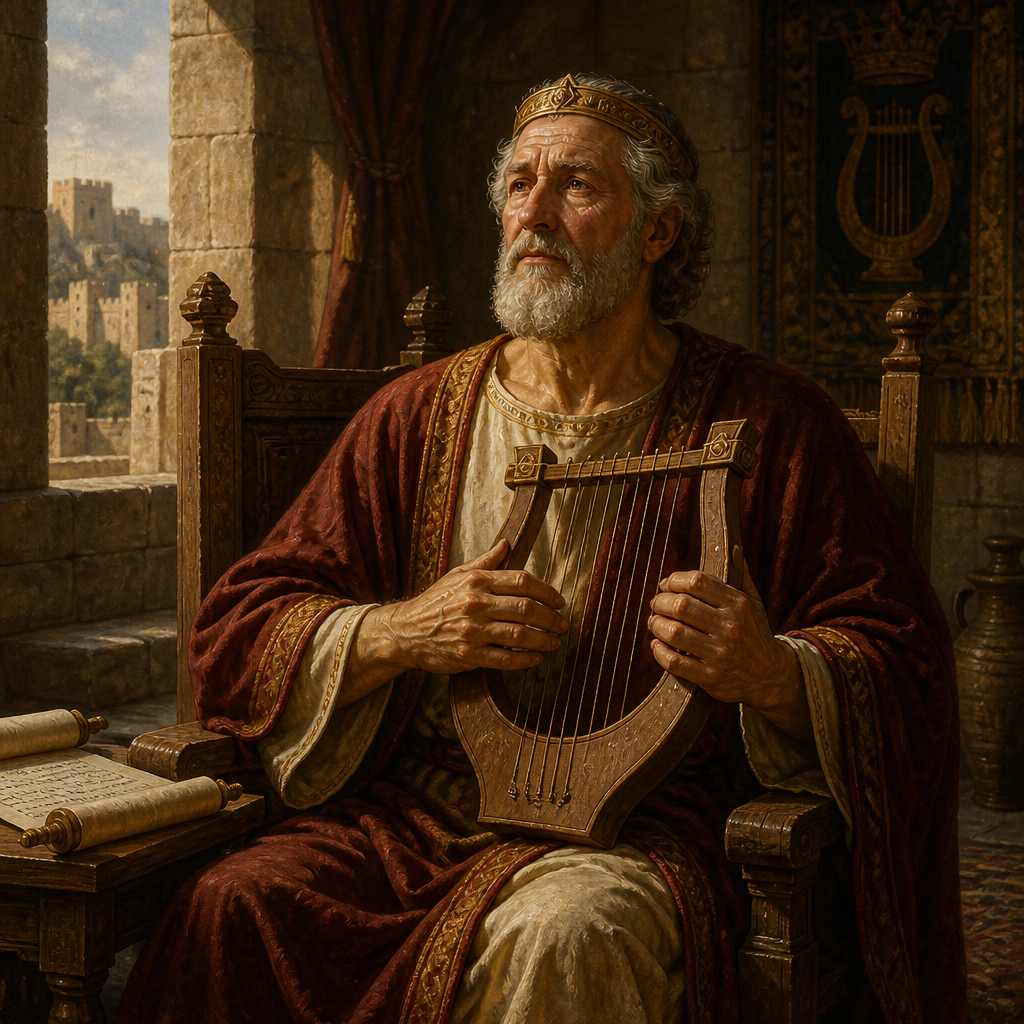
Heman the Singer was a pivotal figure in the establishment of formal liturgical worship during the United Monarchy of Israel. A descendant of Kohath and the grandson of the prophet Samuel, Heman occupied a position of high spiritual and cultural authority under King David. He was not merely a musician but was designated as the 'king’s seer,' a title indicating he received divine revelations and functioned as a prophetic voice through his musical service.
Along with his contemporaries Asaph and Jeduthun (also known as Ethan), Heman led one of the three major Levitical choirs. His role was integral to the transition of Israelite worship from the mobile Tabernacle to the centralized Temple service in Jerusalem. His legacy is defined by a massive family of fourteen sons and three daughters, all of whom were dedicated to the service of the Lord, ensuring a multi-generational commitment to the musical and prophetic traditions of Israel.
Background and Family
Heman was a Levite of the Kohathite clan, a lineage specifically tasked with the care of the most sacred elements of the Tabernacle. According to 1 Chronicles 6:33, he was the son of Joel and the grandson of the renowned prophet and judge Samuel. This pedigree placed him at the heart of Israel’s religious aristocracy. His family life was marked by exceptional divine blessing; 1 Chronicles 25:5 records that God gave Heman fourteen sons and three daughters as part of a divine promise to 'exalt him.'
His sons—Bukkiah, Mattaniah, Uzziel, Shebuel, Jerimoth, Hananiah, Hanani, Eliathah, Giddalti, Romamti-ezer, Joshbekashah, Mallothi, Hothir, and Mahazioth—were not merely descendants but active participants in his ministry. They served under their father’s direction, playing cymbals, harps, and lyres in the house of the LORD. This large family unit formed the backbone of the Hemanite musical guild, which continued to serve the Temple for centuries, as evidenced by their mention during the reforms of Hezekiah (2 Chronicles 29:14) and the Passover of Josiah (2 Chronicles 35:15).
Major Life Events
Heman’s career was defined by the transition of the Ark of the Covenant to Jerusalem. When King David sought to bring the Ark to the City of David, he commanded the Levites to appoint singers and musicians. Heman was the first named among those appointed by the Levites (1 Chronicles 15:17). During the procession, Heman, along with Asaph and Ethan, was responsible for sounding the bronze cymbals, providing the rhythmic and celebratory foundation for the event.
Following the successful relocation of the Ark, David organized the Levites into permanent shifts of service. Heman was placed in charge of the music at the tent David had pitched for the Ark, while others served at the Tabernacle in Gibeon. His service was characterized by both technical skill and spiritual depth; 1 Chronicles 25:1 notes that David and the army commanders set Heman and his colleagues apart to 'prophesy with the accompaniment of lyres, harps, and cymbals.' This suggests that their music was not merely entertainment but a medium for divine communication.
Relationship to Other Biblical Figures
Heman operated in a triumvirate of musical leadership alongside Asaph (a Gershonite) and Jeduthun/Ethan (a Merarite). This trio represented all three branches of the Levites, symbolizing the total involvement of the tribe in the ministry of praise. While Asaph is often associated with the writing of Psalms, Heman is uniquely distinguished by the title 'the king’s seer' (1 Chronicles 25:5, 2 Chronicles 35:15), suggesting a close advisory or prophetic relationship with King David.
His relationship with David was one of mutual respect and administrative order. Heman worked 'under the direction of the king' (1 Chronicles 25:6) to ensure the Temple liturgy was executed with precision. His lineage also connects him to the prophetic tradition of his grandfather Samuel, indicating that the 'spirit of prophecy' remained within his family line but shifted from the judicial and military spheres into the liturgical and musical spheres.
Spiritual Significance
The spiritual significance of Heman lies in the biblical affirmation that music and prophecy are deeply intertwined. The Chronicler emphasizes that Heman’s music was 'for the service of the house of God' and was performed 'according to the word of God.' His life demonstrates that artistic talent, when submitted to divine calling and institutional order, serves as a primary vehicle for the presence of God.
Furthermore, Heman serves as a model of the 'blessed patriarch.' The specific mention of his fourteen sons as a fulfillment of God's promise to 'exalt him' highlights a biblical theme where domestic blessing and public ministry are viewed as a single, unified favor from God. His descendants, the Hemanites, remained faithful to their calling through the divided monarchy and into the late periods of the kingdom, illustrating the impact of a legacy built on the 'loving devotion' of the LORD that 'endures forever' (1 Chronicles 16:41).
Spiritual Significance
Heman represents the institutionalization of worship during Israel’s golden age. By formalizing the role of music as a prophetic and priestly duty, he helped define the spiritual atmosphere of the United Monarchy. His designation as the 'king’s seer' elevates the role of the liturgical leader from a mere performer to a spiritual guardian of the nation's relationship with God.
Theologically, Heman’s life underscores the importance of heritage and divine promise. As the grandson of Samuel, he carries forward a prophetic mantle, but he does so within the new context of Davidic worship. His large family and their inclusion in the Temple service emphasize the communal and generational nature of biblical worship, where the individual’s talent serves the wider community’s spiritual health.
Frequently Asked Questions
Was Heman the Singer related to the prophet Samuel?
Yes, 1 Chronicles 6:33 identifies Heman as the son of Joel, who was the son of Samuel. This makes Heman the grandson of the famous judge and prophet Samuel.
What instruments did Heman play?
Heman is specifically recorded as sounding bronze cymbals (1 Chronicles 15:19). He also led music involving trumpets, harps, and lyres.
Why was Heman called the 'king’s seer'?
The title 'seer' indicates a prophetic function. 1 Chronicles 25:1 and 25:5 explain that Heman and his colleagues were set apart to 'prophesy' with their instruments, meaning their music was a form of inspired communication from God to the king and the people.
How many children did Heman have?
According to 1 Chronicles 25:5, God gave Heman fourteen sons and three daughters to exalt him, fulfilling a divine promise.
Did Heman serve in the Temple of Solomon?
Yes. Although he was appointed by David, 2 Chronicles 5:12 records Heman and his fellow singers participating in the dedication of Solomon’s Temple, standing on the east side of the altar in fine linen.
Connected Figures
David
King who appointed him
Asaph
Musical colleague
Jeduthun
Musical colleague

Samuel
Grandfather
Joel
Father
Categories
Mentions by Book
- 1 Chronicles9
- 2 Chronicles3
Family & Relationships
Child
1 Chronicles 6:33
Child
1 Chronicles 6:33
Child
1 Chronicles 6:33
Child
Hanani, Musician of the Divided Monarchy
1 Chronicles 6:33
Child
Hananiah, Levite Musician of the Divided Monarchy
1 Chronicles 6:33
Child
Mattaniah, Son of Heman the Singer
1 Chronicles 6:33
Child
Uzziel, Son of Heman the Singer
1 Chronicles 6:33
Child
Shebuel, Son of Heman the Singer
1 Chronicles 6:33
Child
Jerimoth, Levite Musician of the Divided Monarchy
1 Chronicles 6:33
Child
1 Chronicles 6:33
Child
1 Chronicles 6:33
Child
1 Chronicles 6:33
Child
1 Chronicles 6:33
Child
1 Chronicles 6:33
Child
1 Chronicles 6:33
Child
1 Chronicles 6:33
Parent
1 Samuel 8:2
Others Named Heman the Singer
Heman, Grandson of Zerah1 Chronicles 2:6
Heman was a descendant of Judah through his son Zerah, identified as one of the five sons of Zerah in the genealogical records of the chronicler.
Heman, Son of Mahol1 Kings 4:31
A renowned sage of the United Monarchy period noted for his exceptional wisdom, which served as a benchmark for King Solomon's own intellect.