Joash, King of Israel
Who was Joash, King of Israel, in the Bible?
The twelfth king of the Northern Kingdom of Israel, Joash was a military leader who defeated the Arameans three times and successfully conquered Jerusalem during a conflict with Judah.
This is one of 8 people named Joash in the Bible. See all 8 →
Joash, also recorded as Jehoash, was the twelfth king of the Northern Kingdom of Israel during the Divided Monarchy. The son of Jehoahaz and grandson of Jehu, he ascended the throne in Samaria during a period of significant national recovery. His sixteen-year reign (c. 798–782 BC) was characterized by a complex mix of spiritual stagnation and military success, occurring during the transition from the Aramean oppression to a season of renewed Israelite strength.
Historically, Joash is noted for his unique relationship with the prophet Elisha and his decisive military victories. Despite being categorized by the biblical authors as one who followed the sins of Jeroboam son of Nebat, he demonstrated a level of personal reverence for Elisha that his predecessors often lacked. His reign laid the groundwork for the subsequent prosperity of his son, Jeroboam II, by reclaiming lost territories and asserting dominance over the Southern Kingdom of Judah.
Background and Family
Joash was the son of Jehoahaz and belonged to the dynasty of Jehu. He inherited a kingdom that had been severely weakened by the repeated incursions of the Arameans (Syrians) under Hazael and Ben-hadad III. The biblical record in 2 Kings 13 notes that during the reign of his father, Israel's military had been reduced to a mere fifty horsemen, ten chariots, and ten thousand footmen.
Joash took the throne in the thirty-seventh year of Joash king of Judah (a contemporary ruler of the same name). His family lineage was significant as it represented the fourth generation of Jehu’s house, fulfilling a divine promise that Jehu’s descendants would sit on the throne of Israel to the fourth generation. He was eventually succeeded by his son, Jeroboam II, under whom Israel reached its greatest territorial extent since the time of Solomon.
Major Life Events
The Final Visit to Elisha
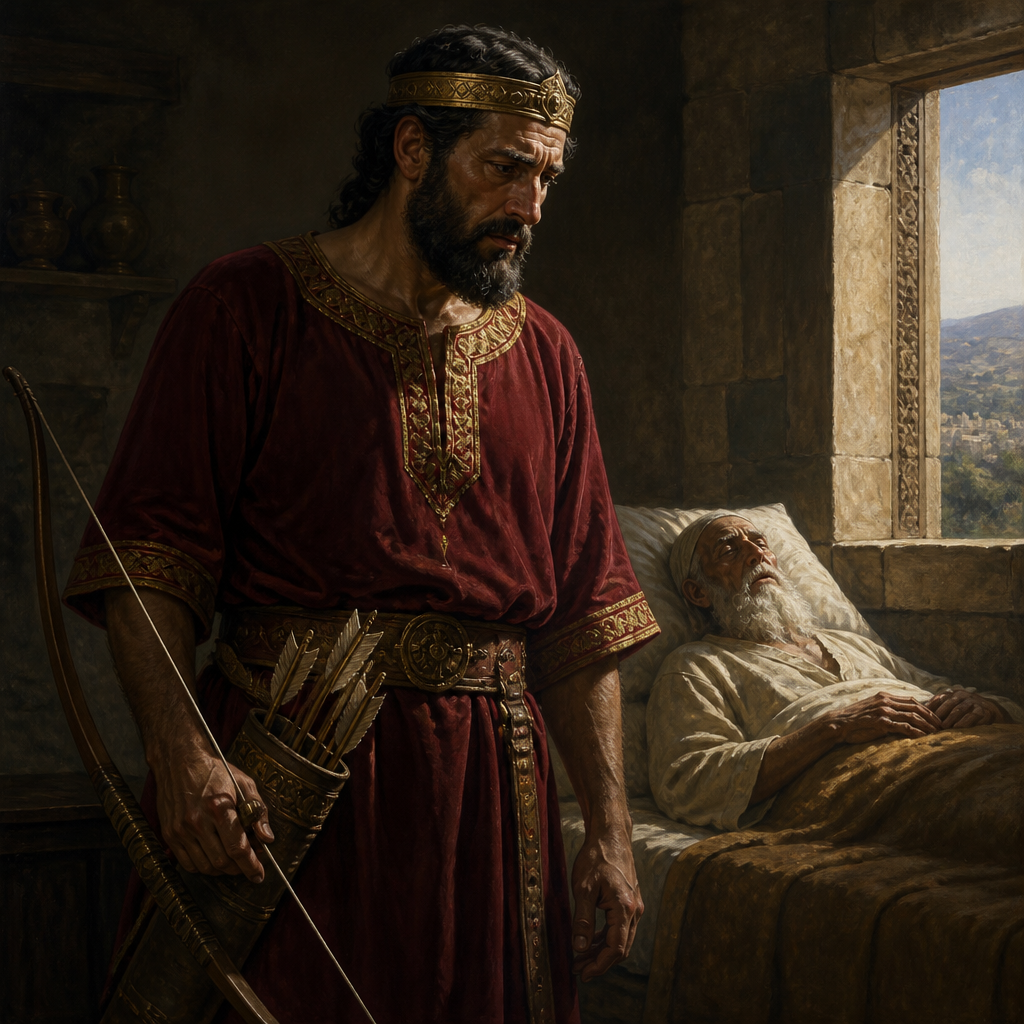
One of the most poignant episodes in the life of Joash was his visit to the deathbed of the prophet Elisha. Despite his adherence to the state-sponsored cult of the golden calves at Bethel and Dan, Joash wept over the dying prophet, crying out, “My father, my father, the chariots and horsemen of Israel!” (2 Kings 13:14). This recognition of Elisha’s spiritual value to the nation’s defense prompted a final prophetic sign.
Elisha commanded the king to shoot an arrow out the window toward the east, symbolizing victory over Aram. Elisha then told the king to strike the ground with the arrows. Joash struck the ground three times and stopped. The prophet was angry, stating that if the king had struck the ground five or six times, he would have totally consumed the Arameans. As it was, he was promised only three victories. This prophecy was fulfilled when Joash defeated Ben-hadad son of Hazael three times, recovering the cities that had been captured from his father.
The Conflict with Judah
Later in his reign, Joash was challenged by Amaziah, the king of Judah. Flush with his own victory over Edom, Amaziah sent a challenge to Joash, saying, “Come, let us meet face to face.” Joash responded with a biting parable involving a thistle and a cedar in Lebanon, warning Amaziah that his pride would lead to his downfall.
When Amaziah refused to back down, the two armies met at Beth-shemesh. Joash decisively defeated the Judean forces and captured King Amaziah. He then marched to Jerusalem, where he broke down four hundred cubits of the city wall, from the Ephraim Gate to the Corner Gate. He looted the gold, silver, and vessels from the Temple and the royal palace, taking hostages back to Samaria. This event marked a rare instance of the Northern Kingdom achieving total military dominance over the Southern Kingdom.
Relationship to Other Biblical Figures
Joash is primarily defined by his interactions with the prophetic and the political spheres of his day. His relationship with Elisha demonstrates the tension of the Divided Monarchy: a king who participated in idolatry yet remained tethered to the Yahwistic prophets for national survival. Unlike the house of Ahab, which was overtly hostile to the prophets, Joash showed Elisha a degree of filial respect.
His rivalry with Amaziah of Judah serves as a case study in the volatile politics of the era. The two kingdoms, though sharing a common ancestry, were frequently at odds. The defeat Joash inflicted on Amaziah was so severe that Judah remained in a weakened state for years, and Amaziah lived for fifteen years after the death of Joash, suggesting the long-term impact of their encounter.
Spiritual Significance
The biblical assessment of Joash is consistently negative regarding his spiritual legacy. The author of 2 Kings states that "he did evil in the eyes of the Lord and did not turn away from any of the sins of Jeroboam son of Nebat" (2 Kings 13:11). This critique focuses on his failure to abolish the golden calf shrines that were the hallmark of the Northern Kingdom's religious rebellion.
However, the narrative of the arrows suggests a theological lesson on the relationship between divine promise and human zeal. While God had decreed victory for Israel, the extent of that victory was tied to Joash's own persistence and faith. His failure to strike the ground more than three times is presented as a lack of spiritual fervor that limited the liberation of his people. Despite this, the text notes in 2 Kings 14:27 that the Lord used the house of Joash to save Israel because "He had not said He would blot out the name of Israel from under heaven."
Joash represents a pivotal moment in the history of the Northern Kingdom where the tide turned from near-extinction under Aramean pressure to military resurgence. His interactions with Elisha highlight the lingering influence of the prophets even in a kingdom committed to the 'sins of Jeroboam.' Theologically, his life illustrates the concept of limited blessing resulting from limited faith, as seen in the episode of the arrows.
Furthermore, his conquest of Jerusalem and the dismantling of its walls serve as a sobering reminder in the biblical narrative of the vulnerability of the Southern Kingdom when its leaders acted in pride. The reign of Joash set the stage for the 'Silver Age' of Israel under his son Jeroboam II, providing the stability and territorial recovery necessary for the Northern Kingdom's final period of worldly greatness before its eventual fall to Assyria.
Frequently Asked Questions
Was Joash a good or bad king?
According to the biblical record, Joash was considered a 'bad' king because he continued the unauthorized worship of the golden calves established by Jeroboam I. However, he was a successful military leader who recovered Israelite territory and showed personal respect to the prophet Elisha.
What did Elisha's prophecy about the arrows mean for Joash?
Elisha told Joash to strike the ground with arrows to symbolize his victories over Aram. Because Joash only struck the ground three times, Elisha prophesied that he would only defeat the Arameans three times, rather than completely destroying them.
Why did Joash attack Jerusalem?
Joash attacked Jerusalem after King Amaziah of Judah challenged him to a 'face to face' meeting (a battle). Joash tried to discourage him with a parable, but when Amaziah persisted, Joash defeated him, broke down the city walls, and looted the Temple.
Who was the son of Joash?
Joash was succeeded by his son, Jeroboam II, who became one of the most powerful and long-reigning kings in the history of the Northern Kingdom of Israel.
How long did Joash reign over Israel?
Joash reigned for sixteen years in Samaria (c. 798–782 BC).
Family & Relationships
Parents
 Jehoahaz, Son of JehuFather2 Kings 13:10Stated
 Joash, King of IsraelThis page
Children
 Jeroboam son of Jehoash, King of IsraelSon2 Kings 13:13
Inferred
No verse names Jeroboam and Joash together; the father link is carried from the surrounding genealogy and is not stated in Scripture.Evidence: 2 Kings 13:13
Connected Figures
Family
Father · 2 Kings 13:10
The eleventh king of the northern kingdom of Israel, Jehoahaz reigned during a period of severe military decline and Aramean oppression.
Divided MonarchyFirst: 2 Kings 10:3515 versesKing of Israel
Son · 2 Kings 13:13
The son of Jehoash and a long-reigning king of the Northern Kingdom of Israel who presided over a period of significant territorial expansion and national prosperity.
Divided MonarchyFirst: 2 Kings 13:1314 versesKing of Israel
Categories
Mentions by Book
- 2 Kings16
- 2 Chronicles5
Scripture References
All 21 indexed verses, in canonical order, from the Berean Standard Bible.
2 Kings · 16
- 2 Kings 13:9
And Jehoahaz rested with his fathers and was buried in Samaria. And his son Jehoash reigned in his place.
- 2 Kings 13:10
In the thirty-seventh year of the reign of Joash over Judah, Jehoash son of Jehoahaz became king of Israel in Samaria, and he reigned sixteen years.
- 2 Kings 13:12
As for the rest of the acts of Jehoash, along with all his accomplishments and his might, including his war against Amaziah king of Judah, are they not written in the Book of the Chronicles of the Kings of Israel?
- 2 Kings 13:13Partial
And Jehoash rested with his fathers, and Jeroboam succeeded him on the throne. Jehoash was buried in Samaria with the kings of Israel.
- 2 Kings 13:14
When Elisha had fallen sick with the illness from which he would die, Jehoash king of Israel came down to him and wept over him, saying, “My father, my father, the chariots and horsemen of Israel!”
- 2 Kings 13:25
Then Jehoash son of Jehoahaz took back from Ben-hadad son of Hazael the cities that Hazael had taken in battle from his father Jehoahaz. Jehoash defeated Ben-hadad three times, and so recovered the cities of Israel.
- 2 Kings 14:1Partial
In the second year of the reign of Jehoash son of Jehoahaz over Israel, Amaziah son of Joash became king of Judah.
- 2 Kings 14:8
Then Amaziah sent messengers to the king of Israel Jehoash son of Jehoahaz, the son of Jehu. “Come, let us meet face to face,” he said.
- 2 Kings 14:9
But Jehoash king of Israel replied to Amaziah king of Judah: “A thistle in Lebanon sent a message to a cedar in Lebanon, saying, ‘Give your daughter to my son in marriage.’ Then a wild beast in Lebanon came along and trampled the thistle.
- 2 Kings 14:11
But Amaziah would not listen, so Jehoash king of Israel advanced. He and King Amaziah of Judah faced each other at Beth-shemesh in Judah.
- 2 Kings 14:13Partial
There at Beth-shemesh, Jehoash king of Israel captured Amaziah king of Judah, the son of Joash, the son of Ahaziah. Then Jehoash went to Jerusalem and broke down the wall of Jerusalem from the Ephraim Gate to the Corner Gate—a section of four hundred cubits.
- 2 Kings 14:15
As for the rest of the acts of Jehoash, along with his accomplishments, his might, and how he waged war against Amaziah king of Judah, are they not written in the Book of the Chronicles of the Kings of Israel?
- 2 Kings 14:16
And Jehoash rested with his fathers and was buried in Samaria with the kings of Israel. And his son Jeroboam reigned in his place.
- 2 Kings 14:17
Amaziah son of Joash king of Judah lived for fifteen years after the death of Jehoash son of Jehoahaz king of Israel.
- 2 Kings 14:23Partial
In the fifteenth year of the reign of Amaziah son of Joash over Judah, Jeroboam son of Jehoash became king of Israel, and he reigned in Samaria forty-one years.
- 2 Kings 14:27
and since the LORD had said that He would not blot out the name of Israel from under heaven, He saved them by the hand of Jeroboam son of Jehoash.
2 Chronicles · 5
- 2 Chronicles 25:17
Then Amaziah king of Judah took counsel and sent word to the king of Israel Jehoash son of Jehoahaz, the son of Jehu. “Come, let us meet face to face,” he said.
- 2 Chronicles 25:18
But Jehoash king of Israel replied to Amaziah king of Judah: “A thistle in Lebanon sent a message to a cedar in Lebanon, saying, ‘Give your daughter to my son in marriage.’ Then a wild beast in Lebanon came along and trampled the thistle.
- 2 Chronicles 25:21
So Jehoash king of Israel advanced, and he and Amaziah king of Judah faced each other at Beth-shemesh in Judah.
- 2 Chronicles 25:23Partial
There at Beth-shemesh, Jehoash king of Israel captured Amaziah king of Judah, the son of Joash, the son of Jehoahaz. Then Jehoash brought him to Jerusalem and broke down the wall of Jerusalem from the Ephraim Gate to the Corner Gate—a section of four hundred cubits.
- 2 Chronicles 25:25Partial
Amaziah son of Joash king of Judah lived for fifteen years after the death of Jehoash son of Jehoahaz king of Israel.
Others Named Joash
Compare all 8 bearers →Joash, Official of David1 Chronicles 27:28
An administrative official in King David's government responsible for managing the kingdom's stores of olive oil.
Joash, Son of Ahab1 Kings 22:26
A prince of the Northern Kingdom of Israel and son of King Ahab who held custodial authority over political prisoners during his father's reign.
Joash, Son of Shelah1 Chronicles 4:22
A descendant of Judah through Shelah who achieved dominion in the region of Moab during the era of the Egyptian sojourn and early wilderness records.
Joash, Son of Becher1 Chronicles 7:8
Joash was a son of Becher and a grandson of the patriarch Benjamin, recorded as a tribal leader and head of a father's house during the Egyptian sojourn.
Joash, Son of Shemaah the Gibeathite1 Chronicles 12:3
A Benjamite warrior and son of Shemaah the Gibeathite who joined David’s forces at Ziklag during the United Monarchy.
Joash, Father of GideonJudges 6:11
Joash was an Abiezrite patriarch and father of the judge Gideon, best known for his clever defense of his son against the devotees of Baal.
Joash, King of Judah2 Kings 11:2
The lone survivor of a royal massacre, Joash was hidden in the Temple for six years before becoming the seventh king of Judah, initially reigning with piety before a tragic moral decline.