Tirzah
Who was Tirzah in the Bible?
Tirzah was one of the five daughters of Zelophehad who successfully petitioned for the right of women to inherit land in the absence of male heirs.
Tirzah was a woman of the tribe of Manasseh who lived during the late stages of the Israelites' wilderness wanderings. She is primarily known as one of the five daughters of Zelophehad, a man who died in the wilderness without leaving any sons. Alongside her sisters—Mahlah, Noah, Hoglah, and Milcah—Tirzah stood before the leaders of Israel to challenge the existing customs regarding land inheritance.
Her inclusion in the biblical record is significant for its legal and social implications. By appearing before Moses, Eleazar the priest, and the assembly at the tent of meeting, Tirzah and her sisters prompted a direct revelation from God that altered the laws of Israel. This narrative ensures that the name of their father would not be lost to history and that the daughters would receive their rightful portion of the Promised Land.
Background and Family
Tirzah was a descendant of Manasseh, the firstborn son of Joseph. Specifically, she was the daughter of Zelophehad, who was the son of Hepher, the son of Gilead, the son of Machir. The biblical record is careful to trace this lineage to establish her legitimate claim to the tribal lands of Manasseh.
Growing up in the context of the Egyptian Sojourn and the subsequent Exodus, Tirzah was part of the generation that prepared to enter Canaan. The text notes that her father, Zelophehad, died in the wilderness due to his own sin (referring to the general judgment upon his generation) rather than participating in the rebellion of Korah. Crucially, he died without sons, which, under the prevailing customs of the time, threatened the extinction of his family name and the loss of his designated land allotment.
Major Life Events
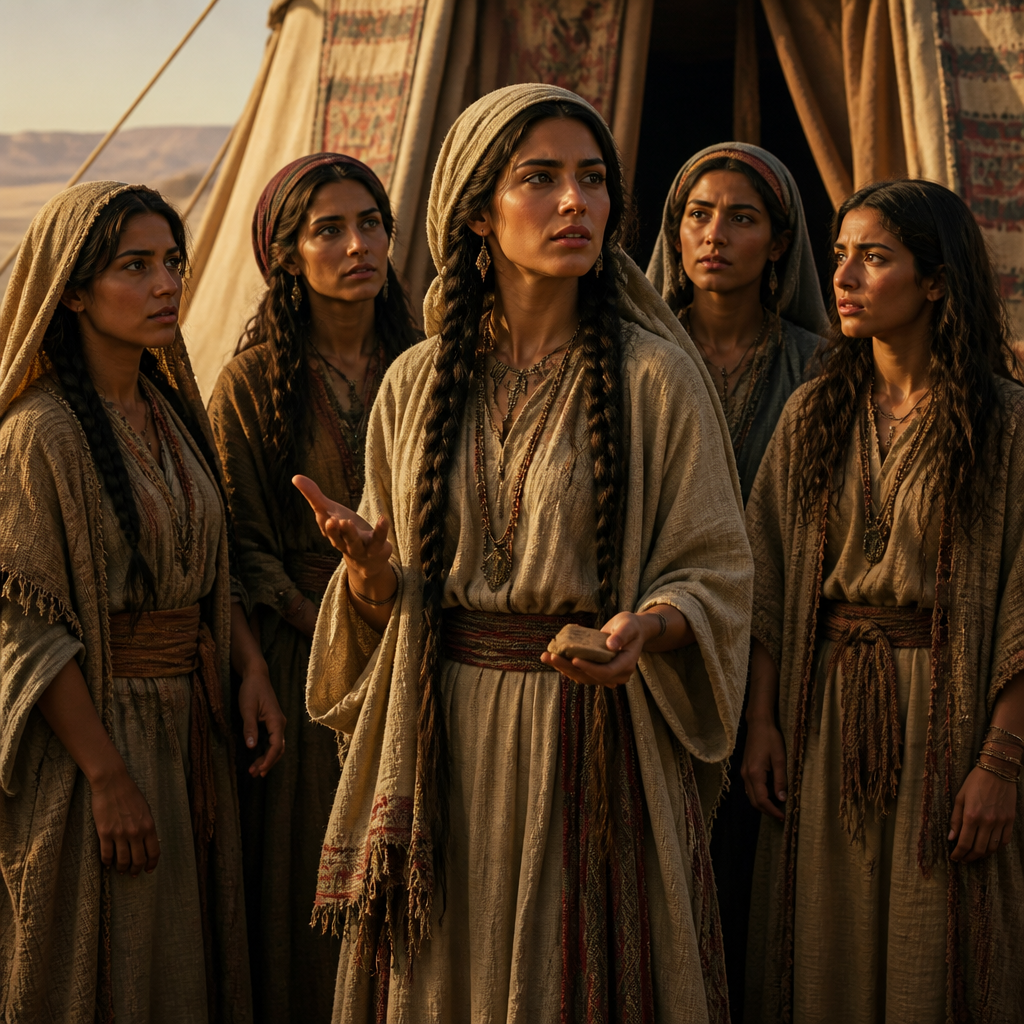
The defining moment of Tirzah’s life occurred as the Israelites were encamped on the plains of Moab, near the Jordan River. As the land was being apportioned among the tribes, Tirzah and her sisters realized their family would be excluded. In an act of bold faith and legal initiative, they approached the entrance of the Tent of Meeting.
They presented their case to Moses and the High Priest, arguing that their father’s name should not be removed from his clan simply because he lacked a male heir. Moses brought their case before the Lord, who vindicated the sisters, stating, "The daughters of Zelophehad speak right" (Numbers 27:7). This resulted in a statutory change: if a man died without a son, his inheritance was to pass to his daughter.
Later, in Numbers 36, a second legal challenge arose regarding the preservation of tribal land. The leaders of Manasseh were concerned that if Tirzah or her sisters married outside their tribe, the land would be transferred to other tribes. In response, a directive was issued that they should marry within the clans of their father’s tribe. Tirzah and her sisters complied, marrying their cousins on their father's side, thereby securing the inheritance for the tribe of Manasseh.
Relationship to Other Biblical Figures
Tirzah is almost always mentioned in concert with her four sisters: Mahlah, Noah, Hoglah, and Milcah. Their unity is a central feature of the narrative, as they acted as a single legal entity to preserve their family's standing. She was also a direct contemporary of Moses and Eleazar the priest, appearing before them during the final year of the wilderness trek. Her later life involved the transition into the land of Canaan under Joshua, where the promise made to her in the wilderness was fulfilled as recorded in Joshua 17:3-4.
Spiritual Significance
Tirzah’s story is a testament to the value placed on the individual and the family within the covenant community. Her initiative reflects a deep desire to remain connected to the inheritance promised by God. Theologically, her inclusion in the text highlights the justice of God in responding to the needs of those who might otherwise be marginalized by social structures. Her faith was not merely in a legal right, but in the certainty that the land God had promised would indeed be conquered and settled.
Tirzah serves as a pivotal figure in the development of biblical inheritance law. Her case established the precedent that women could hold property and carry forward a family legacy in Israel, ensuring that no family's name would be blotted out due to the absence of male heirs. This narrative demonstrates that God's justice is responsive to the petitions of His people.
Furthermore, Tirzah and her sisters are examples of faith in the fulfillment of God's promises. While still in the wilderness, they petitioned for land they did not yet possess, showing absolute confidence that the Israelites would successfully enter and inhabit the Promised Land.
Frequently Asked Questions
Who was Tirzah's father?
Her father was Zelophehad, a descendant of Manasseh through Machir and Gilead.
What was the result of Tirzah's petition to Moses?
God commanded that she and her sisters be given an inheritance of land among their father’s relatives, creating a new law for all of Israel.
Whom did Tirzah marry?
She married one of her cousins from the tribe of Manasseh to ensure her family's land remained within her father's tribe.
In which books of the Bible is Tirzah mentioned?
Tirzah is mentioned in the books of Numbers and Joshua.
Family & Relationships
Parents
 ZelophehadFatherNumbers 27:1Stated
 TirzahThis page
 HoglahSisterNumbers 26:33Stated
 Mahlah, Daughter of ZelophehadSisterNumbers 26:33Stated
 Milcah, Daughter of ZelophehadSisterNumbers 26:33Stated
 Noah, Daughter of ZelophehadSisterNumbers 26:33Stated
Connected Figures
Family
Father · Numbers 27:1
A descendant of Manasseh who died in the wilderness, leaving no sons and prompting a landmark divine ruling on inheritance laws for women.
Sister · Numbers 26:33
One of the five daughters of Zelophehad who successfully petitioned Moses for the right to inherit their deceased father’s land, setting a legal precedent in Israel.
Sister · Numbers 26:33
Mahlah was the eldest of five sisters who successfully petitioned Moses for the right to inherit their father's land, establishing a legal precedent in Israelite law.
Egypt and WildernessFirst: Numbers 26:335 versestribal petitionerManasseh
Sister · Numbers 26:33
One of the five daughters of Zelophehad who successfully petitioned Moses for an inheritance within the tribe of Manasseh, establishing a legal precedent for women's land rights.
Sister · Numbers 26:33
One of the five daughters of Zelophehad whose landmark petition to Moses secured inheritance rights for women within the Tribe of Manasseh.
Categories
Mentions by Book
- Numbers3
- Joshua1
Scripture References
All 4 indexed verses, in canonical order, from the Berean Standard Bible.
Numbers · 3
- Numbers 26:33
Now Zelophehad son of Hepher had no sons but only daughters. The names of his daughters were Mahlah, Noah, Hoglah, Milcah, and Tirzah.
- Numbers 27:1
Now the daughters of Zelophehad son of Hepher, the son of Gilead, the son of Machir, the son of Manasseh, belonged to the clans of Manasseh son of Joseph. These were the names of his daughters: Mahlah, Noah, Hoglah, Milcah, and Tirzah. They approached
- Numbers 36:11
Mahlah, Tirzah, Hoglah, Milcah, and Noah, the daughters of Zelophehad, were married to cousins on their father’s side.
Joshua · 1
- Joshua 17:3
But Zelophehad son of Hepher (the son of Gilead, the son of Machir, the son of Manasseh) had no sons but only daughters. These are the names of his daughters: Mahlah, Noah, Hoglah, Milcah, and Tirzah.