Noah, Daughter of Zelophehad
Who was Noah, Daughter of Zelophehad, in the Bible?
One of the five daughters of Zelophehad whose landmark petition to Moses secured inheritance rights for women within the Tribe of Manasseh.
Noah was one of the five daughters of Zelophehad, a member of the tribe of Manasseh during the Israelites' wilderness wanderings. Her father died in the wilderness without leaving any sons, a circumstance that, under the existing patriarchal customs of the time, threatened to extinguish his name and property rights within his clan. Noah and her sisters are primarily noted in the biblical record for their courage and legal initiative in challenging these inheritance traditions.
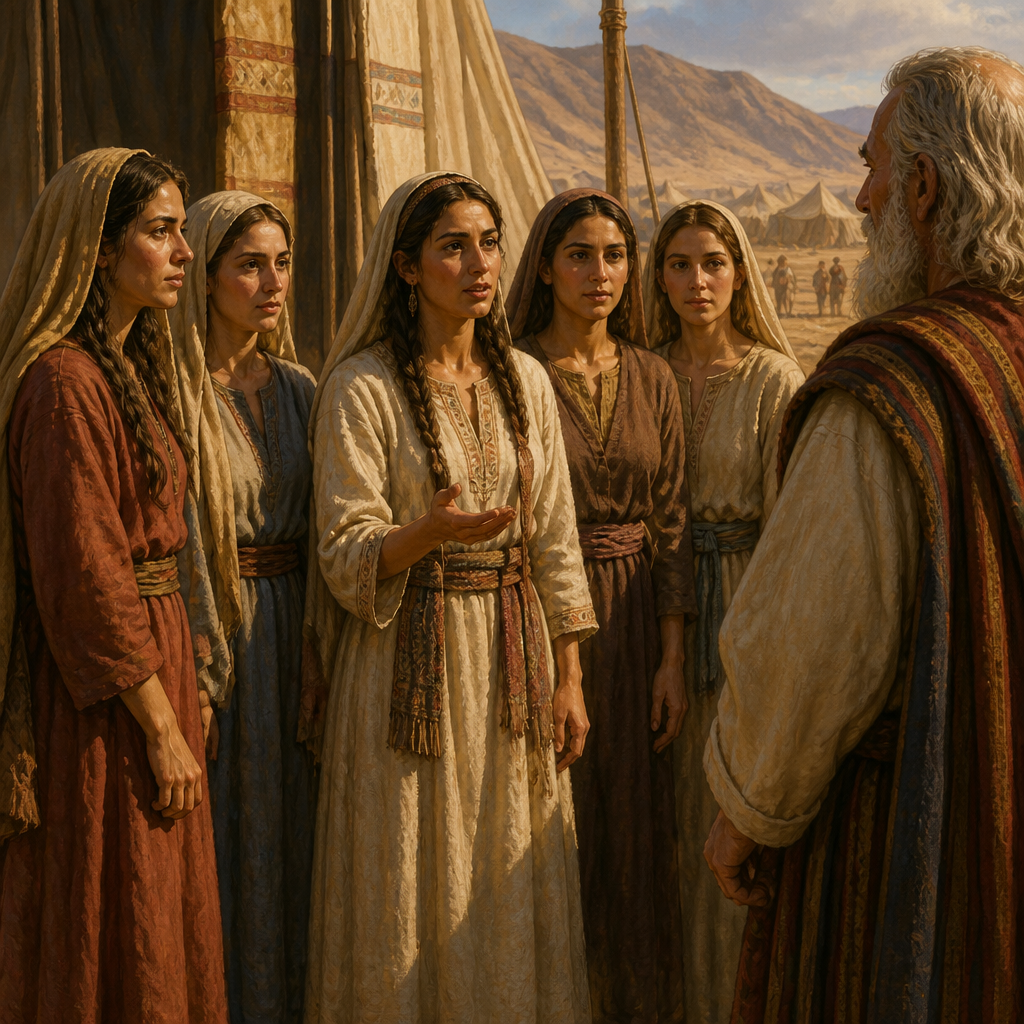
Following the death of their father, Noah and her four sisters—Mahlah, Hoglah, Milcah, and Tirzah—presented themselves before Moses, Eleazar the priest, and the leaders of the assembly. They argued that their father's name should not be removed from his clan simply because he had no male heir. Their request led to a divine decree that fundamentally altered Israelite law regarding the transfer of land and legacy.
Background and Family
Noah belonged to the tribe of Manasseh, the son of Joseph. Her lineage is traced through Hepher, Gilead, and Machir (Numbers 27:1). She was one of five siblings, all of whom were female: Mahlah, Hoglah, Milcah, and Tirzah. The biblical record specifically notes that her father, Zelophehad, died in the wilderness during the forty-year journey from Egypt to Canaan. Crucially, the text clarifies that he was not part of the rebellion of Korah, which had resulted in divine judgment, but rather died "for his own sin"—a standard reference to the mortality of the generation that left Egypt.
Major Life Events
The most significant event in Noah’s life occurred as the Israelites prepared to enter the Promised Land. As the land was being apportioned among the tribes and families, the lack of a male heir meant Zelophehad’s family would receive no allotment. Noah and her sisters took the unprecedented step of approaching the entrance of the Tent of Meeting to plead their case before the highest authorities of the nation.
They requested a possession among their father’s brothers, famously asking, "Why should the name of our father be taken away from his clan because he had no son?" (Numbers 27:4). Moses brought their case before the Lord, and the response was a validation of their claim. God commanded that the daughters be given their father’s inheritance. This established a permanent legal precedent in Israel: if a man died without a son, his inheritance was to pass to his daughters.
Later, in Numbers 36, a further clarification was made regarding Noah and her sisters. To ensure that the land remained within the tribe of Manasseh and did not transfer to another tribe through marriage, it was decreed that they must marry within the clans of their father's tribe. Noah followed this directive, marrying a cousin from the tribe of Manasseh, thereby securing the family estate.
Relationship to Other Biblical Figures
Noah’s primary relationships defined in the text are with her four sisters and her father, Zelophehad. The five women are almost always listed together, suggesting a unified front in their legal petition. She also interacted with the leadership of Israel, including Moses and Eleazar the priest, who acted as the mediators of the divine law that addressed her specific family crisis.
Spiritual Significance
Noah, along with her sisters, is regarded as a figure of faith and assertiveness. Her actions demonstrate a deep value for the Promised Land and the legacy of her ancestors. By petitioning for an inheritance, she expressed confidence that the Israelites would indeed possess the land God had promised them, even while they were still in the wilderness. Theologically, her story highlights the justice of God in addressing the needs of individuals who might otherwise be marginalized by social custom. The inclusion of her name in the census and land records (Joshua 17:3) serves as a testament to her role in the structural development of the Israelite community.
Noah represents a significant development in the biblical legal tradition, specifically regarding women's rights to property and the preservation of family names. Her story serves as a precedent for seeking divine justice when existing social structures fail to account for specific hardships. Furthermore, she and her sisters demonstrate a practical faith in God's promises; they petitioned for land that had not yet been conquered, showing total certainty in the upcoming occupation of Canaan.
Frequently Asked Questions
Who was Noah's father?
Her father was Zelophehad, a descendant of Manasseh through Hepher.
What tribe did Noah belong to?
She belonged to the tribe of Manasseh, one of the two tribes descended from Joseph.
What did Noah and her sisters ask of Moses?
They asked for a legal inheritance of land in the Promised Land, as their father had died without any sons to carry on his name.
Whom did Noah marry?
According to Numbers 36:11, Noah and her sisters married their cousins on their father’s side to keep the land within the tribe of Manasseh.
Did Noah eventually receive land?
Yes, Joshua 17:3-4 records that when the land was being divided in Canaan, the daughters of Zelophehad were given an inheritance among their father’s relatives as the Lord had commanded.
Family & Relationships
Parents
 ZelophehadFatherNumbers 27:1Stated
 Noah, Daughter of ZelophehadThis page
 HoglahSisterNumbers 26:33Stated
 Mahlah, Daughter of ZelophehadSisterNumbers 26:33Stated
 Milcah, Daughter of ZelophehadSisterNumbers 26:33Stated
 TirzahSisterNumbers 26:33Stated
Connected Figures
Family
Father · Numbers 27:1
A descendant of Manasseh who died in the wilderness, leaving no sons and prompting a landmark divine ruling on inheritance laws for women.
Sister · Numbers 26:33
One of the five daughters of Zelophehad who successfully petitioned Moses for the right to inherit their deceased father’s land, setting a legal precedent in Israel.
Sister · Numbers 26:33
Mahlah was the eldest of five sisters who successfully petitioned Moses for the right to inherit their father's land, establishing a legal precedent in Israelite law.
Egypt and WildernessFirst: Numbers 26:335 versestribal petitionerManasseh
Sister · Numbers 26:33
One of the five daughters of Zelophehad who successfully petitioned Moses for an inheritance within the tribe of Manasseh, establishing a legal precedent for women's land rights.
Sister · Numbers 26:33
Tirzah was one of the five daughters of Zelophehad who successfully petitioned for the right of women to inherit land in the absence of male heirs.
Categories
Mentions by Book
- Numbers3
- Joshua1
Scripture References
All 4 indexed verses, in canonical order, from the Berean Standard Bible.
Numbers · 3
- Numbers 26:33
Now Zelophehad son of Hepher had no sons but only daughters. The names of his daughters were Mahlah, Noah, Hoglah, Milcah, and Tirzah.
- Numbers 27:1
Now the daughters of Zelophehad son of Hepher, the son of Gilead, the son of Machir, the son of Manasseh, belonged to the clans of Manasseh son of Joseph. These were the names of his daughters: Mahlah, Noah, Hoglah, Milcah, and Tirzah. They approached
- Numbers 36:11
Mahlah, Tirzah, Hoglah, Milcah, and Noah, the daughters of Zelophehad, were married to cousins on their father’s side.
Joshua · 1
- Joshua 17:3
But Zelophehad son of Hepher (the son of Gilead, the son of Machir, the son of Manasseh) had no sons but only daughters. These are the names of his daughters: Mahlah, Noah, Hoglah, Milcah, and Tirzah.