Balaam
Who was Balaam in the Bible?
A non-Israelite diviner and son of Beor who, despite hearing the voice of God, attempted to curse Israel for profit and later led them into apostasy.
Balaam, the son of Beor, is one of the most enigmatic figures in the biblical narrative of the Wilderness period. Residing in Pethor near the Euphrates, he was a renowned diviner whose reputation for effective blessings and curses reached the highest levels of regional power. Though he was not an Israelite, the biblical record depicts him as a man who communicated directly with Yahweh and acknowledged His authority, yet his heart remained tethered to material gain and the "wages of wickedness."
He is primarily known for his interactions with Balak, the King of Moab, who sought to use Balaam's supernatural influence to neutralize the threat posed by the emerging nation of Israel. While the biblical text records Balaam as a man who could only speak the words God put in his mouth, he is ultimately characterized as a villain whose deceptive counsel led to the deaths of thousands of Israelites through idolatry and sexual immorality. His life ended in judgment during the Israelite campaign against Midian.
Background and Family
Balaam was the son of Beor, originating from Pethor in Aram-naharaim, a region along the Euphrates River (Numbers 22:5; Deuteronomy 23:4). While his specific tribal or national identity is not explicitly detailed, he is consistently associated with the Midianites and Moabites in the geopolitical landscape of the Transjordan. The biblical text identifies him as a "diviner" (Joshua 13:22), a role that in the Ancient Near East involved interpreting omens and using spiritual arts to influence events. Despite this pagan vocation, Balaam possessed a unique and functional relationship with the God of Israel, referring to Him as "the LORD my God" (Numbers 22:18), though the later New Testament witness suggests his devotion was compromised by greed.
Major Life Events
The Summons of Balak
As the Israelites traveled through the wilderness and settled in the plains of Moab, King Balak grew terrified of their numbers. He sent a delegation of elders from Moab and Midian to Balaam with "fees for divination," requesting that Balaam come and curse the Israelites (Numbers 22:7). Initially, God commanded Balaam not to go, stating that the people were blessed. However, when a more prestigious delegation arrived offering greater rewards, Balaam sought God again. God permitted him to go but strictly regulated his speech.
The Talking Donkey
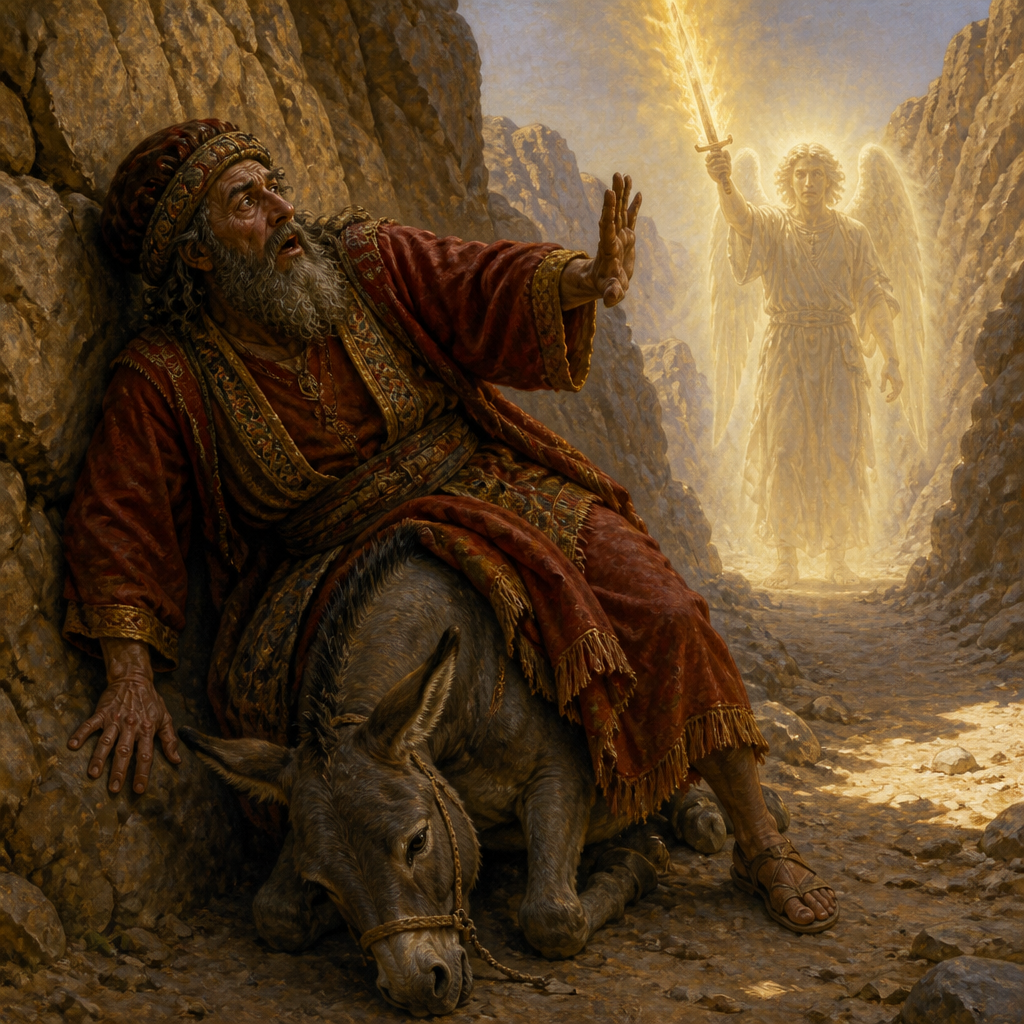
During his journey to Moab, an incident occurred that highlighted Balaam's spiritual blindness. An angel of the LORD stood in the path with a drawn sword, visible only to Balaam’s donkey. The animal turned aside three times to save its master, and each time, Balaam beat it in fury. Finally, the LORD "opened the donkey’s mouth," and the animal questioned Balaam’s cruelty (Numbers 22:28). It was only then that Balaam’s eyes were opened to see the divine messenger, who warned him that the donkey had saved his life and reiterated that he must only speak what God commanded.
The Four Oracles
Upon meeting Balak, Balaam attempted to curse Israel from three different vantage points: Bamoth-baal, the top of Pisgah, and the top of Peor. At each location, Balak built seven altars and offered sacrifices. However, instead of curses, Balaam delivered four profound oracles of blessing. He prophesied Israel's unique status among nations, their military victory, and their future prosperity. His final oracle even included a messianic prophecy: "A star shall come out of Jacob, and a scepter shall rise out of Israel" (Numbers 24:17). Infuriated, Balak dismissed Balaam without the promised rewards.
The Counsel of Peor and Death
While Balaam could not curse Israel through formal oracles, he found another way to achieve Balak's goal. Numbers 31:16 and Revelation 2:14 reveal that Balaam gave "counsel" to Balak, teaching him to entice the Israelite men into sexual immorality and idolatry with the women of Moab and Midian. This led to the incident at Baal-peor, where 24,000 Israelites died in a plague. Because of this treachery, when Israel later went to war against the Midianites, they executed Balaam with the sword (Numbers 31:8; Joshua 13:22).
Relationship to Other Biblical Figures
Balaam’s primary relationship was with Balak, the king of Moab, acting as a hired spiritual consultant. The relationship was characterized by tension, as Balak’s desire for a curse conflicted with the constraints placed upon Balaam by God. Balaam is also linked to the Five Kings of Midian (Evi, Rekem, Zur, Hur, and Reba), with whom he was found and killed during the Israelite raid. In the broader theological landscape, Balaam is held up by Peter and Jude as the archetype of the false teacher who perverts the truth for financial gain.
Spiritual Significance
Balaam serves as a profound warning regarding the distinction between spiritual giftings and moral character. He was a man who truly heard from God and saw visions of the Almighty, yet he remained a "diviner" who practiced sorcery (Numbers 24:1). The biblical writers use him to illustrate the danger of religious hypocrisy and the "error of Balaam," which is the willingness to compromise divine truth for worldly status and money. His life demonstrates that knowing God's word is not the same as obeying God's heart. Despite his articulated wish to "die the death of the upright" (Numbers 23:10), he died as an enemy of God's people, illustrating the finality of divine judgment on those who lead others into sin.
Balaam is significant as a rare example of a non-Israelite through whom God spoke major messianic and national prophecies. His oracles are central to the Pentateuch's depiction of Israel as a chosen and protected nation. However, his legacy is overwhelmingly negative in the canon; he is remembered as the man who introduced a 'stumbling block' by teaching Balak how to seduce Israel into sin. His story emphasizes that God’s blessing on Israel is irrevocable and that those who attempt to subvert it for profit will face destruction.
In the New Testament, Balaam becomes the standard for false teachers. Peter, Jude, and Jesus (in Revelation) all cite him to warn the early church against greed, sexual immorality, and the compromise of faith. He stands as a cautionary figure who possessed the truth but used it as a tool for personal gain, ultimately failing to enter the rest he prophesied for others.
Frequently Asked Questions
Did Balaam's donkey really speak?
Yes, according to Numbers 22:28, the LORD opened the donkey's mouth, allowing it to speak to Balaam. This miraculous event was intended to show Balaam that he was being more spiritually blind than a beast of burden.
Was Balaam a true prophet of God?
Balaam is called a 'diviner' (Joshua 13:22), but the text shows God truly spoke through him. He is best described as a pagan diviner whom God sovereignly utilized to bless Israel, though he lacked the character of a faithful prophet.
Why did God get angry with Balaam for going to Moab if He told him to go?
While God gave Balaam permission to go (Numbers 22:20), He was angry because Balaam's heart was set on the rewards offered by Balak rather than on obedience to God. The angel's confrontation was a warning about his inner motives.
How did Balaam die?
Balaam was killed by the sword of the Israelites during a battle against the Midianites (Numbers 31:8), as judgment for his role in leading Israel into idolatry at Peor.
What is the 'way of Balaam' mentioned in the New Testament?
The 'way of Balaam' refers to the pursuit of religious ministry or spiritual influence for the sake of financial profit and worldly gain (2 Peter 2:15).
Family & Relationships
Parents
 Beor, Father of BalaamFatherNumbers 22:5Stated
 BalaamThis page
Connected Figures
Family
Father · Numbers 22:5
Beor was the father of the Mesopotamian diviner Balaam and a resident of Pethor during the period of the Israelite wilderness wanderings.
Categories
Mentions by Book
- Numbers51
- Deuteronomy2
- Joshua3
- Nehemiah1
- Micah1
- 2 Peter1
- Jude1
- Revelation1
Scripture References
All 61 indexed verses, in canonical order, from the Berean Standard Bible.
- Numbers 22:5
he sent messengers to summon Balaam son of Beor at Pethor, which is by the Euphrates in the land of his people. “Behold, a people has come out of Egypt,” said Balak. “They cover the face of the land and have settled next to me.
- Numbers 22:7
The elders of Moab and Midian departed with the fees for divination in hand. They came to Balaam and relayed to him the words of Balak.
- Numbers 22:8
“Spend the night here,” Balaam replied, “and I will give you the answer that the LORD speaks to me.” So the princes of Moab stayed with Balaam.
- Numbers 22:9
Then God came to Balaam and asked, “Who are these men with you?”
- Numbers 22:10
And Balaam said to God, “Balak son of Zippor, king of Moab, sent me this message:
- Numbers 22:12
But God said to Balaam, “Do not go with them. You are not to curse this people, for they are blessed.”
- Numbers 22:13
So Balaam got up the next morning and said to Balak’s princes, “Go back to your homeland, because the LORD has refused to let me go with you.”
- Numbers 22:14
And the princes of Moab arose, returned to Balak, and said, “Balaam refused to come with us.”
- Numbers 22:16
They came to Balaam and said, “This is what Balak son of Zippor says: ‘Please let nothing hinder you from coming to me,
- Numbers 22:18
But Balaam replied to the servants of Balak, “If Balak were to give me his house full of silver and gold, I could not do anything small or great to go beyond the command of the LORD my God.
- Numbers 22:20
That night God came to Balaam and said, “Since these men have come to summon you, get up and go with them, but you must only do what I tell you.”
- Numbers 22:21
So in the morning Balaam got up, saddled his donkey, and went with the princes of Moab.
- Numbers 22:23
When the donkey saw the angel of the LORD standing in the road with a drawn sword in his hand, she turned off the path and went into a field. So Balaam beat her to return her to the path.
- Numbers 22:25
And the donkey saw the angel of the LORD and pressed herself against the wall, crushing Balaam’s foot against it. So he beat her once again.
- Numbers 22:27Partial
When the donkey saw the angel of the LORD, she lay down under Balaam, and he became furious and beat her with his staff.
- Numbers 22:28
Then the LORD opened the donkey’s mouth, and she said to Balaam, “What have I done to you that you have beaten me these three times?”
- Numbers 22:29
Balaam answered the donkey, “You have made a fool of me! If I had a sword in my hand, I would kill you right now!”
- Numbers 22:30
But the donkey said to Balaam, “Am I not the donkey you have ridden all your life until today? Have I ever treated you this way before?” “No,” he replied.
- Numbers 22:31
Then the LORD opened Balaam’s eyes, and he saw the angel of the LORD standing in the road with a drawn sword in his hand. And Balaam bowed low and fell facedown.
- Numbers 22:34
“I have sinned,” Balaam said to the angel of the LORD, “for I did not realize that you were standing in the road to confront me. And now, if this is displeasing in your sight, I will go back home.”
- Numbers 22:35Partial
But the angel of the LORD said to Balaam, “Go with the men, but you are to speak only what I tell you.” So Balaam went with the princes of Balak.
- Numbers 22:36
When Balak heard that Balaam was coming, he went out to meet him at the Moabite city on the Arnon border, at the edge of his territory.
- Numbers 22:37
And he said to Balaam, “Did I not send you an urgent summons? Why did you not come to me? Am I really not able to reward you richly?”
- Numbers 22:38
“See, I have come to you,” Balaam replied, “but can I say just anything? I must speak only the word that God puts in my mouth.”
- Numbers 22:39
So Balaam accompanied Balak, and they came to Kiriath-huzoth.
- Numbers 22:40
Balak sacrificed cattle and sheep, and he gave portions to Balaam and the princes who were with him.
- Numbers 22:41
The next morning, Balak took Balaam and brought him up to Bamoth-baal. From there he could see the outskirts of the camp of the people.
- Numbers 23:1
Then Balaam said to Balak, “Build for me seven altars here, and prepare for me seven bulls and seven rams.”
- Numbers 23:2Partial
So Balak did as Balaam had instructed, and Balak and Balaam offered a bull and a ram on each altar.
- Numbers 23:3
“Stay here by your burnt offering while I am gone,” Balaam said to Balak. “Perhaps the LORD will meet with me. And whatever He reveals to me, I will tell you.” So Balaam went off to a barren height,
- Numbers 23:4
and God met with him. “I have set up seven altars,” Balaam said, “and on each altar I have offered a bull and a ram.”
- Numbers 23:5
Then the LORD put a message in Balaam’s mouth, saying, “Return to Balak and give him this message.”
- Numbers 23:10Partial
Who can count the dust of Jacob or number even a fourth of Israel? Let me die the death of the righteous; let my end be like theirs!”
Cited as a key verse; added so References, Key Verses and Mentions by Book share one index.
- Numbers 23:11
Then Balak said to Balaam, “What have you done to me? I brought you here to curse my enemies, and behold, you have only blessed them!”
- Numbers 23:16
And the LORD met with Balaam and put a message in his mouth, saying, “Return to Balak and speak what I tell you.”
- Numbers 23:25
Now Balak said to Balaam, “Then neither curse them at all nor bless them at all!”
- Numbers 23:26
But Balaam replied, “Did I not tell you that whatever the LORD says, I must do?”
- Numbers 23:27
“Please come,” said Balak, “I will take you to another place. Perhaps it will please God that you curse them for me from there.”
- Numbers 23:28
And Balak took Balaam to the top of Peor, which overlooks the wasteland.
- Numbers 23:29
Then Balaam said, “Build for me seven altars here, and prepare for me seven bulls and seven rams.”
- Numbers 23:30
So Balak did as Balaam had instructed, and he offered a bull and a ram on each altar.
- Numbers 24:1
And when Balaam saw that it pleased the LORD to bless Israel, he did not seek omens as on previous occasions, but he turned his face toward the wilderness.
- Numbers 24:2
When Balaam looked up and saw Israel encamped tribe by tribe, the Spirit of God came upon him,
- Numbers 24:3
and he lifted up an oracle, saying: “This is the prophecy of Balaam son of Beor, the prophecy of a man whose eyes are open,
- Numbers 24:10Partial
Then Balak’s anger burned against Balaam, and he struck his hands together and said to Balaam, “I summoned you to curse my enemies, but behold, you have persisted in blessing them these three times.
- Numbers 24:12
Balaam answered Balak, “Did I not already tell the messengers you sent me
- Numbers 24:15
Then Balaam lifted up an oracle, saying, “This is the prophecy of Balaam son of Beor, the prophecy of a man whose eyes are open,
- Numbers 24:17Partial
I see him, but not now; I behold him, but not near. A star will come forth from Jacob, and a scepter will arise from Israel. He will crush the skulls of Moab and strike down all the sons of Sheth.
Cited as a key verse; added so References, Key Verses and Mentions by Book share one index.
- Numbers 24:25
Then Balaam arose and returned to his homeland, and Balak also went on his way.
- Numbers 31:8
Among the slain were Evi, Rekem, Zur, Hur, and Reba—the five kings of Midian. They also killed Balaam son of Beor with the sword.
- Numbers 31:16
“Look, these women caused the sons of Israel, through the counsel of Balaam, to turn unfaithfully against the LORD at Peor, so that the plague struck the congregation of the LORD.
- Deuteronomy 23:4
For they did not meet you with food and water on your way out of Egypt, and they hired Balaam son of Beor from Pethor in Aram-naharaim to curse you.
- Deuteronomy 23:5
Yet the LORD your God would not listen to Balaam, and the LORD your God turned the curse into a blessing for you, because the LORD your God loves you.
- Joshua 13:22
The Israelites also killed the diviner Balaam son of Beor along with the others they put to the sword.
- Joshua 24:9
Then Balak son of Zippor, the king of Moab, set out to fight against Israel. He sent for Balaam son of Beor to curse you,
- Joshua 24:10
but I would not listen to Balaam. So he blessed you again and again, and I delivered you from his hand.
- Nehemiah 13:2
because they had not met the Israelites with food and water, but had hired Balaam to call down a curse against them (although our God had turned the curse into a blessing).
- Micah 6:5
My people, remember what Balak king of Moab counseled and what Balaam son of Beor answered. Remember your journey from Shittim to Gilgal, so that you may acknowledge the righteousness of the LORD.’”
- 2 Peter 2:15
They have left the straight way and wandered off to follow the way of Balaam son of Beor, who loved the wages of wickedness.
- Jude 1:11
Woe to them! They have traveled the path of Cain; they have rushed for profit into the error of Balaam; they have perished in Korah’s rebellion.
- Revelation 2:14
But I have a few things against you, because some of you hold to the teaching of Balaam, who taught Balak to place a stumbling block before the Israelites so they would eat food sacrificed to idols and commit sexual immorality.