Jephthah
Who was Jephthah in the Bible?
A Gileadite judge and warrior who led Israel against the Ammonites after being exiled by his family, known for his tragic vow and military success.
A native of Gilead, he was a man of significant physical prowess described as a 'mighty man of valor.' Despite his abilities, his life began under the cloud of social exclusion, as he was the son of a prostitute and was eventually driven away by his legitimate half-brothers to ensure he would receive no inheritance. This forced exile led him to the land of Tob, where he became a leader of a band of men, honing the leadership skills that would later be sought by those who had rejected him.
His narrative, found primarily in the Book of Judges, is characterized by the themes of restoration and tragic consequence. When the Ammonites threatened Gilead, the elders who had previously allowed his expulsion were forced to petition Jephthah for help. He successfully transitioned from an outcast to the head of the Gileadite forces, and eventually, the judge of all Israel. His story is most famously remembered for a rash vow made to God before a battle, which resulted in a devastating personal cost regarding his only child.
Background and Family
Jephthah’s origins were rooted in the region of Gilead, located east of the Jordan River. According to Judges 11:1, he was the son of a man also named Gilead, though his mother was a prostitute. This domestic situation created deep-seated friction within the household. As the legitimate sons of Gilead grew to adulthood, they forcibly expelled Jephthah, stating, “You shall have no inheritance in our father’s house, because you are the son of another woman” (Judges 11:2).
Following his expulsion, Jephthah fled to the land of Tob. The biblical record notes that “worthless men” gathered around him and traveled with him. While the term "worthless" suggests men of low social standing or those without land and occupation, Jephthah’s ability to organize and lead this group established his reputation as a formidable warrior. He remained in Tob until the geopolitical situation in Gilead became desperate due to the aggression of the Ammonites.
Major Life Events
The Call to Leadership
When the Ammonites made war against Israel, the elders of Gilead traveled to Tob to recruit Jephthah. The exchange was marked by tension; Jephthah questioned why they sought his help after hating and expelling him. The elders, acknowledging their need, offered him the position of commander. Jephthah, demonstrating a shrewd understanding of power, negotiated for the permanent position of leader over all Gilead should he be successful in battle. This agreement was ratified at Mizpah in the presence of the Lord.
Diplomacy and War
Jephthah did not immediately resort to violence. He sent messengers to the king of the Ammonites to inquire about the cause of the conflict. The Ammonite king claimed that Israel had stolen land from the Arnon to the Jabbok during the Exodus from Egypt. Jephthah’s response was a detailed historical defense, arguing that Israel had conquered the land from the Amorites (specifically King Sihon) after being refused passage, and that the territory had never belonged to the Ammonites. He further argued that if the Ammonite god Chemosh gave them land, they should be satisfied with it, just as Israel possessed what the Lord gave them.
When diplomacy failed, the Spirit of the Lord came upon Jephthah. He mobilized forces from Gilead and Manasseh. Before engaging the enemy, Jephthah made a vow to the Lord: “If indeed You will deliver the Ammonites into my hand, then whatever comes out of the doors of my house to meet me when I return in peace from the Ammonites shall be the LORD’s, and I will offer it up as a burnt offering” (Judges 11:30-31). Jephthah achieved a decisive victory, subduing twenty cities.
The Tragic Vow
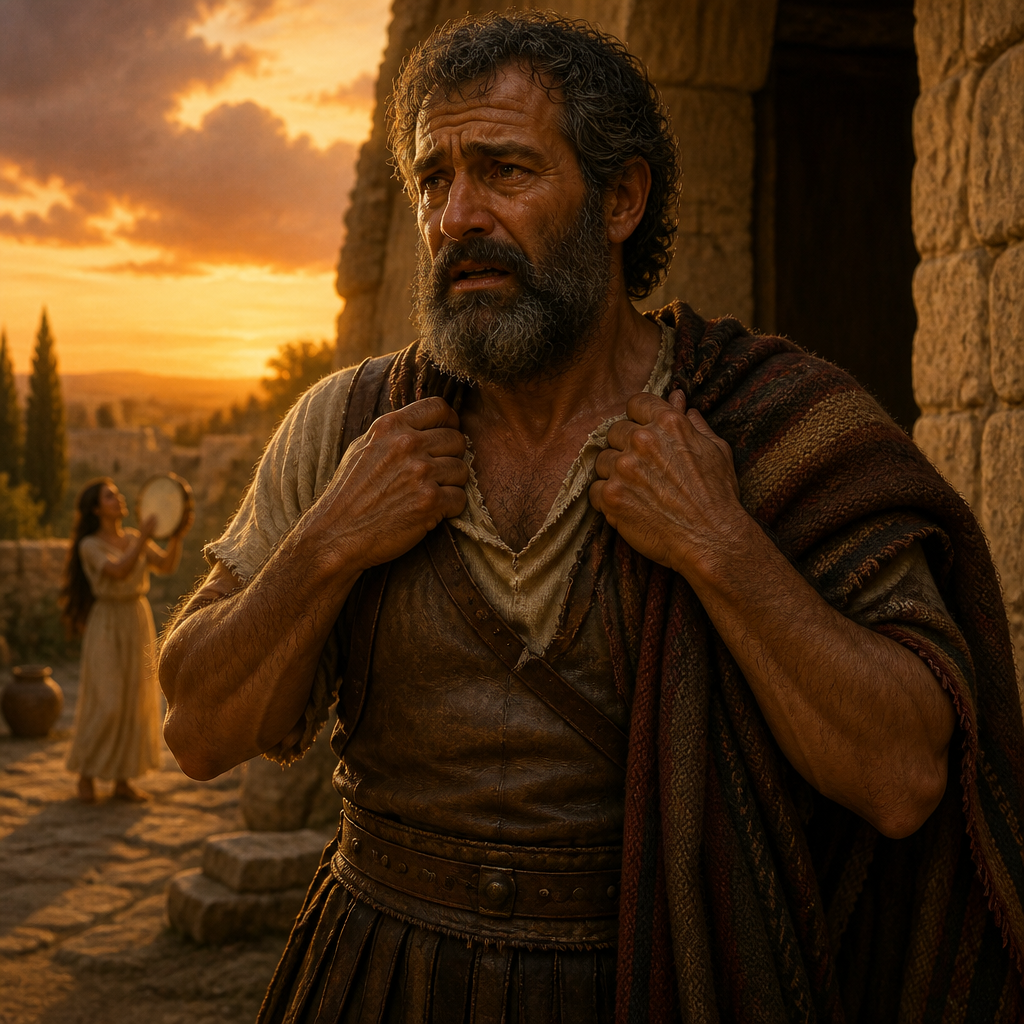
Upon his return to Mizpah, Jephthah was met by his daughter, his only child, who came out to celebrate his victory with tambourines and dancing. Struck with grief, Jephthah rent his clothes, realizing he was bound by his oath. His daughter responded with remarkable submission, requesting only two months to mourn her virginity in the mountains with her companions. The text records that at the end of the two months, he carried out the vow he had made. This event led to a tradition in Israel where young women would lament the daughter of Jephthah for four days each year.
Conflict with Ephraim
Following the victory, the tribe of Ephraim challenged Jephthah, complaining that they were not called to join the battle. Unlike Gideon before him, who used soft words to appease the Ephraimites, Jephthah responded with force. The resulting civil war saw the Gileadites seize the fords of the Jordan. They identified fleeing Ephraimites by their inability to pronounce the word Shibboleth (they said Sibboleth). Forty-two thousand Ephraimites fell in this conflict.
Relationship to Other Biblical Figures
Jephthah’s primary relationships recorded in Scripture are with his father, Gilead, and his unnamed daughter. His interactions with the elders of Gilead define his political rise, while his confrontation with the men of Ephraim highlights the internal tribal fractures of the period. In the New Testament, Jephthah is mentioned in Hebrews 11:32 alongside Gideon, Barak, and Samson as a hero of faith, suggesting that despite the controversy of his vow, his reliance on God for Israel’s deliverance was commendable.
Spiritual Significance
Jephthah’s life serves as a complex study in the interaction between faith and culture. His rise from an excluded social outcast to a national savior reflects the biblical theme of God using the marginalized to accomplish His purposes. However, his vow serves as a cautionary tale regarding the influence of pagan customs on Israelite worship; the practice of human sacrifice was strictly forbidden in the Law of Moses, yet Jephthah’s language suggests he felt bound by a literalistic and perhaps culturally influenced view of oaths.
Ultimately, Jephthah is characterized by his commitment to God’s sovereignty. Throughout his negotiations with the Ammonites and the Ephraimites, he consistently appealed to the Lord as the Judge. His inclusion in the "Hall of Faith" in the book of Hebrews emphasizes his role as a deliverer who, through the Spirit of the Lord, preserved the nation of Israel from extinction during the time of the Judges.
Jephthah represents the 'charismatic' leadership typical of the Period of the Judges, where the Spirit of the Lord empowered individuals to meet specific national crises. His historical defense of Israel's land rights remains one of the most detailed apologetic passages in the Old Testament, demonstrating a deep knowledge of Israel's redemptive history despite his rough upbringing.
Theologically, Jephthah is often viewed as a tragic hero. His vow illustrates the spiritual state of Israel during this era—a time when knowledge of the Torah was eclipsed by the surrounding Canaanite culture. Despite his personal tragedy and the brutal civil war with Ephraim, the New Testament regards him as a man of faith because he looked to the Lord for victory rather than his own strength, successfully ending the Ammonite oppression that had lasted eighteen years.
Frequently Asked Questions
What was Jephthah's vow?
Jephthah vowed to the Lord that if he was given victory over the Ammonites, he would offer as a burnt offering whatever first came out of his house to meet him upon his return.
Did Jephthah actually sacrifice his daughter?
The text in Judges 11:39 states that Jephthah 'did to her according to his vow which he had made.' While some scholars suggest she was dedicated to perpetual virginity in service to God, the plainest reading of the Hebrew text and the annual lamentation tradition suggest a literal sacrifice, reflecting the tragic spiritual confusion of the period.
Why was Jephthah expelled from his home?
He was expelled by his half-brothers because he was the son of a prostitute, and they did not want him to share in their father's inheritance.
What is the meaning of the word 'Shibboleth'?
It was a password used by Jephthah's army to identify Ephraimite fugitives. The Ephraimites could not pronounce the 'sh' sound, and their failure to say the word correctly led to their execution at the fords of the Jordan.
How long did Jephthah judge Israel?
Jephthah judged Israel for a total of six years before he died and was buried in one of the cities of Gilead.
Family & Relationships
Parents
 Gilead, Father of JephthahFatherJudges 11:2Stated
 JephthahThis page
Children
 Jephthah's DaughterDaughterJudges 11:40Stated
Connected Figures
Family
Father · Judges 11:2
A man living during the era of the Judges in Israel and the father of the judge Jephthah by a prostitute.
Daughter · Judges 11:40
The only child of the judge Jephthah, she became the subject of her father's tragic vow after he led Israel to victory over the Ammonites during the era of the Conquest.
Conquest and JudgesFirst: Judges 11:347 versesNone recorded
Categories
Mentions by Book
- Judges25
- 1 Samuel1
- Hebrews1
Scripture References
All 27 indexed verses, in canonical order, from the Berean Standard Bible.
- Judges 11:1Partial
Now Jephthah the Gileadite was a mighty man of valor; he was the son of a prostitute, and Gilead was his father.
- Judges 11:2
And Gilead’s wife bore him sons who grew up, drove Jephthah out, and said to him, “You shall have no inheritance in our father’s house, because you are the son of another woman.”
- Judges 11:3Partial
So Jephthah fled from his brothers and settled in the land of Tob, where worthless men gathered around him and traveled with him.
- Judges 11:5
and made war with them, the elders of Gilead went to get Jephthah from the land of Tob.
- Judges 11:6
“Come,” they said, “be our commander, so that we can fight against the Ammonites.”
- Judges 11:7
Jephthah replied to the elders of Gilead, “Did you not hate me and expel me from my father’s house? Why then have you come to me now, when you are in distress?”
- Judges 11:8
They answered Jephthah, “This is why we now turn to you, that you may go with us, fight the Ammonites, and become leader over all of us who live in Gilead.”
- Judges 11:9
But Jephthah asked them, “If you take me back to fight the Ammonites and the LORD gives them to me, will I really be your leader?”
- Judges 11:10
And the elders of Gilead said to Jephthah, “The LORD is our witness if we do not do as you say.”
- Judges 11:11Partial
So Jephthah went with the elders of Gilead, and the people made him their leader and commander. And Jephthah repeated all his terms in the presence of the LORD at Mizpah.
- Judges 11:12
Then Jephthah sent messengers to the king of the Ammonites, saying, “What do you have against me that you have come to fight against my land?”
- Judges 11:13
The king of the Ammonites answered Jephthah’s messengers, “When Israel came up out of Egypt, they seized my land, from the Arnon to the Jabbok and all the way to the Jordan. Now, therefore, restore it peaceably.”
- Judges 11:14
Jephthah again sent messengers to the king of the Ammonites
- Judges 11:15
to tell him, “This is what Jephthah says: Israel did not take away the land of Moab or of the Ammonites.
- Judges 11:28
But the king of the Ammonites paid no heed to the message Jephthah sent him.
- Judges 11:29
Then the Spirit of the LORD came upon Jephthah, and he passed through Gilead and Manasseh, then through Mizpah of Gilead. And from there he advanced against the Ammonites.
- Judges 11:30
Jephthah made this vow to the LORD: “If indeed You will deliver the Ammonites into my hand,
- Judges 11:31Partial
then whatever comes out the door of my house to greet me on my triumphant return from the Ammonites will belong to the LORD, and I will offer it up as a burnt offering.”
Cited as a key verse; added so References, Key Verses and Mentions by Book share one index.
- Judges 11:32
So Jephthah crossed over to the Ammonites to fight against them, and the LORD delivered them into his hand.
- Judges 11:34
And when Jephthah returned home to Mizpah, there was his daughter coming out to meet him with tambourines and dancing! She was his only child; he had no son or daughter besides her.
- Judges 11:40
that each year the young women of Israel go out for four days to lament the daughter of Jephthah the Gileadite.
- Judges 12:1
Then the men of Ephraim assembled and crossed the Jordan to Zaphon. They said to Jephthah, “Why have you crossed over to fight the Ammonites without calling us to go with you? We will burn your house down with you inside!”
- Judges 12:2
But Jephthah replied, “My people and I had a serious conflict with the Ammonites, and when I called, you did not save me out of their hands.
- Judges 12:4
Jephthah then gathered all the men of Gilead and fought against Ephraim. And the men of Gilead struck them down because the Ephraimites had said, “You Gileadites are fugitives in Ephraim, living in the territories of Ephraim and Manasseh.”
- Judges 12:7Partial
Jephthah judged Israel six years, and when he died, he was buried in one of the cities of Gilead.
- 1 Samuel 12:11
So the LORD sent Jerubbaal, Barak, Jephthah, and Samuel, and He delivered you from the hands of your enemies on every side, and you dwelt securely.
- Hebrews 11:32
And what more shall I say? Time will not allow me to tell of Gideon, Barak, Samson, Jephthah, David, Samuel, and the prophets,