Phinehas, Son of Eli
Phinehas was a priest at Shiloh during the United Monarchy whose death coincided with the Philistine capture of the Ark of the Covenant.
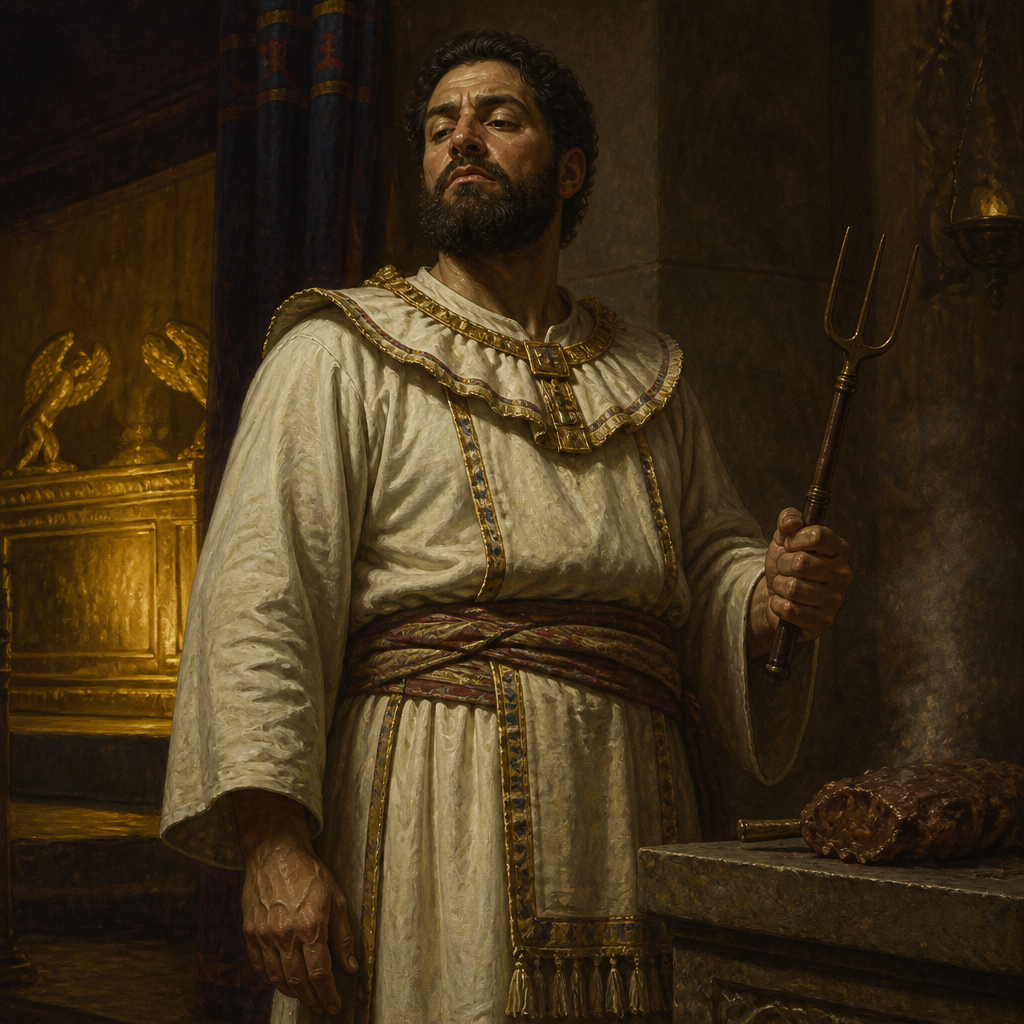
Phinehas, a member of the Tribe of Levi, served as a priest in the tabernacle at Shiloh during the transitional period between the Judges and the establishment of the United Monarchy. He was the son of Eli, the High Priest and Judge of Israel, and the brother of Hophni. Despite his noble lineage and high office, Phinehas is primarily remembered in the biblical narrative for his involvement in the spiritual and moral decline of the priesthood, which eventually led to divine judgment upon his family line.
His life and service were centered around the sanctuary at Shiloh, where the Ark of the Covenant was housed. Phinehas’s career was inextricably linked to that of his brother Hophni; the two are almost always mentioned together in the text, representing a unified front of priestly mismanagement. His life ended abruptly on the battlefield during a disastrous conflict with the Philistines, an event that marked a significant turning point in the history of Israel’s religious life and the transition of leadership to the prophet Samuel.
Background and Family
Phinehas was born into the prominent priestly family of Eli, who served as both the High Priest and the Judge of Israel. As a descendant of the Tribe of Levi, Phinehas was heir to the sacred duties of the tabernacle. He grew up in the religious center of Shiloh, where the worship of Yahweh was centralized during the early years of the United Monarchy era (roughly the 11th century BC). Phinehas was married and had at least two sons, Ahitub and Ichabod. The record indicates that his family occupied a position of immense social and religious authority, as they were the primary mediators between the people of Israel and God at the national sanctuary.
Major Life Events
The biblical narrative introduces Phinehas alongside his brother Hophni in 1 Samuel 1:3, identifying them as "priests to the LORD" at Shiloh. While the text focuses significantly on the rise of Samuel, Phinehas remains a central figure in the decline of the Elide priesthood. Because of the brothers' actions—described elsewhere in the narrative as treating the offerings of the Lord with contempt—a prophetic warning was delivered to their father, Eli. The prophet declared a sign of impending judgment: Phinehas and Hophni would both die on the same day (1 Samuel 2:34).
The fulfillment of this prophecy occurred during a major military engagement with the Philistines. Following an initial defeat, the elders of Israel decided to bring the Ark of the Covenant from Shiloh to the battlefield, believing its presence would ensure victory. Phinehas and Hophni accompanied the Ark to the camp at Aphek. The arrival of the Ark, guarded by the two brothers, initially raised the morale of the Israelite army but ultimately led to a catastrophic defeat.
In the ensuing battle, the Philistines overwhelmed the Israelite forces. The Ark of God was captured, and Phinehas was killed alongside his brother Hophni (1 Samuel 4:11). When news of his death and the capture of the Ark reached Shiloh, his pregnant wife went into premature labor. She died giving birth to their son, whom she named Ichabod, signifying that "the glory has departed from Israel."
Relationship to Other Biblical Figures
Phinehas is defined largely by his relationships to his father, Eli, and his brother, Hophni. His father failed to effectively restrain the brothers' behavior, leading to the divine rejection of their house. Phinehas is also the progenitor of a line that continued to influence the priesthood for several generations. His son Ahitub and his grandson Ahijah (who wore the ephod during the reign of King Saul) are specifically noted in the genealogical records, tracking the movement of the priestly line after the fall of Shiloh (1 Samuel 14:3).
Spiritual Significance
The life of Phinehas serves as a sobering example of the consequences of failing to uphold the holiness of a sacred office. As a priest, he was tasked with guarding the sanctity of the Ark and the integrity of the sacrificial system. However, his presence with the Ark on the battlefield proved to be a hollow ritual rather than a sign of true spiritual power. His death, coinciding with the loss of the Ark, symbolized the temporary withdrawal of God's manifest presence from the national center of worship. The narrative uses Phinehas to illustrate that lineage and religious status do not exempt one from the requirement of personal faithfulness and reverence for the divine.
Spiritual Significance
Phinehas represents the end of the dominant influence of the house of Eli at Shiloh. His death is the specific sign of the end of an era in Israel’s religious history, clearing the way for the rise of Samuel as both prophet and judge. The legacy of Phinehas is one of missed opportunity; though he carried the Ark of the Covenant, his lack of spiritual integrity meant he could not protect it or himself from judgment.
Theologically, the story of Phinehas highlights the transition from a corrupt priesthood to a new prophetic movement. His name appears in subsequent genealogies primarily to establish the lineage of his descendants, such as Ahitub and Ahijah, who continued to serve as priests under the early monarchy despite the shadow of the judgment pronounced against Phinehas and his father’s house.
Frequently Asked Questions
How did Phinehas die?
Phinehas died in battle against the Philistines at the same time the Ark of the Covenant was captured (1 Samuel 4:11).
Who were the children of Phinehas?
Phinehas had two sons mentioned in scripture: Ahitub and Ichabod (1 Samuel 4:19-21, 14:3).
Where did Phinehas serve as a priest?
He served at the tabernacle in Shiloh, which was the primary religious center for Israel before the temple was built in Jerusalem.
What happened to the wife of Phinehas?
Upon hearing of the death of Phinehas and the capture of the Ark, she went into labor, gave birth to Ichabod, and died (1 Samuel 4:19).
Why was the death of Phinehas prophesied?
It was a sign of God's judgment on the house of Eli because Phinehas and his brother Hophni had acted wickedly in their roles as priests (1 Samuel 2:34).
Connected Figures


Categories
Mentions by Book
- 1 Samuel7
Family & Relationships
Child
1 Samuel 1:3
Child
1 Samuel 1:3
Sibling
1 Samuel 1:3
Parent
1 Samuel 1:3
Sibling
1 Samuel 1:3
Others Named Phinehas
Phinehas, Father of EleazarEzra 8:33
A man of the Post-Exilic period whose son, Eleazar, assisted in the handling of sacred temple treasures following the return from Babylon.
Phinehas, Son of EleazarExodus 6:25
Phinehas was a high-ranking priest known for his zeal for the holiness of God, famously halting a plague in Israel through an act of decisive judgment at Peor.