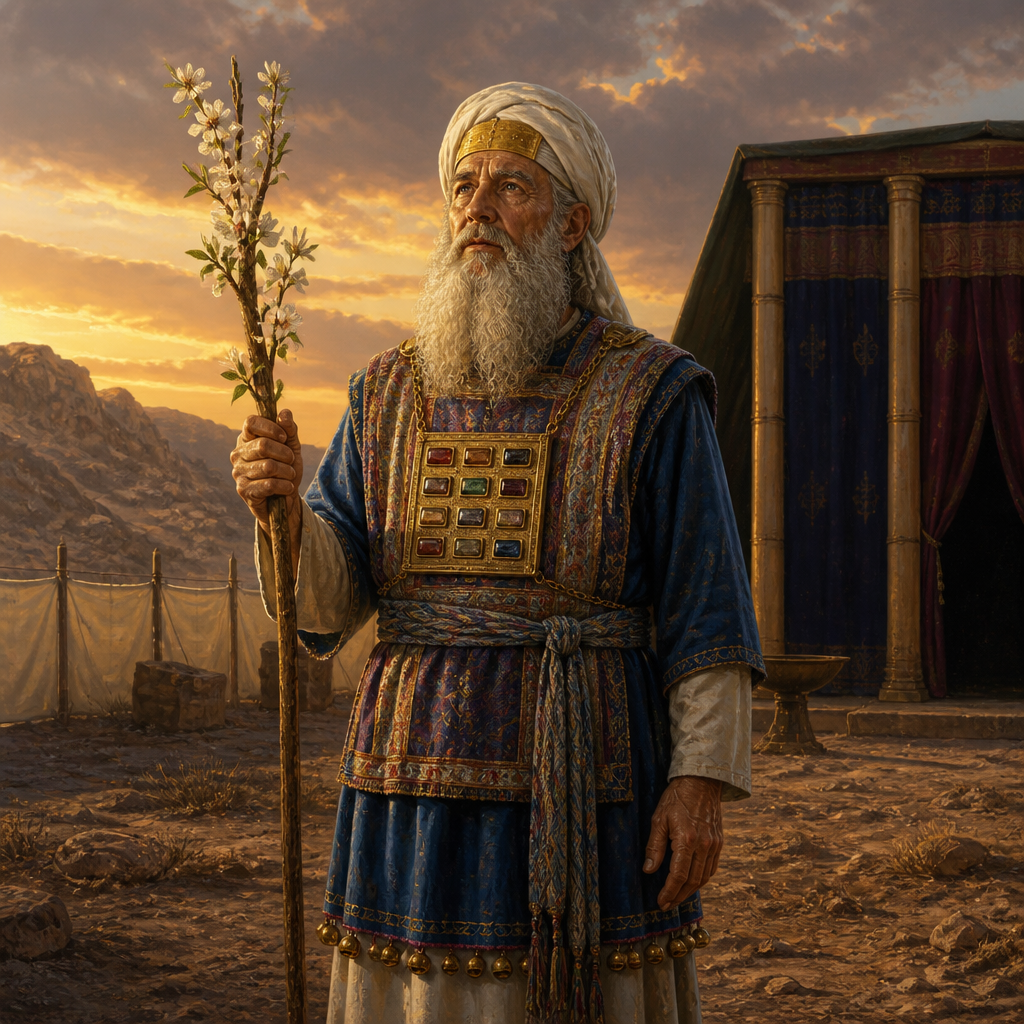
Phinehas, Son of Eleazar
Phinehas was a high-ranking priest known for his zeal for the holiness of God, famously halting a plague in Israel through an act of decisive judgment at Peor.
Phinehas, the son of Eleazar and grandson of Aaron, stands as one of the most significant figures in the transition of Israel from a wandering nation in the wilderness to a settled people in the land of Canaan. Born into the high-priestly lineage of the Tribe of Levi, he inherited a role of immense spiritual and judicial responsibility. He is first mentioned in the genealogies of Exodus as the child of Eleazar and a daughter of Putiel, marking his status as a legitimate heir to the Aaronic priesthood.
His legacy is primarily defined by a singular, intense moment of zeal during the Shittim crisis, where he intervened to stop a plague that threatened the entire Israelite community. This act earned him the 'covenant of a lasting priesthood' and established him as a model of righteous indignation in the face of idolatry and ritual impurity. Beyond his actions in the wilderness, Phinehas served as a military chaplain and a diplomat during the conquest and settlement under Joshua, eventually overseeing the Ark of the Covenant during the early period of the Judges.
Background and Family
Phinehas was the son of Eleazar, the high priest who succeeded Aaron, and his mother was one of the daughters of Putiel (Exodus 6:25). As a member of the Tribe of Levi, Phinehas was born into a life of service to the Tabernacle. His genealogy is meticulously preserved in 1 Chronicles 6 and Ezra 7, tracing the high-priestly line from Aaron through Phinehas to the later priests of the post-exilic era. He was the father of Abishua, ensuring the continuation of the line that God promised would remain with his descendants forever.
Major Life Events
The Incident at Shittim
While Israel was camped at Shittim, the people began to indulge in sexual immorality with Moabite women and were lured into the worship of Baal of Peor. As a divine plague began to sweep through the camp, an Israelite man named Zimri publicly brought a Midianite woman, Cozbi, into his tent in the sight of Moses and the entire assembly.
Phinehas, moved by holy zeal, rose from the assembly, took a spear, and followed the couple into the tent. By executing them both, he signaled a total rejection of the apostasy. The Bible records that this act turned away God's wrath and immediately halted the plague, which had already claimed 24,000 lives. In recognition of his faithfulness, God declared: “Phinehas son of Eleazar... has turned My wrath away from the Israelites... I am giving him My covenant of peace” (Numbers 25:11-12).
Military and Diplomatic Leadership
Following the Peor incident, Phinehas took on roles that blended priestly duties with national defense. In the campaign against the Midianites, Moses sent Phinehas to accompany the army, carrying the holy vessels and the trumpets for signaling (Numbers 31:6).
During the conquest of Canaan, Phinehas acted as a lead negotiator. When the tribes of Reuben, Gad, and the half-tribe of Manasseh built a large altar by the Jordan, the rest of Israel feared it was a sign of rebellion. Phinehas led a delegation to Gilead to confront them. His leadership prevented a civil war when he accepted their explanation that the altar was a memorial, not a place for illicit sacrifice (Joshua 22).
Later Service and Death
In his later years, Phinehas continued to serve as the spiritual authority for the nation. Upon the death of his father, Eleazar, he was buried at Gibeah, a hill in Ephraim that had been given to Phinehas (Joshua 24:33). The Book of Judges records that Phinehas was still serving before the Ark of the Covenant at Bethel during the conflict between Israel and the tribe of Benjamin (Judges 20:28), seeking the Lord's counsel on behalf of the tribes.
Relationship to Other Biblical Figures
Phinehas functioned as a bridge between the founding generation of the Exodus and the subsequent generation of the Judges. He was a contemporary of Moses and Joshua, serving under their leadership before emerging as a primary leader himself. As the grandson of Aaron, his relationship with his father Eleazar was one of apprenticeship, eventually succeeding him in the high priesthood. His diplomatic interaction with the leaders of the Transjordan tribes (Reuben and Gad) demonstrates his role as a unifying figure among the disparate clans of Israel.
Spiritual Significance
The theological significance of Phinehas is centered on the concept of 'zeal.' Psalm 106:30-31 commemorates his actions, stating that his intervention "was credited to him as righteousness for endless generations to come." This language mirrors the justification of Abraham, suggesting that his decisive defense of God's holiness was an act of profound faith.
He is presented as the archetype of the 'jealous' servant—one whose personal passions are perfectly aligned with God's intolerance for sin. The "Covenant of Peace" and the "Permanent Priesthood" granted to him underscore the biblical theme that God rewards those who prioritize His honor above social convention or personal safety. In the broader biblical narrative, Phinehas represents the standard for priestly vigilance against the syncretism that would plague Israel for centuries.
Spiritual Significance
Phinehas is theologically significant as the recipient of the 'Covenant of Peace' and a 'Lasting Priesthood,' a divine promise that his lineage would hold the high priestly office in perpetuity due to his zeal for God's holiness. His actions at Peor are cited in the Psalms as a defining moment of intercession, where his judgment of sin functioned as a means of atonement for the nation. He serves as the biblical model for the 'Zealot,' illustrating that righteous indignation, when directed by God's commands, is a form of spiritual service that preserves the community from divine judgment.
Frequently Asked Questions
What does the name Phinehas mean?
The name Phinehas is widely believed by scholars to be of Egyptian origin ('Pa-nehasi'), meaning 'the Nubian' or 'the dark-skinned one,' reflecting the Israelite history in Egypt.
Why did Phinehas kill the man and woman at Shittim?
He executed them because they were brazenly committing idolatry and immorality in front of the Tabernacle while the rest of the nation was mourning, thereby bringing God's judgment upon the camp.
What was the 'Covenant of Peace' given to Phinehas?
It was a divine promise from God that the high priesthood would remain in the family of Phinehas forever because he was zealous for his God and made atonement for the Israelites.
How long did Phinehas serve as a priest?
Phinehas served for a very long period, from the end of the 40-year wilderness wanderings through the conquest of Joshua and into the time of the Judges, as seen in Judges 20:28.
Was Phinehas involved in the conquest of Canaan?
Yes, he accompanied the army against Midian and later served as the chief negotiator and spiritual leader during the tribal settlement under Joshua.
Connected Figures
Eleazar
Father
Aaron
Grandfather
Abishua
Son

Moses
Leader and Uncle
Joshua
Contemporary and Military Leader
Categories
Mentions by Book
- Joshua5
- 1 Chronicles3
- Numbers3
- Ezra2
- Exodus1
- Judges1
- Psalms1
Family & Relationships
Child
Exodus 6:25
Parent
Exodus 6:23
Parent
Exodus 6:25
Others Named Phinehas
Phinehas, Son of Eli1 Samuel 1:3
Phinehas was a priest at Shiloh during the United Monarchy whose death coincided with the Philistine capture of the Ark of the Covenant.
Phinehas, Father of EleazarEzra 8:33
A man of the Post-Exilic period whose son, Eleazar, assisted in the handling of sacred temple treasures following the return from Babylon.