Nethanel, Musician of the Post-Exilic Period
Nethanel was a post-exilic musician who participated in the joyous dedication of the rebuilt walls of Jerusalem under Nehemiah and Ezra.
Nethanel was a member of the Jewish community that returned from the Babylonian captivity during the Persian period. He is specifically identified as one of the musical associates who participated in the grand dedication ceremony of the Jerusalem wall. As a descendant of Jonathan and Shemaiah, he belonged to a family line deeply invested in the religious and structural restoration of the holy city.
His role was primarily liturgical and celebratory. During the tenure of Nehemiah as governor and Ezra as scribe, Nethanel served alongside his kinsmen to provide the musical accompaniment required for one of the most significant milestones in post-exilic history. His presence in the biblical record signifies the restoration of organized worship and the fulfillment of Davidic musical traditions in the Second Temple era.
Background and Family
Nethanel appears within the genealogical and ceremonial records of the book of Nehemiah, specifically during the period of the restoration following the Babylonian Exile. He was the son of Jonathan, who was the son of Shemaiah. This lineage places him within a prominent family of the post-exilic community. Nethanel was part of a large group of siblings or close kinsmen who served together, including Shemaiah, Azarel, Milalai, Gilalai, Maai, Judah, and Hanani.
The text identifies this group as being associated with the "musical instruments prescribed by David the man of God" (Nehemiah 12:36). This suggests that Nethanel’s family maintained the traditions of the Levites or the specific musical guilds established centuries earlier during the United Monarchy. While his specific tribe is not explicitly named in the text, his participation in sacred music and his association with the instruments of David strongly imply a Levitical heritage, as these roles were traditionally reserved for that tribe.
Major Life Events
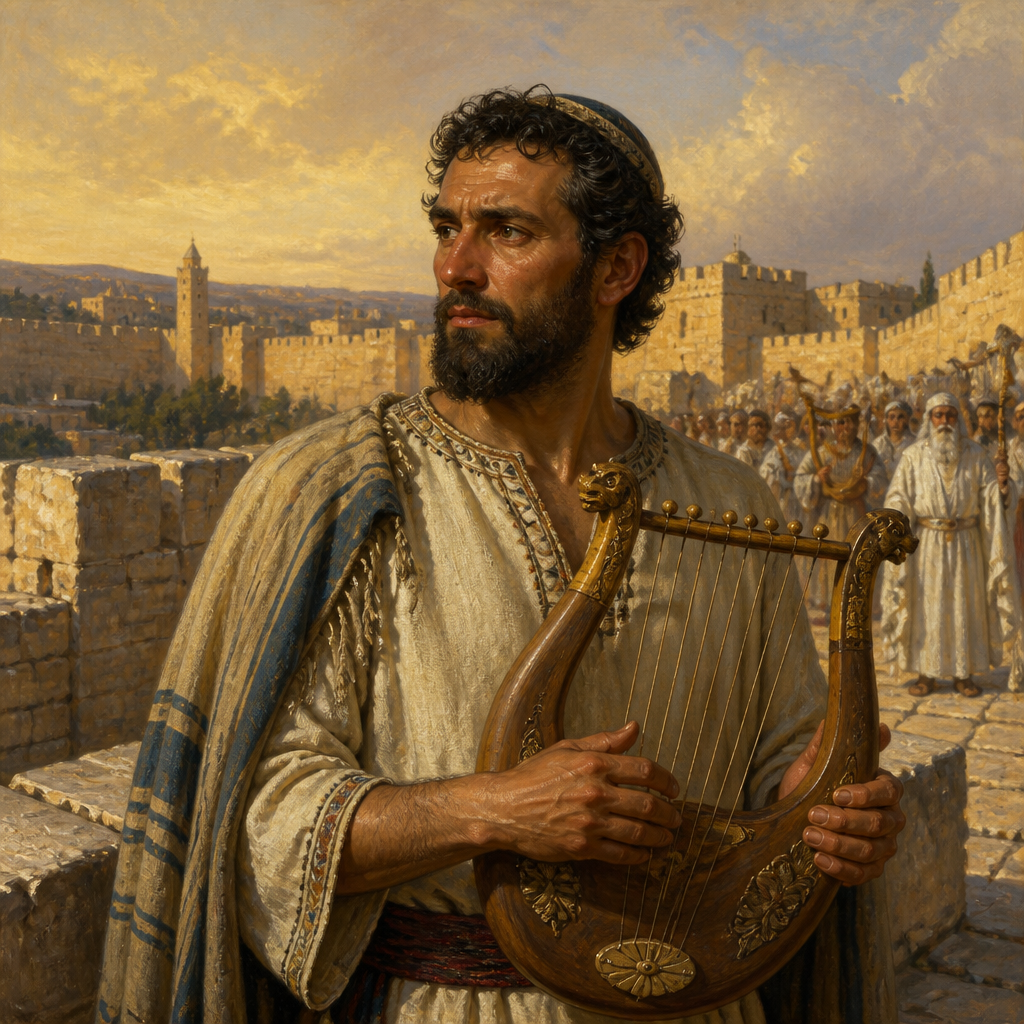
The defining moment of Nethanel’s recorded life occurred during the dedication of the wall of Jerusalem. After Nehemiah had successfully led the effort to rebuild the city’s fortifications despite intense local opposition, a massive celebration was organized to consecrate the structure to God.
Nethanel was part of one of the two large choral and musical processions that walked atop the newly completed walls. According to Nehemiah 12, the companies moved in opposite directions to meet eventually at the House of God. Nethanel followed the procession led by Ezra the scribe. This event was not merely a civic parade but a profound religious act, signaling that Jerusalem was once again a fortified sanctuary for the remnant of Israel. The sound of the musical instruments, including those played by Nethanel, was so great that the "joy of Jerusalem was heard from far away" (Nehemiah 12:43).
Relationship to Other Biblical Figures
Nethanel is most closely linked to Ezra the scribe, as he was part of the specific group that marched behind Ezra during the dedication ceremony. He is also defined by his relationship to his seven brothers or associates mentioned in the same verse: Shemaiah, Azarel, Milalai, Gilalai, Maai, Judah, and Hanani. Together, these men functioned as a cohesive unit of musicians, preserving the liturgical standards of the Davidic era.
Spiritual Significance
Though Nethanel is mentioned in only one verse, his inclusion in the sacred text underscores the importance of music and worship in the restoration of the covenant community. His service represents the "living link" between the pre-exilic traditions of King David and the post-exilic reality of the Second Temple. By using the "instruments prescribed by David," Nethanel and his peers demonstrated that the return from exile was not the start of a new religion, but the continuation and recovery of the ancient faith. His life exemplifies the role of the individual in contributing to the collective joy and spiritual fortification of the community.
Spiritual Significance
Nethanel’s primary significance lies in his role as a preserver of the Davidic musical tradition during the post-exilic reconstruction of Jerusalem. His participation in the dedication of the wall signifies the re-establishment of holy joy and public worship as central pillars of Jewish identity after the trauma of the Babylonian captivity. He represents the specialized laborers who used their artistic talents to consecrate physical infrastructure to spiritual purposes.
Frequently Asked Questions
What role did Nethanel play in the book of Nehemiah?
Nethanel was a musician who participated in the dedication ceremony of the rebuilt walls of Jerusalem, playing instruments prescribed by King David.
Who was Nethanel’s father?
He was the son of Jonathan, and the grandson of Shemaiah (Nehemiah 12:35-36).
Which biblical leader did Nethanel follow in the wall dedication?
Nethanel was part of the procession led by Ezra the scribe.
What kind of instruments did Nethanel play?
The Bible states he used the musical instruments prescribed by David the man of God, which traditionally included harps, lyres, and cymbals.
Was Nethanel a priest?
While the text identifies him as a musician and descendant of Shemaiah—roles typically held by Levites—his specific tribal status is not explicitly stated in Nehemiah 12:36.
Connected Figures
Ezra
Leader of his musical procession
Nehemiah
Governor during his service
Hanani, Musician of the Post-Exilic Period
Brother and fellow musician
Shemaiah
Grandfather
Categories
Mentions by Book
- Nehemiah1
Family & Relationships
Sibling
Zechariah, Musician of the Post-Exilic Period
Nehemiah 12:36
Sibling
Shemaiah, Musician of the Post-Exilic Period
Nehemiah 12:36
Sibling
Azarel, Musician of the Post-Exilic Period
Nehemiah 12:36
Sibling
Nehemiah 12:36
Sibling
Nehemiah 12:36
Sibling
Nehemiah 12:36
Sibling
Nehemiah 12:36
Sibling
Hanani, Musician of the Post-Exilic Period
Nehemiah 12:36
Sibling
Azarel, Musician of the Post-Exilic Period
Nehemiah 12:36
Sibling
Nehemiah 12:36
Sibling
Hanani, Musician of the Post-Exilic Period
Nehemiah 12:36
Parent
Nehemiah 12:35
Sibling
Nehemiah 12:36
Sibling
Nehemiah 12:36
Sibling
Nehemiah 12:36
Sibling
Shemaiah, Musician of the Post-Exilic Period
Nehemiah 12:36
Sibling
Zechariah, Musician of the Post-Exilic Period
Nehemiah 12:35
Others Named Nethanel
Nethanel, Son of Obed-edom1 Chronicles 26:4
Nethanel was a Levite and the fifth son of Obed-edom, serving as a gatekeeper for the Tabernacle during the reign of King David.
Nethanel, Head of the Clan of JedaiahNehemiah 12:21
Nethanel was a post-exilic priest and head of the ancestral house of Jedaiah during the high priesthood of Joiakim.
Nethanel, Trumpeter of the Divided Monarchy1 Chronicles 15:24
A priest during the Divided Monarchy who was appointed to blow the trumpet before the Ark of God during its transport to Jerusalem.
Nethanel, Father of Shemaiah1 Chronicles 24:6
A Levite during the Divided Monarchy whose son, Shemaiah, served as a royal scribe responsible for recording the priestly divisions under King David.
Nethanel, Leader of IssacharNumbers 1:8
Nethanel son of Zuar was the tribal chief and military leader of Issachar during the Israelites' wilderness wanderings after the Exodus from Egypt.
Nethanel, Brother of David1 Chronicles 2:14
Nethanel was the fourth son of Jesse and an elder brother of King David during the era of the United Monarchy.
Nethanel, Officer of the Levites2 Chronicles 35:9
An officer of the Levites who donated livestock for King Josiah’s historic Passover celebration during the Divided Monarchy.
Nethanel, Descendant of PashhurEzra 10:22
Nethanel was a descendant of Pashhur who was among the priests required to divorce their foreign wives following the return from the Babylonian exile.
Nethanel, Official of Jehoshaphat2 Chronicles 17:7
An official of King Jehoshaphat who was sent to teach the Law of the Lord throughout the cities of Judah.