Ezra the Scribe
Who was Ezra the Scribe in the Bible?
A priest and skilled scribe of the Tribe of Levi who led the second wave of exiles from Babylon to Jerusalem to restore the Law of Moses.
This is one of 2 people named Ezra in the Bible. See all 2 →
Ezra the Scribe was a pivotal figure in the post-exilic restoration of Israel, serving as both a priest and a high-ranking official under the Persian Empire. Living during the reign of King Artaxerxes, Ezra was a descendant of Aaron through the line of Seraiah. He is characterized by his profound dedication to the Torah, described in scripture as a man who had "set his heart" to study, practice, and teach the statutes of God to the returned exiles in Judah.
His mission was primarily spiritual and judicial, distinct from the physical reconstruction efforts led by figures like Zerubbabel or Nehemiah. Armed with an official decree from the Persian crown, Ezra led a significant group of Israelites back to their ancestral homeland. His leadership was marked by a rigorous call to holiness, a deep commitment to the purity of the community, and the public reading of the Law, which served to re-establish the covenant identity of the Jewish people after decades of Babylonian captivity.
Background and Family
Ezra was a member of the Tribe of Levi and a direct descendant of the high priestly line. According to Ezra 7:1, he was the "son of Seraiah," whose lineage traced back through Azariah, Hilkiah, and eventually to Aaron the chief priest. This pedigree established his religious authority among the exiles in Babylon. He is also identified as a sibling of Jehozadak (the father of Jeshua the high priest), placing him at the center of the Judean religious leadership during the transition from the Exilic to the Post-Exilic Period.
In the Persian court, Ezra held a position of considerable influence. He is described as a "scribe skilled in the Law of Moses" (Ezra 7:6), a title that likely carried both religious and governmental weight. His expertise was recognized by King Artaxerxes, who granted him all his requests to travel to Jerusalem, attributing his success to the fact that "the hand of the LORD his God was upon him."
Major Life Events
The Journey to Jerusalem
In the seventh year of King Artaxerxes (c. 458 BC), Ezra led a second group of exiles from Babylon to Jerusalem. The king provided Ezra with a letter of authority, which authorized him to collect silver and gold for the Temple, appoint magistrates and judges, and teach the Law of God to those west of the Euphrates. Notably, Ezra refused a royal military escort for the journey, choosing instead to proclaim a fast and pray for God's protection, stating that he was ashamed to ask the king for soldiers after testifying to God's providence.
The Reform of Intermarriage
Upon arriving in Jerusalem, Ezra was confronted with the report that the people of Israel, including priests and Levites, had intermarried with the surrounding pagan nations. This was viewed as a direct violation of the Mosaic covenant that threatened the spiritual survival of the remnant. Ezra’s response was one of extreme grief; he tore his tunic, pulled hair from his head and beard, and sat appalled until the evening sacrifice.
He then fell facedown before the house of God, weeping and confessing the sins of the nation. His public display of repentance led to a mass assembly where the people wept bitterly and agreed to a covenant to separate from their foreign wives. Ezra oversaw a commission that investigated these marriages over the course of several months to ensure the community returned to ritual and covenantal purity.
The Public Reading of the Law
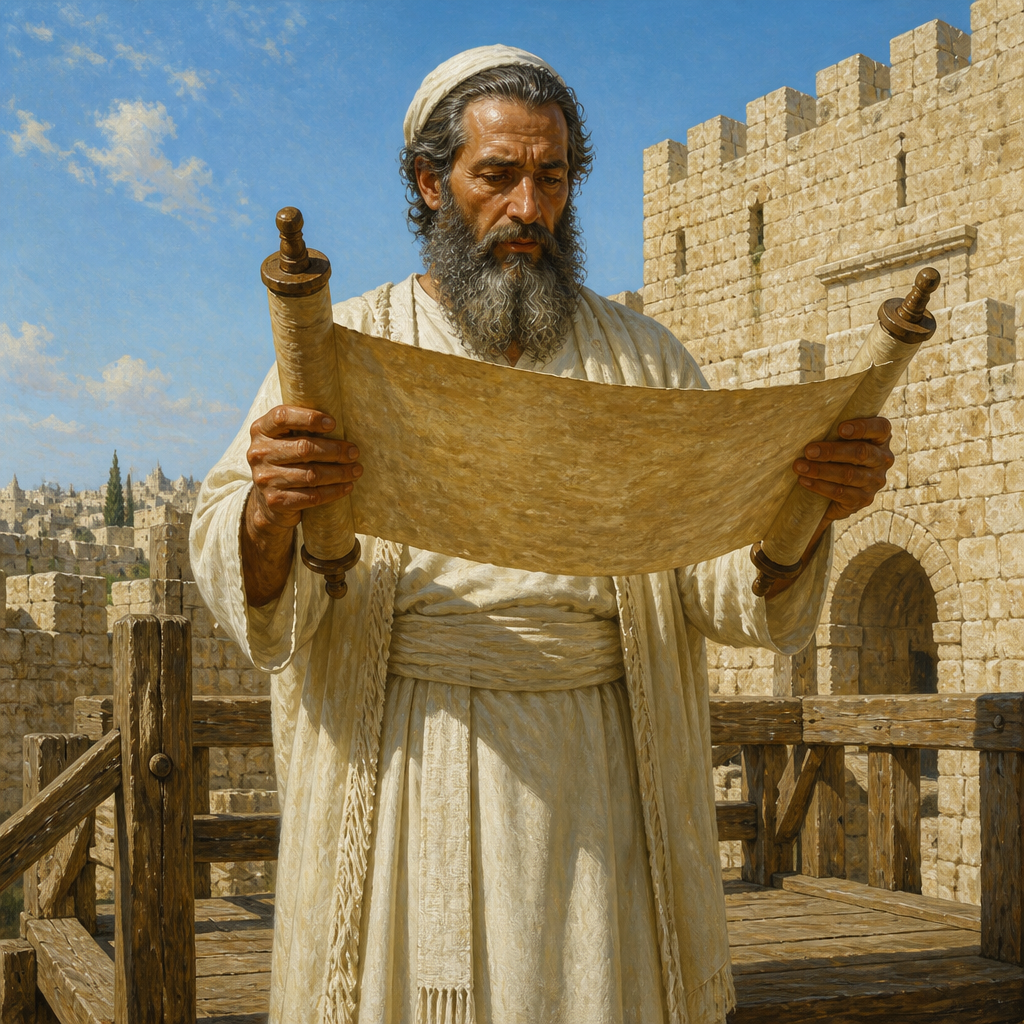
In the book of Nehemiah, Ezra reappears during the governorship of Nehemiah to lead a massive liturgical event. At the Water Gate in Jerusalem, the people gathered and requested that Ezra bring out the "Book of the Law of Moses." Ezra stood on a high wooden platform and read the Law aloud from daybreak until noon. As he opened the book, the entire assembly stood in reverence. This event was not merely a reading but an educational seminar; as Ezra read, the Levites helped the people understand the words, leading to a national spiritual awakening and the celebration of the Feast of Tabernacles.
Relationship to Other Biblical Figures
Ezra worked in close coordination with Nehemiah, the governor of Judah. While Nehemiah focused on the physical security of the city through the rebuilding of the walls, Ezra focused on the spiritual infrastructure of the people. Together, they are recorded as presiding over the dedication of the wall and the instruction of the assembly. He also shared a familial connection to the high priestly line through Jehozadak of the collateral priestly line, linking him to the earlier restoration efforts of Jeshua and Zerubbabel.
Spiritual Significance
Ezra represents the ideal of the "scholar-priest." His legacy is defined by Ezra 7:10: "For Ezra had set his heart to study the Law of the LORD, to practice it, and to teach its statutes and ordinances in Israel." This three-fold commitment—learning, living, and leading—made him the architect of the religious life of the Second Temple period. By centralizing the written Law in the life of the community, he ensured that the identity of Israel was no longer tied solely to a political kingdom, but to a shared commitment to the Word of God. His emphasis on confession, fasting, and the meticulous following of scripture established the foundations for what would become the synagogue system and the scribal tradition.
Ezra is the primary protagonist of the restoration of the Mosaic Law following the Babylonian Exile. He is credited with re-establishing the spiritual foundations of the Jewish community in Jerusalem, moving the focus of national life toward the study and application of the Torah. His reforms regarding intermarriage and his leadership in the public reading of the Law (Nehemiah 8) are seen as the definitive moments when the returned exiles recommitted to their covenant with God.
Theologically, Ezra demonstrates the power of the 'hand of God' working through secular authorities. The decrees of Artaxerxes highlight a biblical theme where God moves the hearts of foreign kings to fulfill His purposes for Israel. Ezra's personal holiness and his role as a scribe also mark a transition in Israel's history where the written word of God becomes the central authority for the faith, bridging the gap between the era of the prophets and the era of the Second Temple.
Frequently Asked Questions
What was Ezra's profession?
Ezra was both a priest, descending from the line of Aaron, and a 'skilled scribe' of the Law of Moses, likely serving as an official in the Persian administration regarding Jewish religious affairs.
Who was the king that sent Ezra to Jerusalem?
Ezra was sent to Jerusalem by King Artaxerxes of Persia, who gave him significant authority and financial resources to restore the Temple worship and appoint judges.
Why did Ezra mourn when he arrived in Jerusalem?
He mourned because he discovered that many of the returned exiles, including the leaders and priests, had married women from the surrounding pagan nations, violating the Law of Moses.
How did Ezra help the people understand the Law?
During the public reading at the Water Gate, Ezra stood on a wooden platform and read the Law while Levites circulated among the people to explain the meaning, ensuring everyone understood what was being read.
What is the 'Hand of the LORD' in Ezra's story?
The phrase 'the hand of the LORD his God was upon him' appears multiple times in Ezra 7 to explain how Ezra found favor with the king and successfully navigated the dangerous journey to Jerusalem.
Family & Relationships
Parents
 Seraiah the Chief PriestFatherEzra 7:1Stated
 Ezra the ScribeThis page
Connected Figures
Family
Father · Ezra 7:1
Seraiah was the final high priest of Solomon’s Temple in Jerusalem before its destruction by the Babylonians and the father of Ezra the Scribe.
Divided MonarchyFirst: 2 Kings 25:185 versesHigh PriestLevi
Categories
Mentions by Book
- Ezra13
- Nehemiah9
Scripture References
All 22 indexed verses, in canonical order, from the Berean Standard Bible.
Ezra · 13
- Ezra 7:1
Many years later, during the reign of Artaxerxes king of Persia, Ezra son of Seraiah, the son of Azariah, the son of Hilkiah,
- Ezra 7:6
this Ezra came up from Babylon. He was a scribe skilled in the Law of Moses, which the LORD, the God of Israel, had given. The king had granted Ezra all his requests, for the hand of the LORD his God was upon him.
- Ezra 7:10
For Ezra had set his heart to study the Law of the LORD, to practice it, and to teach its statutes and ordinances in Israel.
- Ezra 7:11
This is the text of the letter King Artaxerxes had given to Ezra the priest and scribe, an expert in the commandments and statutes of the LORD to Israel:
- Ezra 7:12
Artaxerxes, king of kings. To Ezra the priest, the scribe of the Law of the God of heaven: Greetings.
- Ezra 7:21
I, King Artaxerxes, decree to all the treasurers west of the Euphrates: Whatever Ezra the priest, the scribe of the Law of the God of heaven, may require of you, it must be provided promptly,
- Ezra 7:25
And you, Ezra, according to the wisdom of your God, which you possess, are to appoint magistrates and judges to judge all the people west of the Euphrates—all who know the laws of your God. And you are to teach these laws to anyone who does not know them.
- Ezra 10:1
While Ezra prayed and made this confession, weeping and falling facedown before the house of God, a very large assembly of Israelites—men, women, and children—gathered around him, and the people wept bitterly as well.
- Ezra 10:2
Then Shecaniah son of Jehiel, an Elamite, said to Ezra: “We have been unfaithful to our God by marrying foreign women from the people of the land, yet in spite of this, there is hope for Israel.
- Ezra 10:5
So Ezra got up and made the leading priests, Levites, and all Israel take an oath to do what had been said. And they took the oath.
- Ezra 10:6
Then Ezra withdrew from before the house of God and walked to the chamber of Jehohanan son of Eliashib. And while he stayed there, he ate no food and drank no water, because he was mourning over the unfaithfulness of the exiles.
- Ezra 10:10
Then Ezra the priest stood up and said to them, “You have been unfaithful by marrying foreign women, adding to the guilt of Israel.
- Ezra 10:16
So the exiles did as proposed. Ezra the priest selected men who were family heads, each of them identified by name, to represent their families. On the first day of the tenth month they launched the investigation,
Nehemiah · 9
- Nehemiah 8:1
At that time all the people gathered together in the square before the Water Gate, and they asked Ezra the scribe to bring out the Book of the Law of Moses, which the LORD had commanded for Israel.
- Nehemiah 8:2
On the first day of the seventh month, Ezra the priest brought the Law before the assembly of men and women and all who could listen and understand.
- Nehemiah 8:4
Ezra the scribe stood on a high wooden platform built for this occasion. At his right side stood Mattithiah, Shema, Anaiah, Uriah, Hilkiah, and Maaseiah, and at his left were Pedaiah, Mishael, Malchijah, Hashum, Hash-baddanah, Zechariah, and Meshullam.
- Nehemiah 8:5
Ezra opened the book in full view of all the people, since he was standing above them all, and as he opened it, all the people stood up.
- Nehemiah 8:6
Then Ezra blessed the LORD, the great God, and with their hands uplifted, all the people said, “Amen, Amen!” Then they bowed down and worshiped the LORD with their faces to the ground.
- Nehemiah 8:9
Nehemiah the governor, Ezra the priest and scribe, and the Levites who were instructing the people said to all of them, “This day is holy to the LORD your God. Do not mourn or weep.” For all the people were weeping as they heard the words of the Law.
- Nehemiah 8:13
On the second day of the month, the heads of all the families, along with the priests and Levites, gathered around Ezra the scribe to study the words of the Law.
- Nehemiah 12:26
They served in the days of Joiakim son of Jeshua, the son of Jozadak, and in the days of Nehemiah the governor and Ezra the priest and scribe.
- Nehemiah 12:36
and his associates—Shemaiah, Azarel, Milalai, Gilalai, Maai, Nethanel, Judah, and Hanani—with the musical instruments prescribed by David the man of God. Ezra the scribe led the procession.
Others Named Ezra the Scribe
Compare all 2 bearers →Ezra, Priest of the First ReturnNehemiah 12:1
A prominent priest who returned to Jerusalem from Babylonian exile alongside Zerubbabel and Jeshua during the late 6th century BC.