Elkanah, Warrior of the Divided Monarchy
A Korahite warrior and skilled archer who joined David’s forces at Ziklag during the transition of the Israelite monarchy.
Elkanah was a member of the Korahite clan who distinguished himself as a specialized warrior during the turbulent years of the late 11th century BC. He is specifically identified in the biblical record as one of the 'mighty men' who defected from the traditional loyalties of the northern tribes to support David while he was an outlaw at Ziklag. This period, characterized by the shift from the house of Saul to the house of David, laid the groundwork for the eventually Divided Monarchy by highlighting the diverse tribal allegiances within Israel.
Elkanah was part of a select group of ambidextrous warriors. These men were renowned for their tactical versatility, capable of using both the right and left hands to sling stones or shoot arrows. His inclusion in the list of David’s initial supporters underscores his status as a professional soldier and a man of significant influence within his own tribal division.
Background and Family
The biblical record identifies Elkanah as a 'Korahite.' Historically, the Korahites were a branch of the Levite tribe, descended from Korah, the grandson of Kohath. While the Korahites are frequently associated with temple service and music in later biblical history, the Elkanah mentioned in 1 Chronicles 12:6 is uniquely situated in a military context. The text does not provide the names of his parents or his specific genealogical line, but lists him alongside four brothers-in-arms: Isshiah, Azarel, Joezer, and Jashobeam. Together, these men represented a faction of Korahites who possessed exceptional military prowess.
Major Life Events
Elkanah’s primary contribution to the biblical narrative occurs during David’s exile. While David was residing in Ziklag to escape the pursuit of King Saul, Elkanah was among the 'valiant warriors' who came to his aid. This was a high-risk political and military move; by joining David, Elkanah was effectively declaring his allegiance to a new royal house before the old one had fully passed away.
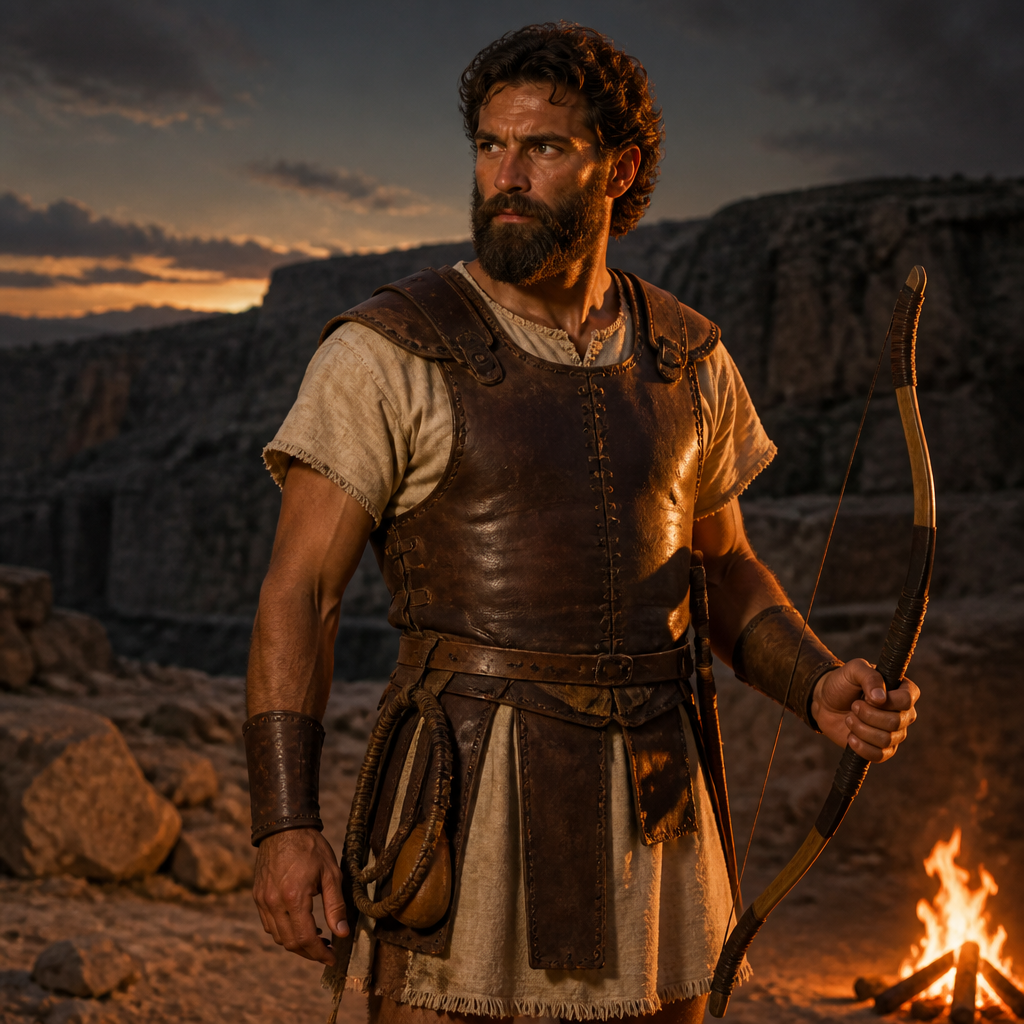
Elkanah and his companions are described as being 'equipped with bows' and having the rare ability to use both hands with equal proficiency. This skill made Elkanah a formidable asset in the guerilla warfare that defined David’s time in the wilderness. His arrival at Ziklag helped swell the ranks of David’s army, which the Chronicler describes as eventually becoming 'a great army, like the army of God.'
Relationship to Other Biblical Figures
Elkanah is mentioned specifically in relation to Jashobeam, Joezer, Azarel, and Isshiah. These men acted as a cohesive unit of Korahites. His relationship to David was one of a mercenary and loyalist; he was one of the foundational figures who recognized David’s divine appointment as king. Unlike many who waited for David to be crowned in Hebron, Elkanah’s loyalty was established when David’s fortunes were at their lowest, marking him as a trusted member of David’s inner military circle.
Spiritual Significance
Though his appearance in the text is brief, Elkanah’s spiritual significance lies in the concept of 'alignment.' As a Korahite, he belonged to a clan with a complex spiritual history. By choosing to support David, Elkanah demonstrated a discernment of God’s will for the future of Israel. In the context of the Chronicler’s history, Elkanah serves as an example of the 'helpers in the war'—those who provided the physical and tactical support necessary for the establishment of the Davidic covenant and the eventual unification (and subsequent division) of the kingdom.
Spiritual Significance
Elkanah represents the transition of tribal loyalty from the house of Saul to the house of David. His presence in the biblical text serves to validate David's legitimacy as king, showing that even members of the priestly tribes (the Korahites) were willing to take up arms to support his rise.
Furthermore, Elkanah illustrates the diversity of skills within the early Israelite military. As an ambidextrous archer and slinger, he highlights the specialized tactical training present in the era. His inclusion in the Chronicles record preserves the memory of those who risked their status to follow the Lord's anointed leader during a time of national instability.
Frequently Asked Questions
What tribe did this Elkanah belong to?
He is identified as a Korahite. While Korahites are traditionally associated with the tribe of Levi, in this context, he is functioning as a warrior for David.
What was Elkanah’s special skill in battle?
According to 1 Chronicles 12, Elkanah was ambidextrous, capable of using both his right and left hands to shoot arrows and sling stones.
Where did Elkanah join David?
He joined David at Ziklag, while David was still an outlaw hiding from King Saul.
Who were Elkanah’s companions?
He is listed alongside Isshiah, Azarel, Joezer, and Jashobeam.
Connected Figures
Categories
Mentions by Book
- 1 Chronicles1
Others Named Elkanah
Elkanah, Official of the Divided Monarchy2 Chronicles 28:7
High-ranking official in the court of King Ahaz of Judah, designated as 'second to the king' before his death during the Syro-Ephraimite War.
Elkanah, Father of Samuel1 Samuel 1:1
A devout Levite of the United Monarchy era, known as the husband of Hannah and the father of the prophet Samuel.
Elkanah, Son of KorahExodus 6:24
A Levite during the era of the Exodus and son of Korah who served as a progenitor of the Korahite clans.
Elkanah, Ancestor of Heman1 Chronicles 6:26
A Levite of the United Monarchy period who appears in the Kohathite genealogical records as the son of Ahimoth and father of Zuph.
Elkanah, Levite of the Exile and Return1 Chronicles 9:16
A Levite whose descendants returned from the Babylonian Exile to inhabit the rural villages surrounding Jerusalem.
Elkanah, Guardian of the Ark1 Chronicles 15:23
A man appointed as a gatekeeper and guardian for the Ark of the Covenant during the Divided Monarchy.
Elkanah, Son of Shaul1 Chronicles 6:25
A Levite of the Divided Monarchy period who served in the lineage of the Kohathites as the son of Shaul and father of Amasai.