Rahab
Who was Rahab in the Bible?
A resident of Jericho who aided Israelite spies and became an ancestor of King David and Jesus Christ.
Rahab is a significant figure in the Old Testament, primarily known for her pivotal role during the Israelite conquest of Canaan. Residing in the city of Jericho, she is identified in the biblical text as a prostitute whose house was situated within or against the city wall. Her story is one of transformation, moving from a position of social marginalization to becoming an integral part of the nation of Israel and the messianic lineage.
Historically situated during the transition from the wilderness wanderings to the settlement of the Promised Land, Rahab represents one of the earliest examples of a non-Israelite coming to faith in Yahweh. Her actions in concealing the spies sent by Joshua and her subsequent protection during the fall of Jericho are cited throughout the New Testament as exemplars of faith and justification through works. Her inclusion in the genealogy of Jesus Christ further cements her status as a foundational figure in biblical history.
Background and Family
Rahab resided in Jericho during the late 15th or early 14th century BC, a period coinciding with the end of the Israelite Exodus and the beginning of the conquest of Canaan. The biblical narrative in Joshua 2:1 identifies her as a prostitute (zonah). While her specific ethnicity or tribal origins are not explicitly detailed, she was a Canaanite by nationality. Her household was substantial, including her father, mother, brothers, and other relatives who were all residing with or near her at the time of the Israelite arrival.
Following the destruction of Jericho, Rahab and her family were assimilated into the community of Israel. According to the genealogical records in Matthew 1:5, Rahab entered into a union with Salmon. This marriage produced a son named Boaz, who would later become a central figure in the Book of Ruth. Through this lineage, Rahab is established as the great-great-grandmother of King David, placing her directly in the ancestral line of the Messiah.
Major Life Events
The most significant event in Rahab’s life occurred when Joshua, the leader of the Israelites, sent two spies to inspect the city of Jericho. Rahab received these men into her home, providing them with shelter and intelligence. When the King of Jericho received word of the spies' presence and demanded their surrender, Rahab engaged in a calculated act of deception. She hid the Israelites under stalks of flax on her roof and informed the king’s messengers that the men had already departed the city before the gates closed at dark (Joshua 2:3-6).
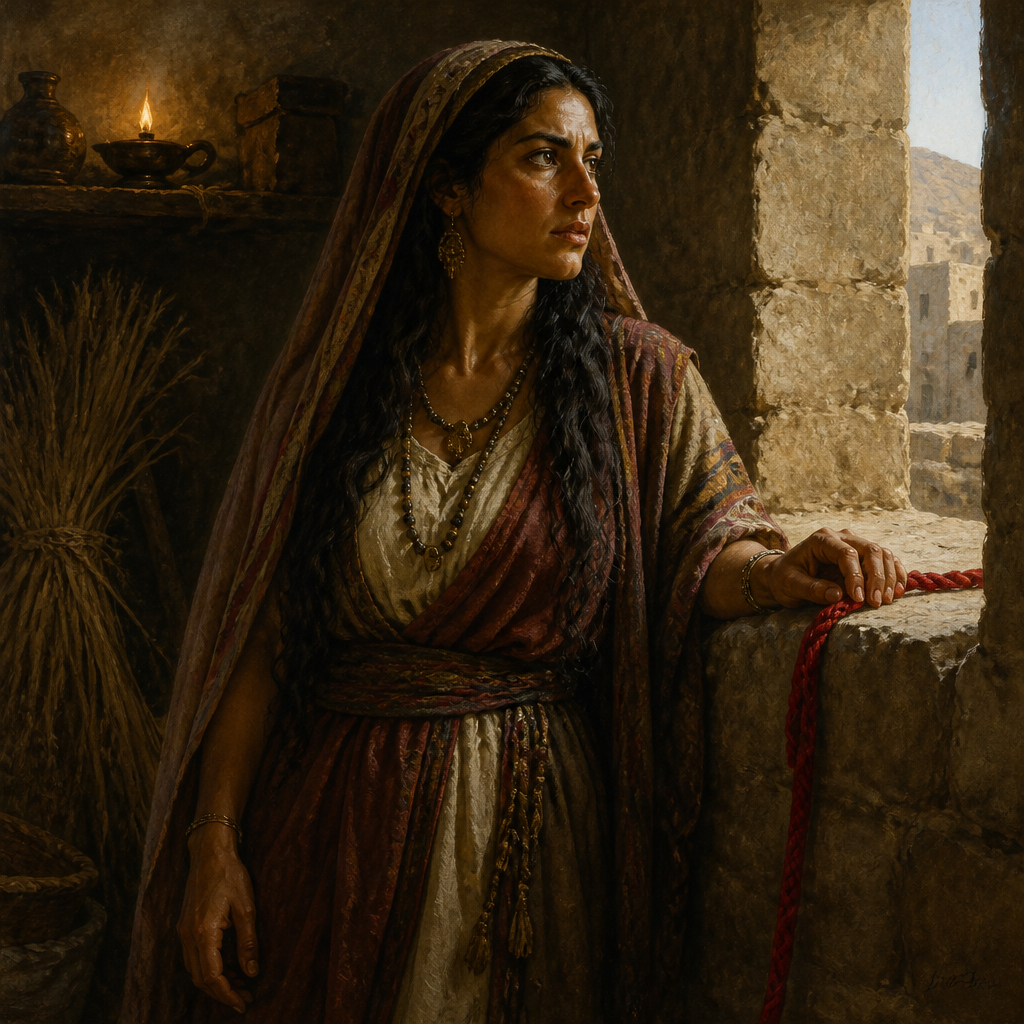
Before the spies departed, Rahab confessed her belief in the power of the Israelite God, noting that the inhabitants of Jericho were terrified because they had heard how Yahweh dried up the Red Sea and defeated the Amorite kings. She struck a covenant with the spies: because she had shown them kindness, they promised to spare her and her entire household during the coming invasion. The sign of this agreement was a scarlet cord tied in her window (Joshua 2:18-21).
During the fall of Jericho, as the walls collapsed following the Israelite procession, Rahab’s house—and all within it—remained secure. Joshua specifically commanded the two spies to retrieve Rahab and her kindred. They were initially settled outside the camp of Israel but were soon fully integrated into the nation. The author of Joshua notes that she "lived among the Israelites to this day" (Joshua 6:25), indicating her permanent status change from a Canaanite outsider to a member of the covenant community.
Relationship to Other Biblical Figures
Rahab’s primary interactions within the narrative are with the two unnamed spies sent by Joshua. Her role as a protector of these messengers establishes her as a collaborator with Joshua’s military campaign. In the broader biblical framework, her most vital relationships are familial. As the partner of Salmon, she becomes a matriarchal figure within the tribe of Judah. Her son, Boaz, reflects her legacy of kindness and hospitality in his own dealings with Ruth, another foreign woman who would join the Israelite lineage. Rahab’s inclusion in the New Testament genealogies links her directly to the most prominent figures of the faith, including King David and Jesus of Nazareth.
Spiritual Significance
In biblical theology, Rahab is frequently presented as a model of faith and active righteousness. The author of Hebrews includes her in the "Hall of Faith," emphasizing that her survival was a result of her belief and peaceful welcome of the spies (Hebrews 11:31). This suggests that her actions were not merely political pragmatism but were rooted in a genuine recognition of God's sovereignty.
Similarly, the Epistle of James uses Rahab to illustrate the necessity of works as evidence of faith. James 2:25 argues that she was justified by her actions, highlighting the practical application of her belief through the risky act of harboring the spies. Rahab’s story serves as a powerful testament to the inclusivity of the biblical narrative, demonstrating that divine grace and participation in the redemptive plan are not limited by a person’s past or ethnic background.
Rahab holds a unique position in scripture as a Gentile woman of questionable social standing who becomes a pillar of faith. Her story underscores the theme that God’s providence extends beyond the borders of Israel, incorporating those who acknowledge His authority. Her confession of faith in Joshua 2:11—"for the LORD your God is God in heaven above and on the earth below"—is one of the most comprehensive statements of monotheistic belief in the early Old Testament.
Theologically, Rahab serves as a bridge between the Law and Grace. While she lived during the period of the conquest, her inclusion in the lineage of Christ (Matthew 1:5) demonstrates that the Messianic line was not kept ethnically "pure" in a secular sense, but was instead built through individuals of diverse backgrounds who exhibited extraordinary faith. Her scarlet cord has also been traditionally interpreted in Christian typology as a symbol of the blood of Christ, providing protection and salvation to those behind the mark.
Frequently Asked Questions
Was Rahab actually a prostitute?
Yes, the Hebrew term 'zonah' and the Greek 'porne' used in both the Old and New Testaments consistently refer to a prostitute. While some tradition suggests she was merely an innkeeper, the biblical text specifically uses terms associated with prostitution.
How did Rahab survive the fall of Jericho's walls?
Rahab's house was built into the city wall. During the miraculous collapse of Jericho, her specific section of the wall remained intact, as promised by the spies, allowing her and her family to be rescued by the Israelite soldiers.
Who was Rahab's husband?
According to the genealogy in Matthew 1:5, Rahab was the partner of Salmon, a man from the tribe of Judah.
What happened to Rahab after the battle of Jericho?
She and her family were brought into the Israelite camp. She eventually married Salmon and lived the remainder of her life as a member of the tribe of Judah.
Why is Rahab mentioned in the New Testament?
She is mentioned as a hero of faith in Hebrews 11, an example of righteous works in James 2, and as a direct ancestor of Jesus in Matthew 1.
Family & Relationships
Connected Figures
Family

Husband · Matthew 1:5
A prominent member of the tribe of Judah and a crucial link in the Davidic and Messianic genealogies, noted for being the father of Boaz.
Conquest and JudgesFirst: Ruth 4:209 versesPatriarchJudah

Son · Matthew 1:5
A prominent landowner from Bethlehem and a kinsman-redeemer who married Ruth, becoming a pivotal ancestor in the Davidic line and the genealogy of Jesus Christ.
Conquest and JudgesFirst: Ruth 2:123 versesJudge-era ElderJudah
Categories
Mentions by Book
- Joshua5
- Matthew1
- Hebrews1
- James1
Scripture References
All 8 indexed verses, in canonical order, from the Berean Standard Bible.
Joshua · 5
- Joshua 2:1
Then Joshua son of Nun secretly sent two spies from Shittim, saying, “Go, inspect the land, especially Jericho.” So they went and entered the house of a prostitute named Rahab and stayed there.
- Joshua 2:3
So the king of Jericho sent to Rahab and said, “Bring out the men who came to you and entered your house, for they have come to spy out the whole land.”
- Joshua 6:17
Now the city and everything in it must be devoted to the LORD for destruction. Only Rahab the prostitute and all those with her in her house will live, because she hid the spies we sent.
- Joshua 6:23
So the young spies went in and brought out Rahab, her father and mother and brothers, and all who belonged to her. They brought out her whole family and settled them outside the camp of Israel.
- Joshua 6:25
And Joshua spared Rahab the prostitute, with her father’s household and all who belonged to her, because she hid the men Joshua had sent to spy out Jericho. So she has lived among the Israelites to this day.
Matthew · 1
- Matthew 1:5
Salmon was the father of Boaz by Rahab, Boaz the father of Obed by Ruth, Obed the father of Jesse,
Hebrews · 1
- Hebrews 11:31
By faith the prostitute Rahab, because she welcomed the spies in peace, did not perish with those who were disobedient.
James · 1
- James 2:25
In the same way, was not even Rahab the prostitute justified by her actions when she welcomed the spies and sent them off on another route?