Jeduthun, Chief Musician of David
A Levite of the United Monarchy who served as one of King David's three primary chief musicians and a royal seer.
Jeduthun was a prominent Levite and musician who rose to high office during the United Monarchy under King David. He is recognized in the biblical narrative as one of the three principal directors of music for the Tabernacle and later the Temple, serving alongside Heman and Asaph. His role was not merely artistic; he is specifically described as the 'king’s seer,' indicating a prophetic dimension to his musical service.
Belonging to the Merarite branch of the Tribe of Levi, Jeduthun (also identified in early lists as Ethan) was responsible for organizing the liturgical life of Israel. He led a large family of musicians and gatekeepers, establishing a dynastic tradition of worship that persisted through the reforms of later Judean kings such as Hezekiah and Josiah. His name is also preserved in the titles of several Psalms, underscoring his lasting influence on Hebrew hymnody.
Background and Family
Jeduthun was the son of Kishi (also rendered as Kushaiah) and a descendant of Merari, the son of Levi. In the initial organization of the Levites during the transport of the Ark of the Covenant to Jerusalem, he is referred to as Ethan (1 Chronicles 15:17-19). However, as David’s reign progressed and the musical guilds were formalized, he is consistently identified as Jeduthun.
He was the patriarch of a significant musical family. The biblical record lists several of his sons who served under his direct supervision: Gedaliah, Zeri (also called Izri), Jeshaiah, Shimei, Hashabiah, and Mattithiah (1 Chronicles 25:3). Additionally, the text identifies Obed-edom as a son of Jeduthun who served as a gatekeeper. This large household provided a stable foundation for the Levitical choir, ensuring that the 'service of the house of God' was maintained across generations. Even centuries later, during the reign of King Josiah, the 'Jeduthunites'—including figures like Shemaiah and Uzziel—were still recognized as a distinct and vital group within the Temple hierarchy.
Major Life Events
Jeduthun’s public ministry began during the United Monarchy when King David reorganized the national worship structure. His primary assignment was at the high place in Gibeon, where the Tabernacle of the LORD remained before the completion of the Solomonic Temple. There, he worked with Heman to provide music that accompanied the daily burnt offerings.
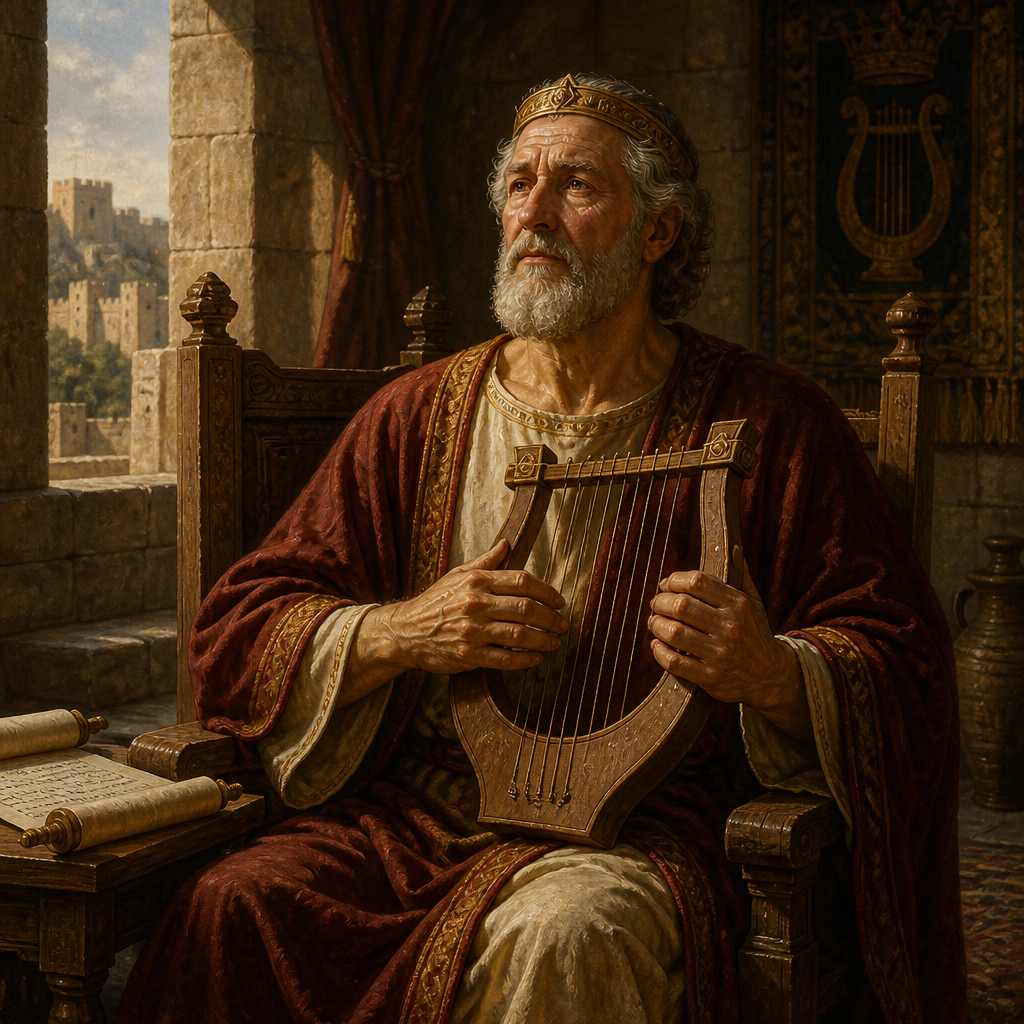
One of the most defining moments of his career was his appointment to the specialized group of musicians who were set apart to 'prophesy with the accompaniment of lyres, harps, and cymbals' (1 Chronicles 25:1). Unlike modern conceptions of performance, Jeduthun’s music was an act of intercession and revelation. He is explicitly described as prophesying 'with the harp, giving thanks and praise to the LORD' (1 Chronicles 25:3). This suggests that his musical compositions were viewed as divinely inspired communications.
During the dedication of the Temple under Solomon, Jeduthun played a central role. He and his fellow musicians stood on the east side of the altar, dressed in fine linen, leading a massive ensemble of 120 priests with trumpets and a full choir. The record indicates that when this group, including Jeduthun, joined together in one voice to praise God, the glory of the LORD filled the Temple in the form of a cloud.
Relationship to Other Biblical Figures
Jeduthun’s life was defined by his professional partnership with Asaph and Heman. Together, these three men represented the three branches of the Levites (Kohath, Gershon, and Merari), ensuring that all of Israel’s priestly tribe was represented in the ministry of song.
He served under the direct authority of King David, who is credited with the original vision for the Levitical choirs. The Chronicler notes that Jeduthun was 'under the direction of the king' (1 Chronicles 25:6). His relationship with the monarchy was not merely one of a subordinate but of a spiritual advisor; he is given the title 'the king’s seer' (2 Chronicles 35:15). This title implies that David and subsequent kings looked to Jeduthun for spiritual insight, possibly through the medium of his inspired music.
Spiritual Significance
Jeduthun represents the biblical integration of art, prophecy, and liturgy. His life demonstrates that music in the biblical tradition was not 'entertainment' but a vehicle for 'giving thanks and praise to the LORD' (1 Chronicles 25:3). The inclusion of his name in the superscriptions of Psalms 39, 62, and 77 suggests that a specific musical style or a guild of singers bore his name, perpetuating his spiritual legacy. These psalms often deal with themes of silent trust in God and the struggle of the soul, perhaps reflecting the meditative and prophetic nature of Jeduthun’s own ministry. His legacy is one of order and devotion, proving that structured, institutional worship can coexist with authentic prophetic experience.
Spiritual Significance
Jeduthun's theological significance lies in the formalization of 'prophetic music.' He was not merely a singer but a 'seer' whose artistic output was considered a form of divine communication. By organizing the Levites into professional guilds, he helped transform Israelite worship from a purely sacrificial system into one characterized by congregational praise and the proclamation of God's 'loving devotion.'
Furthermore, Jeduthun serves as a model of multigenerational faithfulness. The biblical text emphasizes that his sons served 'under the direction of their father,' establishing a precedent for the transmission of spiritual roles within the family. His presence in the records of later kings like Hezekiah and Josiah highlights the endurance of the Davidic worship traditions and the essential role of the Levites in maintaining the spiritual health of the nation.
Frequently Asked Questions
Was Jeduthun also known by another name?
Yes, in the earlier lists of musicians in 1 Chronicles 6 and 15, the Merarite leader serving alongside Heman and Asaph is called 'Ethan son of Kishi.' Scholars generally agree that Ethan and Jeduthun are the same individual, with 'Jeduthun' perhaps being a professional or liturgical name.
What instruments did Jeduthun play?
Jeduthun is specifically associated with the harp (kinnor) and cymbals. He is described as prophesying with the accompaniment of these instruments to give thanks to God.
What does it mean that Jeduthun was a 'seer'?
A 'seer' (Hebrew: chozeh) was a type of prophet. This indicates that Jeduthun received divine visions or insights, and in his case, he likely communicated these through his musical compositions and leadership.
Which Psalms mention Jeduthun?
Jeduthun is mentioned in the titles of Psalms 39, 62, and 77. These titles indicate that the psalms were either dedicated to him, written for his choir to perform, or composed in a musical style he pioneered.
How many sons did Jeduthun have?
The Bible explicitly names six sons who were under his musical direction: Gedaliah, Zeri, Jeshaiah, Shimei, Hashabiah, and Mattithiah. He is also identified as the father of Obed-edom.
Connected Figures
David
King and patron who appointed him
Heman
Associate chief musician
Asaph
Associate chief musician

Obed-edom
Son

Kishi
Father
Categories
Mentions by Book
- 1 Chronicles9
- 2 Chronicles3
- Psalms3
Family & Relationships
Child
Gedaliah, Levite of the United Monarchy
1 Chronicles 6:44
Child
Hashabiah, Levite of the United Monarchy
1 Chronicles 6:44
Child
1 Chronicles 6:44
Child
Mattithiah, Levite of the United Monarchy
1 Chronicles 6:44
Child
1 Chronicles 6:44
Child
Jeshaiah, Levite of the United Monarchy
1 Chronicles 6:44
Child
Shemaiah, Levite of the Jeduthunites
1 Chronicles 6:44
Child
1 Chronicles 6:44
Parent
1 Chronicles 6:44
Others Named Jeduthun
Jeduthun, Ancestor of Post-Exilic Levites1 Chronicles 9:16
A Levite of the tribe of Levi whose descendants returned from the Babylonian Exile to resettle in Jerusalem and the surrounding villages.