Hadadezer
Who was Hadadezer in the Bible?
Hadadezer, son of Rehob, was the powerful Aramean king of Zobah whose defeat by King David established Israelite dominance in the Levant during the 10th century BC.
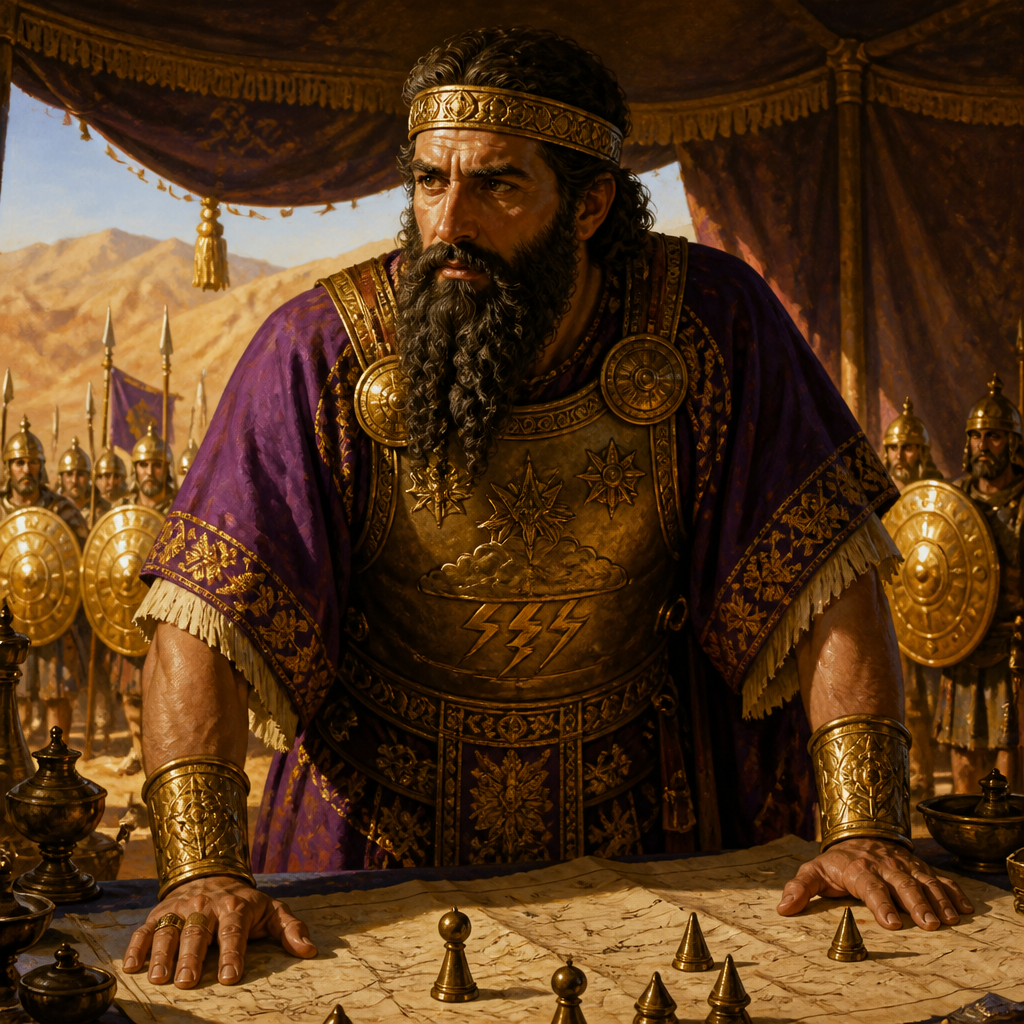
Hadadezer (also written as Hadarezer) was a significant geopolitical rival to King David during the era of the United Monarchy. As the son of Rehob and the king of Zobah, a powerful Aramean state located north of Damascus, Hadadezer commanded a vast regional empire. His influence extended beyond his own borders, encompassing various vassal kings and reaching as far as the Euphrates River. His reign represents the peak of Aramean power before the consolidation of the Davidic empire.
His interactions with Israel are documented primarily through a series of military conflicts. These battles were not merely border skirmishes but were large-scale engagements involving thousands of troops, chariotry, and significant resources.
Background and Family
Hadadezer was the son of Rehob and ruled as the king of Zobah. While the biblical text does not provide a detailed genealogy beyond his father, his title and the scope of his influence suggest he belonged to a well-established dynasty of Aramean rulers. Zobah, his primary seat of power, was situated in the region of modern-day Syria, likely between the Anti-Lebanon Mountains and the Euphrates River.
The name Hadadezer (meaning "Hadad is help") invokes the Aramean storm god Hadad, signifying his cultural and religious identity as a leader of the Aramean people. At the height of his power, he was not merely a local chieftain but a regional hegemon who commanded the loyalty of several other kings (2 Samuel 10:19). His primary rival in the region was King Toi (or Tou) of Hamath, indicating that Hadadezer was an expansionist ruler seeking to consolidate control over the northern Levant.
Major Life Events
The biblical record of Hadadezer is defined by his military campaigns against King David. The first major encounter occurred when Hadadezer marched toward the Euphrates River to restore or establish his dominion. David intercepted his forces, defeating them and capturing a significant number of horsemen and infantry. In a strategic move to neutralize the Aramean military advantage, David hamstrung all but a hundred of the chariot horses (2 Samuel 8:3–4; 1 Chronicles 18:3–4).
When the Arameans of Damascus arrived to support Hadadezer, David defeated them as well, killing twenty-two thousand men. This victory resulted in the total subjugation of the region; David placed garrisons in Damascus, and the Arameans became subjects who paid tribute to Israel. During these conquests, David seized the gold shields belonging to Hadadezer’s officers and took a massive quantity of bronze from the cities of Betah and Berothai (also called Tibhath and Cun).
A second major conflict arose during David’s war with the Ammonites. The Ammonites hired Aramean mercenaries, including troops from Zobah, to fight Israel. After Joab and Abishai defeated these combined forces, Hadadezer attempted a final counter-offensive. He summoned additional Aramean forces from beyond the Euphrates, placing them under the command of Shobach (or Shophach). David personally led the Israelite army across the Jordan to Helam, where he decisively crushed Hadadezer’s coalition. Following this defeat, the kings who were previously subject to Hadadezer switched their allegiance to David, and the Arameans were no longer willing to aid the Ammonites.
Relationship to Other Biblical Figures
Hadadezer’s most prominent relationship was his adversarial one with King David. Their conflict defined the northern borders of Israel for a generation. The wealth stripped from Hadadezer’s kingdom had long-lasting effects; 1 Chronicles 18:8 notes that the bronze Solomon later used to cast the "bronze Sea," the pillars, and other temple articles was taken from Hadadezer’s cities.
He also had a notable relationship with Rezon son of Eliada. According to 1 Kings 11:23, Rezon was a former servant of Hadadezer who fled from his master. After Hadadezer’s defeat by David, Rezon gathered a band of men and eventually seized Damascus, becoming a persistent adversary to David’s successor, Solomon. Additionally, Hadadezer’s ongoing war with King Toi of Hamath made Toi a natural ally for David; when Hadadezer was defeated, Toi sent his son Joram (or Hadoram) to David with gifts of gold and silver to express his gratitude.
Spiritual Significance
In the biblical narrative, Hadadezer serves as a symbol of the worldly powers that opposed the establishment of God's chosen king. His defeat is recorded not merely as a military feat, but as evidence of divine favor toward David: "The LORD gave David victory wherever he went" (2 Samuel 8:6).
The transition of wealth from Hadadezer to the treasury of Israel is also significant. The gold and bronze taken from his kingdom were dedicated to the LORD and eventually used in the construction of the Temple in Jerusalem. This follows a recurring biblical theme where the riches of the nations are brought into the service of God's sanctuary. Hadadezer’s rise and fall illustrate the biblical principle that the boundaries of nations and the success of kings are ultimately under sovereign control, serving to fulfill the promises made regarding the extent of the land of Israel.
Hadadezer is significant as the primary external threat during David's expansion of the United Monarchy. His defeat fulfilled the geographical promises regarding the extent of Israel's borders reaching toward the Euphrates. The vast resources captured from his cities—specifically the gold and bronze—provided the material foundation for Solomon's Temple, illustrating how the spoils of pagan nations were repurposed for the worship of the LORD. Furthermore, the dissolution of Hadadezer's power structure led to the rise of Rezon of Damascus, setting the stage for the centuries of conflict between Israel and Syria (Aram-Damascus) documented throughout the books of Kings.
Frequently Asked Questions
Who was Hadadezer's father?
Hadadezer was the son of Rehob, as identified in 2 Samuel 8:3.
What kingdom did Hadadezer rule?
He was the king of Zobah, a powerful Aramean territory in the region of modern-day Syria.
How did Hadadezer's wealth contribute to the Temple of Solomon?
King David captured large amounts of bronze from Hadadezer's cities (Tibhath and Cun), which Solomon later used to craft the bronze Sea, the pillars, and various articles for the Temple.
Who was the commander of Hadadezer's army?
The commander of his army was Shobach (referred to as Shophach in 1 Chronicles), who was killed in battle against David's forces.
Why did King Toi of Hamath send gifts to David after Hadadezer's defeat?
King Toi had been at war with Hadadezer; he sent his son with gifts to thank David for defeating their common enemy.
Family & Relationships
Parents
 Rehob, Father of HadadezerFather2 Samuel 8:3Stated
 HadadezerThis page
Connected Figures
Family
Father · 2 Samuel 8:3
Rehob was the father of Hadadezer, the king of Zobah, during the period of the United Monarchy in the 10th century BC.
United MonarchyFirst: 2 Samuel 8:32 versesPatriarch of the royal house of Zobah
Categories
Mentions by Book
- 2 Samuel9
- 1 Kings1
- 1 Chronicles8
Scripture References
All 18 indexed verses, in canonical order, from the Berean Standard Bible.
2 Samuel · 9
- 2 Samuel 8:3
David also defeated Hadadezer son of Rehob, king of Zobah, who had marched out to restore his dominion along the Euphrates River.
- 2 Samuel 8:5
When the Arameans of Damascus came to help King Hadadezer of Zobah, David struck down twenty-two thousand of their men.
- 2 Samuel 8:7
And David took the gold shields that belonged to the officers of Hadadezer and brought them to Jerusalem.
- 2 Samuel 8:8
And from Betah and Berothai, cities of Hadadezer, King David took a large amount of bronze.
- 2 Samuel 8:9
When King Toi of Hamath heard that David had defeated the entire army of Hadadezer,
- 2 Samuel 8:10
he sent his son Joram to greet King David and bless him for fighting and defeating Hadadezer, who had been at war with Toi. Joram brought with him articles of silver and gold and bronze,
- 2 Samuel 8:12
from Edom and Moab, from the Ammonites and Philistines and Amalekites, and from the spoil of Hadadezer son of Rehob, king of Zobah.
- 2 Samuel 10:16
Hadadezer sent messengers to bring more Arameans from beyond the Euphrates, and they came to Helam with Shobach the commander of Hadadezer’s army leading them.
- 2 Samuel 10:19
When all the kings who were subject to Hadadezer saw that they had been defeated by Israel, they made peace with Israel and became subject to them. So the Arameans were afraid to help the Ammonites anymore.
1 Kings · 1
- 1 Kings 11:23
And God raised up against Solomon another adversary, Rezon the son of Eliada, who had fled from his master, Hadadezer king of Zobah,
1 Chronicles · 8
- 1 Chronicles 18:3
As far as Hamath, David also defeated King Hadadezer of Zobah, who had marched out to establish his dominion along the Euphrates River.
- 1 Chronicles 18:5
When the Arameans of Damascus came to help King Hadadezer of Zobah, David struck down twenty-two thousand of their men.
- 1 Chronicles 18:7
And David took the gold shields that belonged to the officers of Hadadezer and brought them to Jerusalem.
- 1 Chronicles 18:8
And from Tibhath and Cun, cities of Hadadezer, David took a large amount of bronze, with which Solomon made the bronze Sea, the pillars, and various bronze articles.
- 1 Chronicles 18:9
When King Tou of Hamath heard that David had defeated the entire army of Hadadezer king of Zobah,
- 1 Chronicles 18:10
he sent his son Hadoram to greet King David and bless him for fighting and defeating Hadadezer, who had been at war with Tou. Hadoram brought all kinds of articles of gold and silver and bronze,
- 1 Chronicles 19:16
When the Arameans saw that they had been defeated by Israel, they sent messengers to bring more Arameans from beyond the Euphrates, with Shophach the commander of Hadadezer’s army leading them.
- 1 Chronicles 19:19
When Hadadezer’s subjects saw that they had been defeated by Israel, they made peace with David and became subject to him. So the Arameans were unwilling to help the Ammonites anymore.