Achish
Who was Achish in the Bible?
The Philistine King of Gath who provided refuge to David during his flight from King Saul and later employed him as a mercenary.
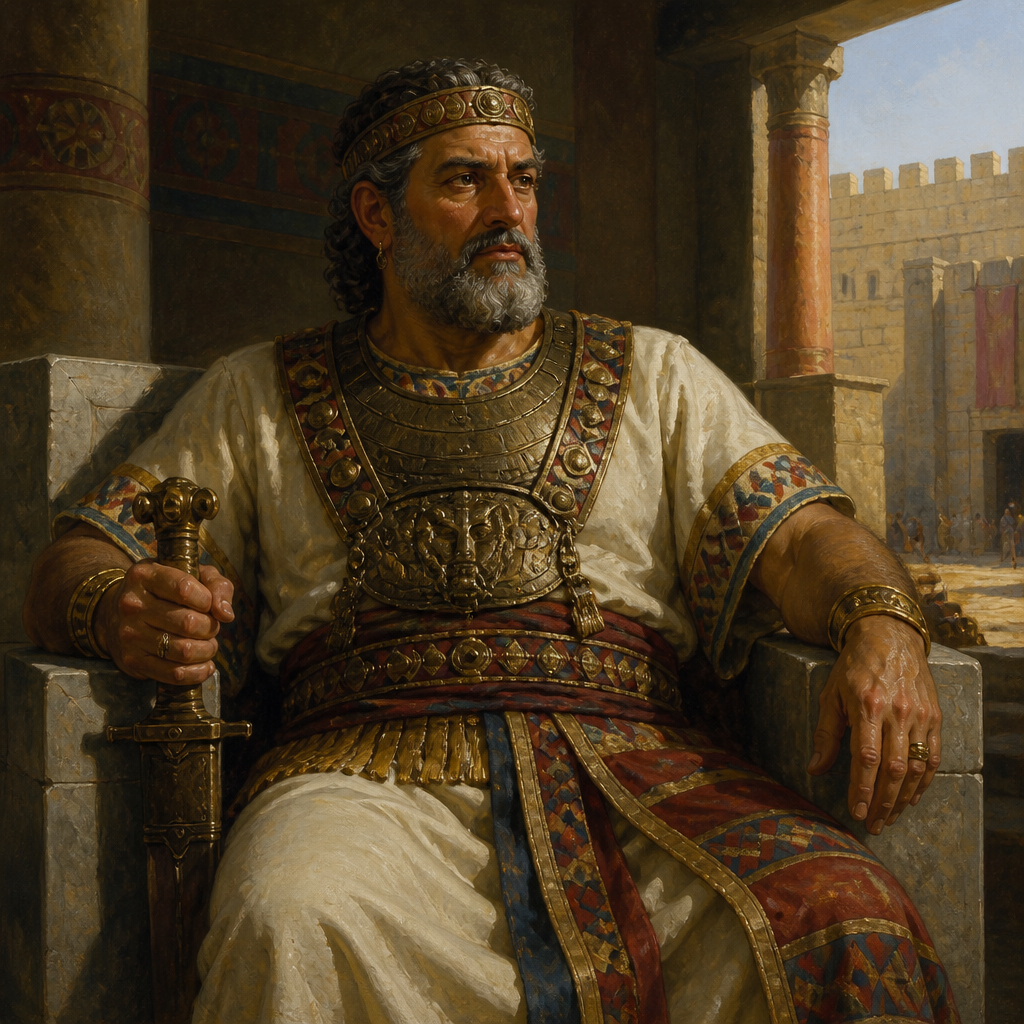
Achish was a Philistine monarch who ruled the city-state of Gath during the United Monarchy period of Israel's history. He is primarily known for his complex interactions with David, the future king of Israel, who twice sought asylum in Gath while fleeing the murderous jealousy of King Saul. As the son of Maoch (also referred to as Maacah), Achish represents a pragmatic political figure in the Philistine pentapolis, willing to harbor an enemy of his enemy to further his own strategic interests.
His character is presented as both a shrewd ruler and a somewhat vulnerable leader who was eventually overruled by his own military commanders. Despite being a pagan king of a nation traditionally hostile to Israel, the biblical record highlights his surprising trust in David, even going so far as to describe David as 'an angel of God' in his sight. His reign serves as a crucial backdrop for David’s development and the political maneuvering that preceded the transition of the Israelite throne.
Background and Family
Achish was the King of Gath, one of the five major city-states of the Philistine confederation. The biblical text identifies him as the son of Maoch (1 Samuel 27:2), also spelled Maacah in later accounts (1 Kings 2:39). His reign coincided with the latter years of King Saul’s rule over Israel (c. 1010 BC). Gath was a formidable stronghold and was famously the home of Goliath, the giant whom David had previously slain. This historical context makes the interaction between Achish and David particularly remarkable, as David entered the lion's den of his former victim’s hometown to seek safety.
Major Life Events
The First Encounter at Gath
David first fled to Achish in 1 Samuel 21:10, hoping to find anonymity. However, the servants of Achish immediately recognized David as the celebrated warrior of Israel, quoting the song: "Saul has slain his thousands, and David his tens of thousands." Fearing for his life, David feigned insanity, scratching on the doors of the gate and letting saliva run down his beard. Achish, displaying a sense of weary pragmatism, dismissed David, asking his servants, "Do I lack madmen that you have brought this fellow to play the madman in my presence?" (1 Samuel 21:15). This strategic deception allowed David to escape to the Cave of Adullam.
The Second Asylum and Ziklag
Years later, David returned to Achish with 600 men and their families. This time, Achish welcomed him as a valuable defecting mercenary. David requested a place in the country to live, and Achish granted him the town of Ziklag. For sixteen months, David lived under the protection of Achish, conducting raids against groups like the Geshurites and Amalekites. However, David deceived Achish, claiming he was raiding the southern territories of Judah. Achish grew to trust David implicitly, believing David had become a "stench" to his own people and would therefore remain a loyal servant forever (1 Samuel 27:12).
The Battle of Mount Gilboa
When the Philistines gathered for a massive campaign against Israel, Achish intended for David and his men to serve as his personal bodyguard. This created a crisis for David, who faced the prospect of fighting his own people. However, the other Philistine lords mistrusted David, fearing he would turn on them in the heat of battle to regain favor with Saul. Despite Achish’s vocal defense of David’s integrity—stating he had found no fault in him—the other commanders forced Achish to send David back to Ziklag. Consequently, David was not present at the battle where Saul and Jonathan were killed.
Later Mention in the Reign of Solomon
Achish is mentioned one final time in 1 Kings 2:39–40, set during the early reign of King Solomon (c. 970 BC). Shimei, a man who had cursed David, left Jerusalem to retrieve two runaway slaves who had fled to Achish in Gath. This indicates that Achish’s reign was exceptionally long or that "Achish" may have functioned as a dynastic title among the kings of Gath, though the text specifically identifies him again as the son of Maacah.
Relationship to Other Biblical Figures
Achish’s primary relationship was with David. Their bond was one of mutual utility; David gained protection, while Achish gained a legendary warrior. The text notes that Achish viewed David with extreme favor, using the phrase "as pleasing in my sight as an angel of God" (1 Samuel 29:9). His relationship with his own Philistine Commanders was one of tension, as they did not share his confidence in David’s loyalty. Lastly, his interaction with Shimei serves as a narrative device to show the reach of Gath’s influence and the eventual downfall of Shimei.
Spiritual Significance
In the broader biblical narrative, Achish represents God’s providence in providing an unlikely sanctuary for His anointed. While Saul, the king of God's people, hunted David, Achish, a pagan enemy, shielded him. Psalm 34, which according to its superscription was composed when David changed his behavior before Abimelech (likely a title for Achish, or a reference to the same event), emphasizes God's protection of the righteous. Achish’s misplaced trust also serves as a study in human perception versus reality; he saw a loyal servant, while David remained devoted to the cause of Israel.
Achish is significant as the pagan protector who unintentionally facilitated the survival of the Davidic line during its most vulnerable period. His willingness to grant David the city of Ziklag provided David with a strategic base and the resources necessary to support his growing army without falling under Saul's reach. This period of exile in the land of the Philistines was essential for David's growth as a leader and military commander.
Furthermore, the narrative of Achish highlights the sovereignty of God over international politics. By causing the Philistine lords to reject David, God prevented David from being forced into a fratricidal war against Israel, which would have compromised his future legitimacy as king. Achish serves as a literary foil to Saul; where the Israelite king is paranoid and hostile, the Philistine king is trusting and hospitable, underscoring the irony of David's situation.
Frequently Asked Questions
Why did Achish let David go the first time he visited Gath?
David feigned insanity, acting like a madman by scratching at the gates and drooling. Achish was unimpressed and annoyed, asking his servants if they thought he didn't have enough madmen already, which allowed David to escape.
Did Achish know David was lying about his raids?
No. The Bible states that Achish trusted David completely, believing David was raiding Judah when he was actually attacking enemies of Israel. Achish believed David had ruined his reputation with Israel forever.
What city did Achish give to David?
Achish gave David the town of Ziklag, which remained in the possession of the kings of Judah from that time forward.
Why was Achish mentioned in the book of 1 Kings?
He is mentioned because two of Shimei's slaves fled to him in Gath. Shimei broke his house arrest to retrieve them, leading to his execution by King Solomon.
Is Achish the same person as Abimelech in Psalm 34?
Many scholars believe 'Abimelech' was a royal title (like Pharaoh) used for Philistine kings, and that Psalm 34 refers to the specific incident where David feigned madness before Achish.
Family & Relationships
Parents
 MaochFather1 Samuel 27:2Stated
 AchishThis page
Connected Figures
Family
Father · 1 Samuel 27:2
Maoch was a Philistine royal father whose son, Achish, served as the King of Gath during the reigns of King Saul and King Solomon.
United MonarchyFirst: 1 Samuel 27:22 versesPatriarch of the royal house of Gath
Categories
Mentions by Book
- 1 Samuel18
- 1 Kings2
Scripture References
All 20 indexed verses, in canonical order, from the Berean Standard Bible.
1 Samuel · 18
- 1 Samuel 21:10
That day David fled from Saul and went to Achish king of Gath.
- 1 Samuel 21:11
But the servants of Achish said to him, “Is this not David, the king of the land? Did they not sing about him in their dances, saying: ‘Saul has slain his thousands, and David his tens of thousands’?”
- 1 Samuel 21:12
Now David took these words to heart and was very much afraid of Achish the king of Gath.
- 1 Samuel 21:14
Then Achish said to his servants, “Look, you can see that the man is insane! Why have you brought him to me?
- 1 Samuel 27:2
So David set out with his six hundred men and went to Achish son of Maoch, the king of Gath.
- 1 Samuel 27:3
David and his men settled in Gath with Achish. Each man had his family with him, and David had his two wives: Ahinoam of Jezreel and Abigail of Carmel, the widow of Nabal.
- 1 Samuel 27:5
Then David said to Achish, “If I have found favor in your eyes, let me be assigned a place in one of the outlying towns, so I can live there. For why should your servant live in the royal city with you?”
- 1 Samuel 27:6
That day Achish gave him Ziklag, and to this day it still belongs to the kings of Judah.
- 1 Samuel 27:9
Whenever David attacked a territory, he did not leave a man or woman alive, but he took the flocks and herds, the donkeys, camels, and clothing. Then he would return to Achish,
- 1 Samuel 27:10
who would ask him, “What have you raided today?” And David would reply, “The Negev of Judah,” or “The Negev of Jerahmeel,” or “The Negev of the Kenites.”
- 1 Samuel 27:12
So Achish trusted David, thinking, “Since he has made himself an utter stench to his people Israel, he will be my servant forever.”
- 1 Samuel 28:1
Now in those days the Philistines gathered their forces for warfare against Israel. So Achish said to David, “You must understand that you and your men are to go out to battle with me.”
- 1 Samuel 28:2Partial
David replied, “Then you will come to know what your servant can do.” “Very well,” said Achish. “I will make you my bodyguard for life.”
- 1 Samuel 29:2
As the Philistine leaders marched out with their units of hundreds and thousands, David and his men marched behind them with Achish.
- 1 Samuel 29:3
Then the commanders of the Philistines asked, “What about these Hebrews?” Achish replied, “Is this not David, the servant of King Saul of Israel? He has been with me all these days, even years, and from the day he defected until today I have found no fault in him.”
- 1 Samuel 29:6
So Achish summoned David and told him, “As surely as the LORD lives, you have been upright, and it seems right in my sight that you should march in and out with me in the army, because I have found no fault in you from the day you came to me until this day. But you are not good in the sight of the leaders.
- 1 Samuel 29:8
“But what have I done?” David replied. “What have you found against your servant, from the day I came to you until today, to keep me from going along to fight against the enemies of my lord the king?”
- 1 Samuel 29:9
Achish replied, “I know that you are as pleasing in my sight as an angel of God. But the commanders of the Philistines have said, ‘He must not go into battle with us.’
1 Kings · 2
- 1 Kings 2:39
After three years, however, two of Shimei’s slaves ran away to Achish son of Maacah, king of Gath. And Shimei was told, “Look, your slaves are in Gath.”
- 1 Kings 2:40
So Shimei saddled his donkey and set out to Achish at Gath in search of his slaves, and he brought them back from Gath.