Maaseiah son of Baruch
Who was Maaseiah son of Baruch in the Bible?
A descendant of Judah through the line of Shelah who resettled in Jerusalem during the Post-Exilic Period under the leadership of Nehemiah.
This is one of 20 people named Maaseiah in the Bible. See all 20 →
Maaseiah son of Baruch was a prominent resident of Jerusalem during the time of the Exile and Return. Following the Babylonian captivity, the city of Jerusalem faced a significant population crisis. While the walls had been rebuilt under the leadership of Nehemiah, the interior of the city remained sparsely populated. Maaseiah was among those identified by the biblical record as a member of the tribe of Judah who took up residence in the holy city to ensure its security and functional restoration.
He is specifically identified as a descendant of Shelah, the son of Judah. This genealogical link is significant, as it connects the post-exilic community directly back to the patriarchal promises and the tribal inheritance of Judah. His presence in Jerusalem during this era represents the continuity of the Jewish people and the fulfillment of the prophetic hope for a return to Zion after the seventy-year exile in Babylon.
Background and Family
The primary record of Maaseiah son of Baruch is found in the eleventh chapter of the Book of Nehemiah. This chapter serves as a census and registry of the leaders and families who dwelled in Jerusalem after the completion of the city walls. Maaseiah’s lineage is provided in considerable detail, tracing his ancestry back through several generations: he was the son of Baruch, the son of Col-hozeh, the son of Hazaiah, the son of Adaiah, the son of Joiarib, the son of Zechariah.
Crucially, the text identifies Maaseiah as a "descendant of Shelah" (Nehemiah 11:5). Shelah was the third son of the patriarch Judah and his Canaanite wife, the daughter of Shua (Genesis 38:5). By the time of the return from Babylon, the Shelanites represented one of the major branches of the tribe of Judah. The preservation of this specific genealogy suggests that Maaseiah belonged to a family that had carefully maintained its records throughout the duration of the Babylonian Exile (c. 605–536 BC).
Major Life Events
Maaseiah lived during the Post-Exilic Period, specifically during the governorship of Nehemiah (roughly mid-5th century BC). The most significant event associated with his life was the repopulation of Jerusalem. After the walls were dedicated, Nehemiah observed that "the city was large and spacious, but there were few people in it" (Nehemiah 7:4). To remedy this, the leaders of the people dwelt in Jerusalem, while the rest of the people cast lots to bring one out of every ten to live in the holy city.
Maaseiah is listed among the "provincial leaders who settled in Jerusalem" (Nehemiah 11:3). Whether he was one of the volunteers who "willingly offered themselves to live in Jerusalem" (Nehemiah 11:2) or was designated by his status as a leader, his relocation was a matter of civic and religious duty. By residing in the city, Maaseiah contributed to the physical defense and the economic revitalization of the Judean capital.
Relationship to Other Biblical Figures
Maaseiah’s identity is defined largely by his relationship to his father, Baruch, and his notable ancestor, Shelah. In the context of Nehemiah 11, he is grouped with other men of Judah, such as Athaiah son of Uzziah. These men worked in tandem with the Levites, priests, and Benjamites to re-establish the social fabric of Israel. While he is not credited with specific speeches or miraculous deeds, his inclusion in the registry places him alongside the faithful remnant that sought to rebuild the Davidic center of worship.
Spiritual Significance
The spiritual significance of Maaseiah son of Baruch lies in his representation of the "remnant." The prophets, such as Isaiah and Jeremiah, had long spoken of a day when God would gather His people back to their land. Maaseiah is a literal embodiment of that gathered remnant. His life serves as a testament to the survival of the tribe of Judah despite the catastrophic judgment of the exile.
Furthermore, as a descendant of Shelah, Maaseiah represents the endurance of the lesser-known branches of the tribe of Judah. His presence in the holy city reaffirmed that God’s covenant with Judah extended to all the families within the tribe. In the biblical narrative, his name—which means "Work of Yahweh"—underscores the theological theme that the return to Jerusalem was not merely a human political movement, but a divine work of restoration.
Maaseiah son of Baruch is significant as a representative of the tribal continuity of Judah during the Post-Exilic Period. His inclusion in Nehemiah's registry highlights the importance of the Shelanite line and the commitment of specific families to resettle the desolate city of Jerusalem. His presence underscores the historical reality of the return from Babylon and the meticulous efforts to document the ancestry of those reclaiming the Promised Land.
Theologically, Maaseiah exemplifies the 'faithful remnant' who prioritized the restoration of the holy city over the comforts of rural settlements. His life is a localized fulfillment of the prophetic promises that Jerusalem would once again be inhabited by the people of God, serving as a link between the ancient patriarchal past and the restored community of the Second Temple era.
Frequently Asked Questions
Which tribe did Maaseiah son of Baruch belong to?
Maaseiah son of Baruch belonged to the tribe of Judah, specifically descending from the line of Shelah.
When did Maaseiah son of Baruch live?
He lived during the Post-Exilic Period (5th century BC), during the time when Nehemiah was the governor of Judah.
What is the meaning of the name Maaseiah?
The name Maaseiah (Ma'aseyah) means 'Work of Yahweh' or 'Deed of the Lord' in Hebrew.
Why is Maaseiah mentioned in the Book of Nehemiah?
He is mentioned in Nehemiah 11:5 as one of the leaders of the tribe of Judah who settled in Jerusalem to help repopulate the city after the walls were rebuilt.
Who was Maaseiah's father?
His father was Baruch, the son of Col-hozeh.
Family & Relationships
Parents
 Baruch, Ancestor of MaaseiahFatherNehemiah 11:5Stated
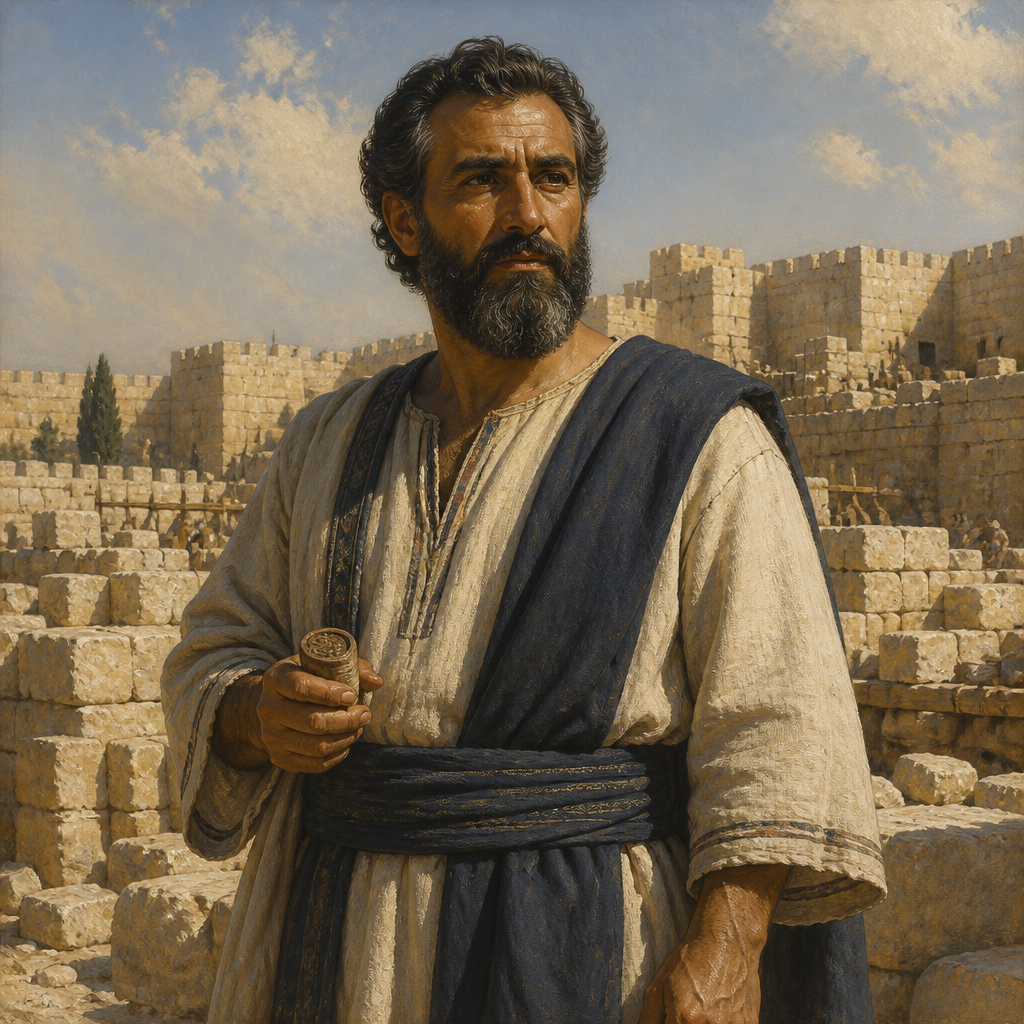 Maaseiah son of BaruchThis page
Connected Figures
Family
Father · Nehemiah 11:5
A descendant of Judah through Shelah, whose lineage helped repopulate Jerusalem following the Babylonian exile.
Categories
Mentions by Book
- Nehemiah1
Scripture References
All 1 indexed verse, in canonical order, from the Berean Standard Bible.
Nehemiah · 1
- Nehemiah 11:5
and Maaseiah son of Baruch, the son of Col-hozeh, the son of Hazaiah, the son of Adaiah, the son of Joiarib, the son of Zechariah, a descendant of Shelah.
Others Named Maaseiah son of Baruch
Compare all 20 bearers →Maaseiah son of Shallum, DoorkeeperJeremiah 35:4
A Levite official and doorkeeper of the Temple in Jerusalem during the final years of the Divided Monarchy.
Maaseiah the Officer2 Chronicles 26:11
A high-ranking military officer in the Judean army who served under King Uzziah during the 8th century BC.
Maaseiah, Father of AzariahNehemiah 3:23
Maaseiah, son of Ananiah, was a resident of Jerusalem during the Post-Exilic Period whose son Azariah participated in the rebuilding of the city walls under Nehemiah.
Maaseiah, Priest of the Exile and ReturnEzra 10:18
A descendant of the priest Jeshua who was among the post-exilic leadership identified for having married a foreign woman during the return to Jerusalem.
Maaseiah of the Harim ClanEzra 10:21
A member of the descendants of Harim who returned to Jerusalem after the Babylonian exile and was identified for having married a foreign woman.
Maaseiah, Father of Zedekiah the False ProphetJeremiah 29:21
The father of the false prophet Zedekiah who was executed by Nebuchadnezzar during the Divided Monarchy.
Maaseiah, Father of ZephaniahJeremiah 21:1
A man of the Divided Monarchy whose son, Zephaniah the priest, served as a prominent diplomatic and religious official during the final years of the Kingdom of Judah.
Maaseiah, Signer of the CovenantNehemiah 10:25
A leader of the Jewish people during the Post-Exilic Period who signed the sacred covenant to follow God's law under Nehemiah.
Maaseiah of the Pashhur ClanEzra 10:22
A member of the descendants of Pashhur who returned to Jerusalem after the Babylonian exile and was cited in the book of Ezra.
Maaseiah of the Pahath-moab ClanEzra 10:30
A member of the descendants of Pahath-moab who returned from the Babylonian exile and committed to separating from his foreign wife during Ezra's reforms.
Maaseiah the TrumpeterNehemiah 12:41
A priest and musician who played the trumpet during the formal dedication of the rebuilt walls of Jerusalem under the leadership of Nehemiah.
Maaseiah, Musician of the United Monarchy1 Chronicles 15:18
A Levite musician appointed to play the harp during the transport of the Ark of the Covenant to Jerusalem during the United Monarchy era.
Maaseiah the InstructorNehemiah 8:7
A Levite during the Post-Exilic Period who assisted Ezra the scribe by instructing the people of Jerusalem in the understanding of the Mosaic Law.
Maaseiah, Ancestor of SalluNehemiah 11:7
A Benjamite ancestor whose descendant, Sallu, was among the first to resettle Jerusalem following the return from the Babylonian exile.
Maaseiah, Singer of the Wall DedicationNehemiah 12:42
A participant in the joyous musical procession during the dedication of Jerusalem's rebuilt walls under Nehemiah.
Maaseiah son of Adaiah2 Chronicles 23:1
A military commander of hundreds who entered into a sacred covenant with the high priest Jehoiada to overthrow Queen Athaliah and restore the Davidic line to the throne.
Maaseiah, son of King Ahaz2 Chronicles 28:7
A Judean prince and son of King Ahaz who was killed by Zichri of Ephraim during the Syro-Ephraimite War.
Maaseiah, Governor of Jerusalem2 Chronicles 34:8
A high-ranking Judean official who served as the governor of Jerusalem during the reign and religious reforms of King Josiah.
Maaseiah, Attendant to EzraNehemiah 8:4
A prominent leader or official who stood to the right of Ezra the scribe during the historic public reading of the Law in Jerusalem.