Darius the Mede
Who was Darius the Mede in the Bible?
The Median ruler who assumed control of the Babylonian kingdom after the fall of Belshazzar and famously spared Daniel from the lions' den.
This is one of 3 people named Darius in the Bible. See all 3 →
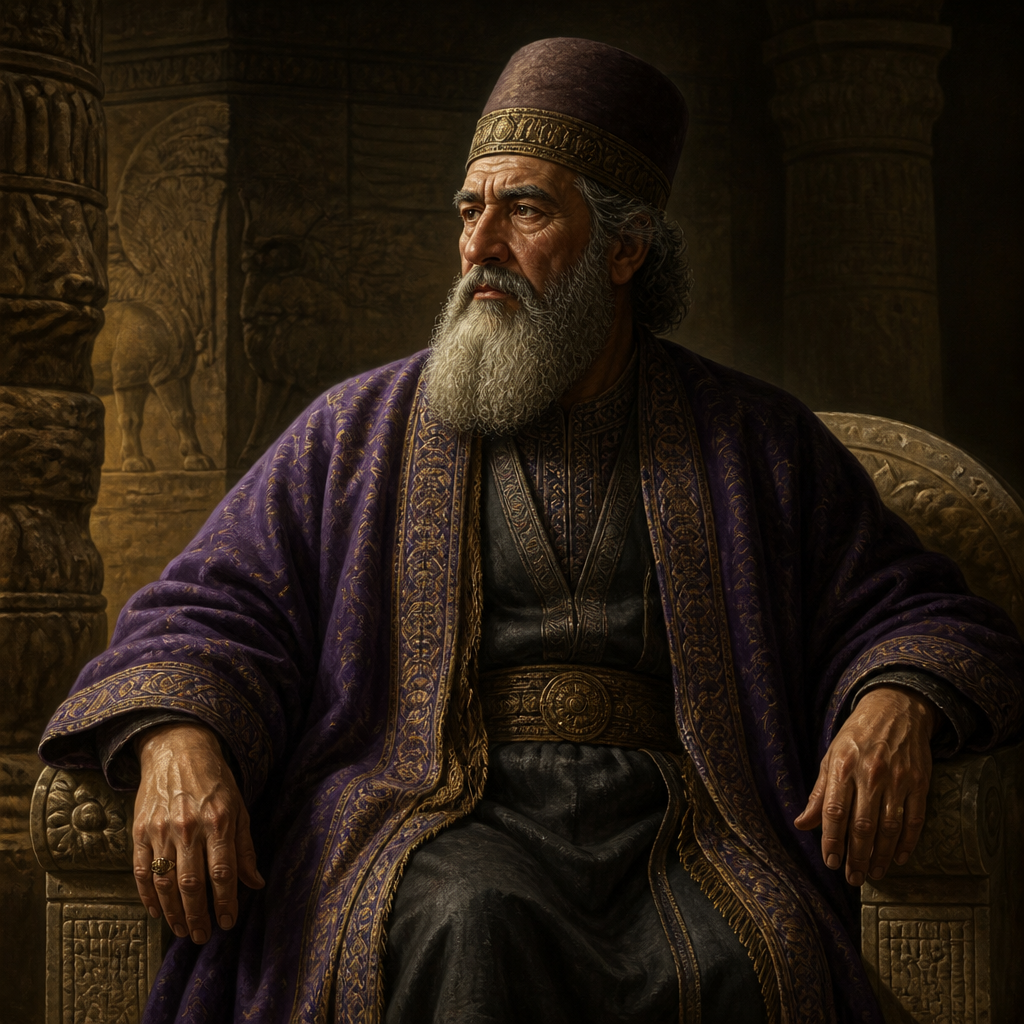
Darius the Mede is a significant administrative figure appearing in the Book of Daniel, positioned as the immediate successor to the Chaldean (Babylonian) rule. Described as the son of Ahasuerus and a Mede by descent, he ascended to the throne of the Chaldeans at the age of sixty-two. His reign is characterized by a high degree of bureaucratic organization and a complex relationship with the prophet Daniel, whom he respected and elevated within his government.
Historically, Darius the Mede represents the transition from Babylonian to Medo-Persian hegemony. While he held absolute monarchical power, including the authority to issue irrevocable decrees, he is portrayed as a ruler bound by the legal traditions of the Medes and Persians. His presence in the biblical narrative serves to bridge the gap between the exile under Nebuchadnezzar and the eventual restoration under Cyrus.
Background and Family
According to the biblical record in the Book of Daniel, Darius the Mede was the son of Ahasuerus (Xerxes) and a descendant of the Medes. The text identifies him as being approximately sixty-two years old when he "received the kingdom" (Daniel 5:31). Within the royal lineage established in the text, he is identified as a sibling of Artaxerxes and the child of Vashti, placing him within the high-ranking nobility of the Persian-Median power structure.
Darius assumed authority over the kingdom of the Chaldeans following the death of Belshazzar. His reign is specifically noted as the period during which Daniel received several of his most profound visions and navigated the internal politics of the newly formed administration. Unlike earlier Babylonian kings who ruled through personal whim, Darius operated within a system of constitutional law known as the "law of the Medes and Persians," which could not be altered once a royal decree was signed.
Major Life Events
The most prominent event recorded during the reign of Darius the Mede is the reorganization of the kingdom. To manage the vast territories of the former Babylonian Empire, Darius appointed 120 satraps to rule throughout the land, overseen by three administrators. Daniel was selected as one of these three administrators due to his exceptional qualities. Darius even considered setting Daniel over the entire realm, a move that sparked intense jealousy among the other officials.
This political friction led to the famous incident of the lions' den. Unable to find any actual fault or corruption in Daniel’s conduct, his rivals manipulated Darius into signing an edict that prohibited petitions to any god or man except the king for thirty days, on pain of death. Darius, seemingly unaware of the plot against Daniel, signed the document. When Daniel continued his practice of praying to God three times a day, the king was legally forced to cast him into the den of lions. The text portrays Darius as deeply distressed, spending the night in fasting and refusing entertainment. Upon discovering Daniel’s miraculous survival the following morning, Darius issued a decree commanding all people in his dominion to fear and tremble before the God of Daniel.
Relationship to Other Biblical Figures
Darius held a relationship of deep mutual respect with the prophet Daniel. Despite the disparity in their ages and backgrounds—Darius being the conqueror and Daniel the elderly exile—the king recognized Daniel’s "extraordinary spirit." Daniel 9:1 records that it was during the first year of Darius’s reign that Daniel turned to the scriptures, specifically the prophecies of Jeremiah, to understand the timing of the end of the desolation of Jerusalem.
The biblical account also places Darius in a chronological sequence alongside Cyrus the Persian. Daniel 6:28 notes that Daniel prospered during both the reign of Darius and the reign of Cyrus. This indicates a period of administrative transition where Darius functioned as the ruler over the specific region of the Chaldeans within the broader context of the rising Persian Empire.
Spiritual Significance
Theologically, the account of Darius the Mede demonstrates the sovereignty of God over Gentile rulers. Darius, despite his status as a powerful monarch, found himself powerless to save his friend Daniel from the very laws he had signed. The narrative emphasizes that the King of Heaven is the only one whose decrees are truly eternal.
Darius’s final proclamation in Daniel 6 serves as a powerful witness to the nations. He acknowledges that God is the "living God" who endures forever, and whose kingdom will never be destroyed. His reign marks a turning point for the Jewish exiles, signaling the end of Babylonian oppression and the beginning of a new era of Median and Persian governance that would eventually facilitate the return to Jerusalem.
Darius the Mede serves as a pivotal administrative figure who validates the prophetic integrity of Daniel. His interactions with Daniel demonstrate that even within a pagan imperial structure, God preserves His faithful servants and uses secular rulers to proclaim His glory. His decree at the end of Daniel 6 is one of the most comprehensive acknowledgments of Yahweh's sovereignty by a Gentile king in the Old Testament.
Furthermore, the reign of Darius provides the chronological framework for Daniel’s 'Seventy Weeks' prophecy. It was during Darius's first year that Daniel engaged in the intercessory prayer for the restoration of Israel, highlighting the intersection of human history and divine timing in the plan of redemption.
Frequently Asked Questions
How old was Darius when he became king?
According to Daniel 5:31, Darius the Mede was sixty-two years old when he received the kingdom.
What was the 'law of the Medes and Persians'?
It was a legal principle mentioned during Darius's reign where a decree signed by the king was irrevocable and could not be changed, even by the king himself.
Who was Darius the Mede's father?
The Bible identifies his father as Ahasuerus (also known as Xerxes) in Daniel 9:1.
Did Darius want to kill Daniel?
No. The biblical account in Daniel 6 indicates that Darius was 'deeply distressed' and 'determined to rescue Daniel,' but he was trapped by the legal decree he had signed.
How did Darius react to Daniel's survival in the lions' den?
He was overjoyed and issued a royal proclamation throughout his kingdom commanding that people worship and fear the God of Daniel.
Family & Relationships
Parents
 Xerxes, Father of Darius the MedeFatherDaniel 9:1Stated
 Darius the MedeThis page
Connected Figures
Family
Father · Daniel 9:1
The father of Darius the Mede, named once in Daniel 9:1 and otherwise unrecorded in Scripture.
Exile and ReturnFirst: Daniel 9:11 versesNoble or Royal of the Medes
Categories
Mentions by Book
- Daniel10
Scripture References
All 10 indexed verses, in canonical order, from the Berean Standard Bible.
Daniel · 10
- Daniel 5:31
and Darius the Mede received the kingdom at the age of sixty-two.
- Daniel 6:1
Now it pleased Darius to appoint 120 satraps to rule throughout the kingdom,
- Daniel 6:6
So the administrators and satraps went together to the king and said, “O King Darius, may you live forever!
- Daniel 6:9
Therefore King Darius signed the written decree.
- Daniel 6:25
Then King Darius wrote to the people of every nation and language throughout the land: “May your prosperity abound.
- Daniel 6:26Partial
I hereby decree that in every part of my kingdom, men are to tremble in fear before the God of Daniel: For He is the living God, and He endures forever; His kingdom will never be destroyed, and His dominion will never end.
Cited as a key verse; added so References, Key Verses and Mentions by Book share one index.
- Daniel 6:27Partial
He delivers and rescues; He performs signs and wonders in the heavens and on the earth, for He has rescued Daniel from the power of the lions.”
Cited as a key verse; added so References, Key Verses and Mentions by Book share one index.
- Daniel 6:28
So Daniel prospered during the reign of Darius and the reign of Cyrus the Persian.
- Daniel 9:1
In the first year of Darius son of Xerxes, a Mede by descent, who was made ruler over the kingdom of the Chaldeans—
- Daniel 11:1
“And I, in the first year of Darius the Mede, stood up to strengthen and protect him.
Others Named Darius the Mede
Compare all 3 bearers →Darius the Persian (Nehemiah 12)Nehemiah 12:22
A Persian king mentioned in the Book of Nehemiah whose reign served as a chronological marker for the genealogical records of the Levites and priests.
Darius, King of Persia (Ezra 4–6)Ezra 4:5
The Persian monarch who authorized and funded the completion of the Second Temple in Jerusalem, upholding the original decree of Cyrus the Great.