Xerxes
Who was Xerxes in the Bible?
The powerful Persian king of the post-exilic period who deposed Queen Vashti and eventually chose Esther to be his queen, unknowingly saving the Jewish people from genocide.
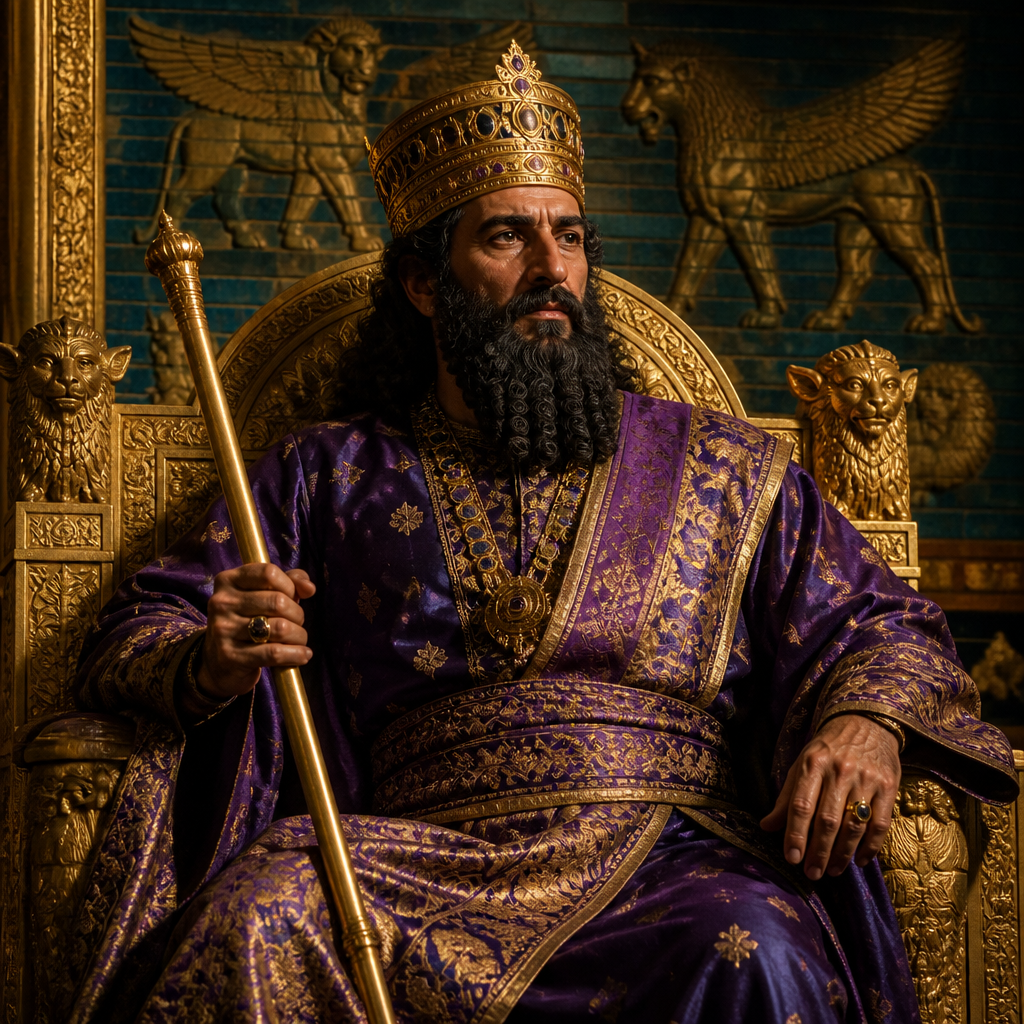
Xerxes was the supreme monarch of the Persian Empire during a critical period of the Jewish diaspora following the Babylonian exile. According to the biblical record, his dominion was vast, spanning from India to Cush (modern-day Ethiopia) and encompassing 127 provinces. He is primarily known for his central role in the Book of Esther, where his royal decrees and shifting favors drive the narrative of the Jewish people's survival in a foreign land.
Characterized by his immense wealth and a volatile temperament, Xerxes is depicted as a ruler whose decisions were often influenced by his advisors. His reign marks a time when the Jewish people, though permitted by previous edicts to return to Jerusalem, remained largely scattered across the Persian provinces. The biblical account focuses on his court in the citadel of Susa, highlighting the intersection of imperial politics and divine providence.
Background and Family
Xerxes was a member of the Persian royalty, identified in the Book of Daniel as the son of Darius and the father of the succeeding Darius (Daniel 9:1). His lineage is further connected to the administrative transition of the empire, as he is recorded as the parent of Artaxerxes. During his reign, he operated from the citadel of Susa, one of the primary royal residences of the Persian monarchs. The biblical text emphasizes the sheer scale of his authority, noting in Esther 1:1 that his empire consisted of 127 provinces. This geographical span indicates a peak of Persian imperial power, encompassing diverse ethnicities and languages.
His immediate household included his first queen, Vashti. The relationship ended abruptly during the third year of his reign following a public act of defiance by the queen. Later, Xerxes took Esther, a Jewish orphan raised by her cousin Mordecai, as his wife and queen. This domestic shift served as the catalyst for the preservation of the Jewish people within his realm.
Major Life Events
The most detailed account of Xerxes’s life occurs in the Book of Esther, beginning with a massive 180-day feast intended to display his royal riches and the splendor of his majesty. On the seventh day of a subsequent week-long banquet, a drunken Xerxes ordered Queen Vashti to appear before his guests to display her beauty. Her refusal led to a royal crisis. On the advice of his counselors, Xerxes issued a decree stripping Vashti of her royal position and calling for a search for a new queen. This search resulted in the selection of Esther in the seventh year of his reign.
His reign was also marked by internal threats. Two of his eunuchs, Bigthan and Teresh, conspired to assassinate him, a plot that was uncovered by Mordecai and recorded in the king’s chronicles. However, the king's most significant administrative error occurred when he elevated Haman the Agagite to high office. Influenced by Haman’s prejudice and a promise of wealth, Xerxes authorized a decree for the systematic annihilation of the Jews throughout his empire, sealed with his own signet ring.
This crisis was only averted when Queen Esther revealed Haman's true intentions during a series of private banquets. Realizing he had been manipulated into authorizing the death of his queen's people, Xerxes ordered the execution of Haman. Because Persian law dictated that a royal decree could not be repealed, Xerxes issued a second edict allowing the Jews to defend themselves, an event now commemorated by the festival of Purim. In the final years of his recorded reign, he imposed tribute throughout his lands and elevated Mordecai to the position of second-in-command.
Relationship to Other Biblical Figures
Xerxes’s primary interactions were with Esther and Mordecai. His relationship with Esther was one of traditional imperial distance bridged by Esther’s courage; she risked her life by approaching him unsummoned. Xerxes showed her favor by extending his golden scepter, a gesture of mercy that allowed her to present her petition.
Mordecai’s relationship with the king evolved from a loyal subject who saved the king's life to a high-ranking official who managed the empire’s affairs. The king’s reliance on advisors is a recurring theme, seen first in his dependence on the seven princes of Persia and Media (Esther 1:14), then Haman, and finally Mordecai. In Ezra 4:6, Xerxes is also noted as a recipient of accusations lodged against the people of Judah and Jerusalem at the beginning of his reign, showing that he was a figure of authority to whom both the Jewish exiles and their enemies appealed.
Spiritual Significance
While Xerxes is not depicted as a follower of the God of Israel, his actions are central to the theological theme of "hidden providence." In the Book of Esther, where the name of God is never explicitly mentioned, Xerxes serves as the instrument through which the Jewish people are preserved. His insomnia (Esther 6:1), which led him to read the chronicles and remember Mordecai’s loyalty, is viewed by scholars as a moment of divine intervention.
The portrayal of Xerxes serves as a study of sovereign power under the influence of both good and evil counsel. His story emphasizes that even the most powerful secular rulers are subject to the ultimate purposes of God. By the end of his biblical narrative, his reign is characterized not by the destruction of the Jews, but by the promotion of peace and the advancement of the Jewish people through the leadership of Mordecai.
Xerxes represents the archetypal Gentile world-ruler during the period of the Jewish dispersion. His significance lies in his role as the legal authority who both threatened and eventually protected the Jewish people. His decrees provide the legal and historical framework for the Feast of Purim, one of the few Jewish festivals established in the post-exilic period outside of the Torah. Through his narrative, the Bible illustrates how the fate of God's people often rests in the hands of secular powers, yet those powers are subtly directed by divine will.
Furthermore, Xerxes’s reign highlights the precarious nature of life in the diaspora. The contrast between his initial susceptibility to Haman’s genocidal plot and his eventual empowerment of Mordecai underscores the biblical theme that 'the king's heart is a waterway in the hand of the Lord.' His inclusion in the records of Ezra and Daniel anchors the poetic narrative of Esther within the broader historical and prophetic context of the Return from Exile.
Frequently Asked Questions
Who was Ahasuerus's first wife?
His first wife was Queen Vashti, who was deposed after she refused the king's command to appear before his guests at a royal banquet.
How many provinces did Ahasuerus rule?
According to Esther 1:1, Ahasuerus ruled over 127 provinces, stretching from India to Cush (modern-day Ethiopia).
Why did Ahasuerus sign a decree to destroy the Jews?
He was persuaded by his advisor Haman, who claimed that a certain people (the Jews) were lawless and detrimental to the king's interests, and who offered a large sum of money to the royal treasury.
How did Ahasuerus discover Mordecai's loyalty?
During a night when he could not sleep, the king ordered the book of the chronicles to be read to him, which contained the record of Mordecai exposing an assassination plot against the king.
Who succeeded Ahasuerus in his administrative lineage?
The biblical text in Daniel 9:1 and other administrative notes identify him as the parent of figures such as Artaxerxes and Darius.
Family & Relationships
 EstherWifeEsther 2:17Stated
 VashtiWifeEsther 1:9
Inferred
Esther 1 calls her Queen Vashti and names the king as the one whose command she refused (1:9–12, 1:17), without using the word wife.Evidence: Esther 1:9
 XerxesThis page
Extended family
 Abihail, Father of EstherFather-in-lawEsther 2:15
Inferred
No verse names Abihail and Xerxes together; the son-in-law link is carried from the surrounding genealogy and is not stated in Scripture.Evidence: Esther 2:15
Connected Figures
Family
Wife · Esther 2:17
The Jewish orphan who became Queen of Persia and risked her life to intercede with King Xerxes to save her people from total annihilation.
Exile and ReturnFirst: Esther 2:747 versesQueen of PersiaBenjamin
Wife · Esther 1:9
The first queen of King Xerxes who was deposed after refusing to appear before the king and his guests during a royal banquet in Susa.
Exile and ReturnFirst: Esther 1:910 versesQueen of Persia
Father-in-law · Esther 2:15
Abihail was a Benjamite of the Persian exile and the biological father of Hadassah, who became Queen Esther.
Categories
Mentions by Book
- Ezra1
- Esther30
Scripture References
All 31 indexed verses, in canonical order, from the Berean Standard Bible.
- Ezra 4:6
At the beginning of the reign of Xerxes, an accusation was lodged against the people of Judah and Jerusalem.
- Esther 1:1Partial
This is what happened in the days of Xerxes, who reigned over 127 provinces from India to Cush.
- Esther 1:2
In those days King Xerxes sat on his royal throne in the citadel of Susa.
- Esther 1:9
Queen Vashti also gave a banquet for the women in the royal palace of King Xerxes.
- Esther 1:10
On the seventh day, when the king’s heart was merry with wine, he ordered the seven eunuchs who served him—Mehuman, Biztha, Harbona, Bigtha, Abagtha, Zethar, and Carkas—
- Esther 1:15
“According to law,” he asked, “what should be done with Queen Vashti, since she refused to obey the command of King Xerxes delivered by the eunuchs?”
- Esther 1:16
And in the presence of the king and his princes, Memucan replied, “Queen Vashti has wronged not only the king, but all the princes and the peoples in all the provinces of King Xerxes.
- Esther 1:17
For the conduct of the queen will become known to all women, causing them to despise their husbands and say, ‘King Xerxes ordered Queen Vashti to be brought before him, but she did not come.’
- Esther 1:19
So if it pleases the king, let him issue a royal decree, and let it be recorded in the laws of Persia and Media so that it cannot be repealed, that Vashti shall never again enter the presence of King Xerxes, and that her royal position shall be given to a woman better than she.
- Esther 2:1
Some time later, when the anger of King Xerxes had subsided, he remembered Vashti and what she had done, and what had been decreed against her.
- Esther 2:12
In the twelve months before her turn to go to King Xerxes, the harem regulation required each young woman to receive beauty treatments with oil of myrrh for six months, and then with perfumes and cosmetics for another six months.
- Esther 2:15Partial
Now Esther was the daughter of Abihail, the uncle from whom Mordecai had adopted her as his own daughter. And when it was her turn to go to the king, she did not ask for anything except what Hegai, the king’s trusted official in charge of the harem, had advised. And Esther found favor in the eyes of everyone who saw her.
Cited as evidence on a family card; added so References, Key Verses and Mentions by Book share one index.
- Esther 2:16
She was taken to King Xerxes in the royal palace in the tenth month, the month of Tebeth, in the seventh year of his reign.
- Esther 2:17Partial
And the king loved Esther more than all the other women, and she found grace and favor in his sight more than all of the other virgins. So he placed the royal crown upon her head and made her queen in place of Vashti.
Cited as a key verse; added so References, Key Verses and Mentions by Book share one index.
- Esther 2:21
In those days, while Mordecai was sitting at the king’s gate, Bigthan and Teresh, two of the king’s eunuchs who guarded the entrance, grew angry and conspired to assassinate King Xerxes.
- Esther 3:1
After these events, King Xerxes honored Haman son of Hammedatha, the Agagite, elevating him to a position above all the princes who were with him.
- Esther 3:6
And when he learned the identity of Mordecai’s people, he scorned the notion of laying hands on Mordecai alone. Instead, he sought to destroy all of Mordecai’s people, the Jews, throughout the kingdom of Xerxes.
- Esther 3:7
In the twelfth year of King Xerxes, in the first month, the month of Nisan, the Pur (that is, the lot) was cast before Haman to determine a day and month. And the lot fell on the twelfth month, the month of Adar.
- Esther 3:8
Then Haman informed King Xerxes, “There is a certain people scattered and dispersed among the peoples of every province of your kingdom. Their laws are different from everyone else’s, and they do not obey the king’s laws. So it is not in the king’s best interest to tolerate them.
- Esther 3:12
On the thirteenth day of the first month, the royal scribes were summoned and the order was written exactly as Haman commanded the royal satraps, the governors of each province, and the officials of each people, in the script of each province and the language of every people. It was written in the name of King Xerxes and sealed with the royal signet ring.
- Esther 6:2
And there it was found recorded that Mordecai had exposed Bigthana and Teresh, two of the eunuchs who guarded the king’s entrance, when they had conspired to assassinate King Xerxes.
- Esther 7:5
Then King Xerxes spoke up and asked Queen Esther, “Who is this, and where is the one who would devise such a scheme?”
- Esther 8:1
That same day King Xerxes awarded Queen Esther the estate of Haman, the enemy of the Jews. And Mordecai entered the king’s presence because Esther had revealed his relation to her.
- Esther 8:7
So King Xerxes said to Esther the Queen and Mordecai the Jew, “Behold, I have given Haman’s estate to Esther, and he was hanged on the gallows because he attacked the Jews.
- Esther 8:10
Mordecai wrote in the name of King Xerxes and sealed it with the royal signet ring. He sent the documents by mounted couriers riding on swift horses bred from the royal mares.
- Esther 8:12
The single day appointed throughout all the provinces of King Xerxes was the thirteenth day of the twelfth month, the month of Adar.
- Esther 9:2
In each of the provinces of King Xerxes, the Jews assembled in their cities to attack those who sought to harm them. No man could withstand them, because the fear of them had fallen upon all peoples.
- Esther 9:20
Mordecai recorded these events and sent letters to all the Jews in all the provinces of King Xerxes, both near and far,
- Esther 9:30
And Mordecai sent letters with words of peace and truth to all the Jews in the 127 provinces of the kingdom of Xerxes,
- Esther 10:1
Now King Xerxes imposed tribute throughout the land, even to its farthest shores.
- Esther 10:3
For Mordecai the Jew was second only to King Xerxes, preeminent among the Jews and highly favored by his many kinsmen, seeking the good of his people and speaking peace to all his countrymen.