Belshazzar
Who was Belshazzar in the Bible?
The final ruler of the Babylonian Empire mentioned in the book of Daniel, known for the 'writing on the wall' incident during a sacrilegious feast.
Belshazzar was a king of the Chaldeans during the Exilic Period, serving as a primary figure in the narrative of the prophet Daniel. He is historically and biblically situated as the son of Nebuchadnezzar, the monarch who initially brought the Jews into captivity. Belshazzar's reign is marked by a continuation of the Babylonian hegemony, though his personal legacy is defined by a singular act of spiritual defiance that preceded the sudden collapse of his kingdom.
His character serves as a dramatic foil to the humility occasionally displayed by his predecessor. While the book of Daniel chronicles several visions occurring during his reign, Belshazzar is most famously remembered for his final banquet. His decision to desecrate the holy vessels of the Jerusalem temple led to a divine intervention that signaled the immediate end of his life and his empire.
Background and Family
Belshazzar is identified in the biblical text as the king of the Chaldeans and the son of Nebuchadnezzar (Daniel 5:2, 5:22). While secular historical records from the 6th century BC often focus on Nabonidus as the final king of Babylon, the biblical account places Belshazzar in the role of active monarch in the capital during the empire's final days. His lineage connects him directly to the glory of the Neo-Babylonian Empire established by his father, who had conquered Jerusalem and destroyed the first temple.
Throughout the book of Daniel, Belshazzar is depicted as a ruler of significant authority, though he is consistently measured against the standard set by Nebuchadnezzar. The text suggests that Belshazzar was aware of his father’s history—specifically the divine humbling Nebuchadnezzar experienced—yet he chose a path of pride and idolatry rather than acknowledging the sovereignty of the God of Israel.
Major Life Events
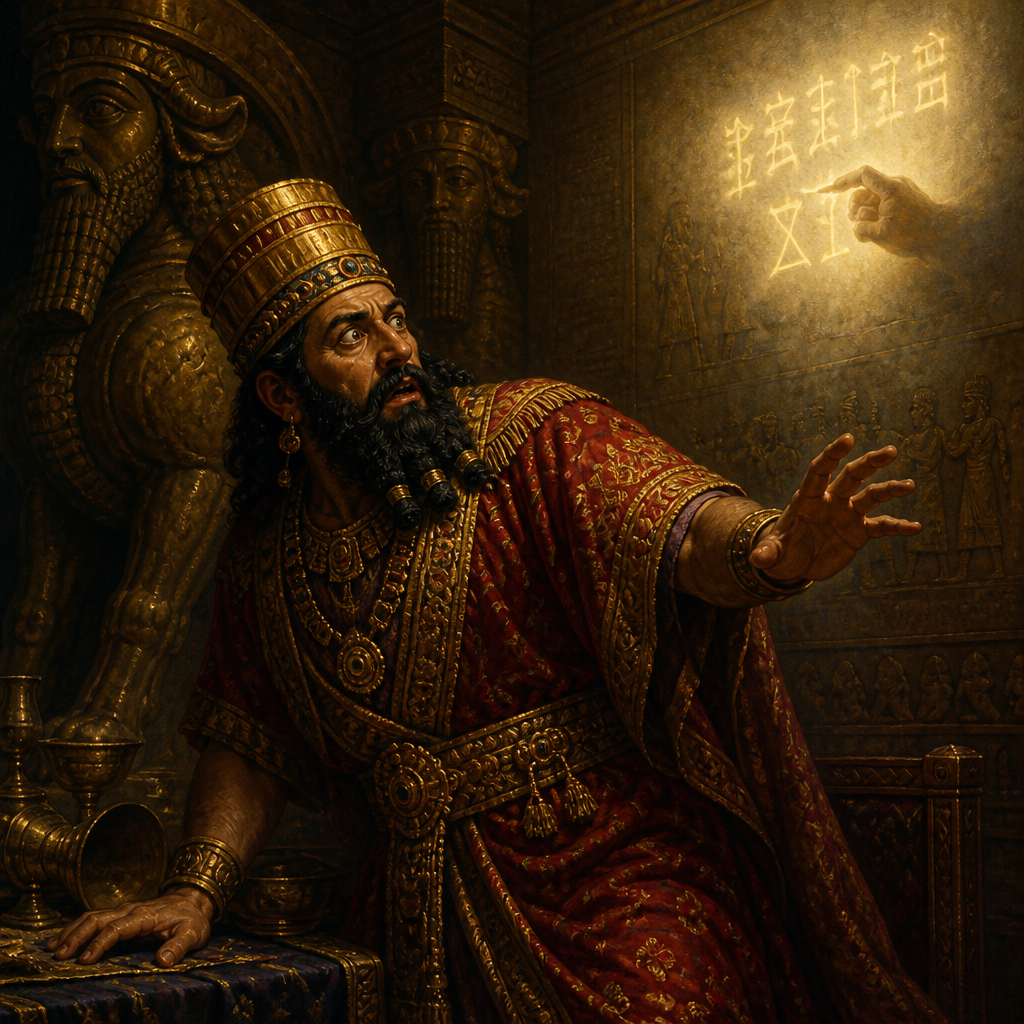
The most detailed account of Belshazzar’s life occurs in Daniel 5. The king hosted a massive feast for a thousand of his nobles, an event characterized by opulence and excessive wine consumption. In a moment of extreme hubris, Belshazzar ordered the gold and silver vessels, which had been looted from the Temple in Jerusalem, to be brought into the banquet hall. He, along with his nobles, wives, and concubines, drank from these sacred vessels while praising their gods of gold, silver, bronze, iron, wood, and stone.
During this act of sacrilege, a supernatural event occurred: the fingers of a human hand appeared and wrote a message on the plaster of the palace wall. The sight terrified the king to the point that his face grew pale and his knees knocked together (Daniel 5:6-9). When his wise men failed to interpret the inscription—Mene, Mene, Tekel, Parsin—the queen suggested summoning Daniel, who had served under Nebuchadnezzar.
Daniel’s interpretation was a stinging rebuke. He reminded Belshazzar that despite knowing how God had humbled his father, Belshazzar had lifted himself up against the Lord of heaven. Daniel translated the message as a declaration that God had numbered Belshazzar's kingdom and finished it, that the king had been weighed in the balances and found wanting, and that his kingdom was to be divided and given to the Medes and Persians.
Relationship to Other Biblical Figures
Belshazzar’s primary interaction is with the prophet Daniel. Unlike Nebuchadnezzar, who eventually showed a degree of reverence for Daniel’s God, Belshazzar’s relationship with the prophet was one of transactional necessity. Even after Daniel delivered a message of impending doom, Belshazzar followed through on his promise to reward him, clothing Daniel in purple and proclaiming him the third highest ruler in the kingdom (Daniel 5:29).
His relationship to Nebuchadnezzar is also central to his narrative. Daniel 5:22 emphasizes that Belshazzar was Nebuchadnezzar’s 'son' (a term often used in the ancient Near East to denote a successor or direct descendant). The text highlights Belshazzar’s failure to learn from his father’s spiritual journey, portraying him as a successor who inherited the throne but lacked the wisdom gained through his father’s trials.
Spiritual Significance
Spiritually, Belshazzar represents the height of human arrogance and the inevitable judgment that follows the desecration of the holy. His use of the temple vessels for a common drunken revelry is presented as the final provocation of divine patience. The 'writing on the wall' has become a cultural and theological idiom for the clear signs of approaching ruin that the prideful choose to ignore.
The life of Belshazzar concludes with the fulfillment of the divine word. Daniel 5:30 records that 'that very night Belshazzar king of the Chaldeans was slain.' His death marked the transition from the Babylonian Empire to the Medo-Persian Empire, fulfilling the prophetic timeline established in Daniel’s earlier visions. His reign also serves as the chronological backdrop for two of Daniel’s major visions: the vision of the four beasts (Daniel 7:1) and the vision of the ram and the goat (Daniel 8:1), both of which occurred in the early years of Belshazzar’s rule.
Belshazzar serves as a primary example of the biblical principle that 'pride goes before destruction.' His significance lies in his role as the final monarch of the Babylonian captivity, whose personal failings catalyzed the transition to the Medo-Persian era, which eventually allowed the Jewish exiles to return to their land. His story underscores the concept that earthly rulers are subject to the judgment of the Most High God, regardless of their worldly power.
Furthermore, the narrative of Belshazzar emphasizes the holiness of the things dedicated to God. By using the temple vessels for secular and idolatrous purposes, he crossed a theological boundary that necessitated an immediate divine response. His sudden downfall stands in the biblical record as a warning against the neglect of spiritual history and the dangers of self-exaltation.
Frequently Asked Questions
What did the writing on the wall say?
The writing consisted of the words 'Mene, Mene, Tekel, Parsin.' Daniel interpreted this to mean that God had numbered Belshazzar's kingdom, weighed the king and found him lacking, and would divide the kingdom between the Medes and Persians.
How is Belshazzar related to Nebuchadnezzar?
The Bible refers to Belshazzar as the son of Nebuchadnezzar (Daniel 5:2, 22). In biblical terminology, this can indicate a direct biological son or a descendant/successor who takes on the mantle of the previous ruler.
What happened to Belshazzar after the feast?
According to Daniel 5:30, Belshazzar was slain that very night, and his kingdom was subsequently taken over by Darius the Mede.
Why did Belshazzar use the temple vessels?
Under the influence of wine, Belshazzar ordered the gold and silver vessels taken from the Jerusalem temple to be used for drinking during his feast to honor his pagan gods, an act of intentional sacrilege.
What rank did Daniel hold under Belshazzar?
After Daniel interpreted the writing on the wall, Belshazzar proclaimed him the third highest ruler in the kingdom and gave him a gold chain and purple clothing.
Family & Relationships
Parents
 NebuchadnezzarFatherDaniel 5:2
Inferred
Daniel 5:2 names Nebuchadnezzar and Belshazzar in the same verse but does not state a son tie between them; the link rests on the surrounding narrative.Evidence: Daniel 5:2
 BelshazzarThis page
Connected Figures
Family
Father · Daniel 5:2
The powerful king of Babylon who destroyed Jerusalem, deported the Judeans, and eventually acknowledged the sovereignty of the God of Israel.
Divided MonarchyFirst: 2 Kings 24:189 versesKing of Babylon
Categories
Mentions by Book
- Daniel9
Scripture References
All 9 indexed verses, in canonical order, from the Berean Standard Bible.
Daniel · 9
- Daniel 5:1
Later, King Belshazzar held a great feast for a thousand of his nobles, and he drank wine with them.
- Daniel 5:2
Under the influence of the wine, Belshazzar gave orders to bring in the gold and silver vessels that Nebuchadnezzar his father had taken from the temple in Jerusalem, so that the king could drink from them, along with his nobles, his wives, and his concubines.
- Daniel 5:5Partial
At that moment the fingers of a human hand appeared and wrote on the plaster of the wall, near the lampstand in the royal palace. As the king watched the hand that was writing,
Cited as a key verse; added so References, Key Verses and Mentions by Book share one index.
- Daniel 5:9
Then King Belshazzar became even more terrified, his face grew even more pale, and his nobles were bewildered.
- Daniel 5:22
But you his son, O Belshazzar, have not humbled your heart, even though you knew all this.
- Daniel 5:29
Then Belshazzar gave the command, and they clothed Daniel in purple, placed a gold chain around his neck, and proclaimed him the third highest ruler in the kingdom.
- Daniel 5:30
That very night Belshazzar king of the Chaldeans was slain,
- Daniel 7:1
In the first year of the reign of Belshazzar over Babylon, Daniel had a dream, and visions passed through his mind as he lay on his bed. He wrote down the dream, and this is the summary of his account.
- Daniel 8:1
In the third year of the reign of King Belshazzar, a vision appeared to me, Daniel, subsequent to the one that had appeared to me earlier.