Ben-hadad, Son of Tabrimmon
Who was Ben-hadad, Son of Tabrimmon, in the Bible?
The Aramean King of Damascus who formed an alliance with King Asa of Judah and later waged a major military campaign against King Ahab of Israel.
This is one of 3 people named Ben-hadad in the Bible. See all 3 →
Ben-hadad, the son of Tabrimmon and grandson of Hezion, was a powerful Aramean monarch who ruled from Damascus during the early period of the Divided Monarchy. His reign is characterized by the shifting political alliances common between the kingdoms of Aram (Syria), Israel, and Judah. He first appears in the biblical record as a mercenary ally to Judah, breaking a previous treaty with Israel to facilitate King Asa’s military goals.
Historically, Ben-hadad represents the formidable northern threat to the Omride dynasty of Israel. His military reach was extensive, leading a coalition of thirty-two vassal kings in a siege against Samaria. Though his campaigns were marked by initial arrogance and subsequent defeats, his presence in the biblical narrative serves to highlight the spiritual and political tensions within the house of Israel during the ministries of the early prophets.
Background and Family
Ben-hadad was the ruler of Aram, centered in the ancient city of Damascus. According to 1 Kings 15:18, he was the son of Tabrimmon and the grandson of Hezion. This lineage establishes him as part of a consolidated Aramean dynasty that sought to exert hegemony over the Levant during the 9th century BC. His name, which means "Son of Hadad," invokes the Aramean storm god, Hadad, reflecting the religious and cultural identity of his kingdom.
The Alliance with King Asa
Ben-hadad’s entry into the biblical narrative occurs during the reign of King Asa of Judah. At the time, Asa was under immense pressure from King Baasha of Israel, who had fortified Ramah to blockade Judah. In a strategic maneuver, Asa stripped the silver and gold from the Temple and his own palace and sent it as a bribe to Ben-hadad in Damascus.
Though Ben-hadad had an existing treaty with Baasha, the wealth offered by Judah prompted him to switch allegiances. He dispatched his army commanders against the northern territories of Israel, successfully conquering Ijon, Dan, Abel-beth-maacah, and the entire region of Naphtali (1 Kings 15:20; 2 Chronicles 16:4). This intervention forced Baasha to abandon his fortification of Ramah, effectively shifting the balance of power in the region.
Conflict with Ahab of Israel
In a later stage of the Divided Monarchy, Ben-hadad mobilized a massive force to subjugate the Northern Kingdom of Israel. He besieged Samaria with an assembly of thirty-two subordinate kings, demanding not only Israel’s gold and silver but also the king's wives and children. When King Ahab initially acquiesced but later balked at even more intrusive demands, Ben-hadad threatened to level Samaria until its dust would not provide a handful for each of his soldiers (1 Kings 20:10).
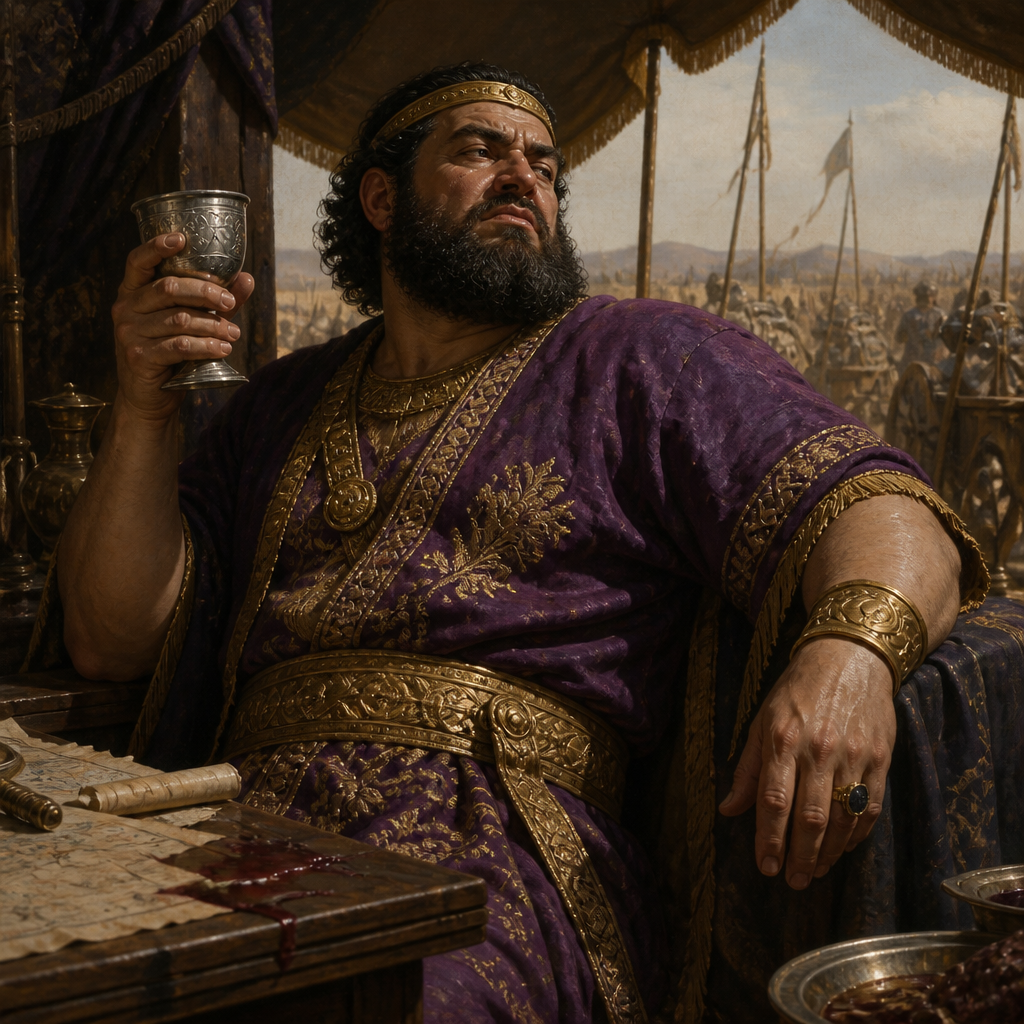
Despite his numerical superiority, Ben-hadad’s campaign was undermined by his own hubris. While he was drinking in his tents with his allied kings, a small Israelite force—guided by a prophet’s word—launched a surprise attack. The Arameans were routed, and Ben-hadad was forced to flee on horseback.
The Battle of Aphek and Captivity
One year later, Ben-hadad returned to fight Israel at Aphek, under the misguided belief that Israel’s God was a "god of the hills" and would be powerless on the plains. The resulting battle was a catastrophic defeat for Aram. The biblical record states that the Israelite forces slaughtered a hundred thousand Aramean foot soldiers in a single day, and the city walls of Aphek fell upon the survivors.
Ben-hadad fled into the city and hid in an inner room. His servants, wearing sackcloth and ropes as a sign of submission, pleaded with King Ahab for Ben-hadad’s life. In a controversial move that drew prophetic condemnation, Ahab spared Ben-hadad, calling him his "brother" and entering into a new treaty with him. Ben-hadad promised to return the cities his father had taken from Israel and allowed Ahab to establish marketplaces in Damascus (1 Kings 20:34).
Spiritual Significance
The account of Ben-hadad serves as a narrative vehicle to demonstrate the sovereignty of Yahweh over foreign deities and the consequences of royal disobedience. Ben-hadad’s assumption that the God of Israel was geographically limited was proven false by his defeat in the valley. Conversely, Ahab’s decision to spare a man whom God had "devoted to destruction" resulted in a prophetic judgment against the house of Israel. The final mention of Ben-hadad in Jeremiah 49:27 looks forward to a time of judgment, where the "fortresses of Ben-hadad" in Damascus are destined for fire, symbolizing the eventual collapse of Aramean pride and power.
Ben-hadad serves as the primary external antagonist to the Northern Kingdom during the mid-9th century BC. His interactions with King Asa and King Ahab highlight the dangers of relying on foreign alliances rather than divine providence. To the biblical writers, Ben-hadad’s hubris and his eventual defeat at Aphek were evidence that the God of Israel was not merely a local deity of the mountains, but a sovereign Lord over all nations and terrains.
Furthermore, the mercy shown to Ben-hadad by King Ahab is presented as a significant failure of leadership. By treating a sworn enemy of the covenant people as a 'brother' for the sake of political and economic concessions, Ahab prioritized secular diplomacy over divine mandate. This narrative sets the stage for the eventual downfall of the Omride dynasty and underscores the recurring theme that the safety of Israel depended more on their spiritual fidelity than their military treaties.
Frequently Asked Questions
Why did Ben-hadad break his treaty with King Baasha?
Ben-hadad broke his treaty with Baasha of Israel because King Asa of Judah sent him a large bribe consisting of silver and gold from the Temple and the royal palace treasuries (1 Kings 15:18-19).
What happened to Ben-hadad at the Battle of Aphek?
After his army was decimated by Israel, Ben-hadad fled into the city of Aphek and hid in an inner room. He eventually surrendered to King Ahab, wearing sackcloth and a rope around his head to beg for mercy (1 Kings 20:30-32).
How many kings were allied with Ben-hadad during the siege of Samaria?
The Bible records that Ben-hadad was accompanied by thirty-two kings, along with their horses and chariots, when he marched against Samaria (1 Kings 20:1).
What were the terms of the treaty between Ben-hadad and Ahab?
Ben-hadad agreed to return the cities his father had captured from Israel and permitted Ahab to set up marketplaces (bazaars) for trade in Damascus (1 Kings 20:34).
How does the book of Jeremiah refer to Ben-hadad?
In Jeremiah 49:27, the prophet delivers an oracle against Damascus, stating that God will set fire to the city walls and consume the fortresses of Ben-hadad as a form of divine judgment.
Family & Relationships
Parents
 TabrimmonFather1 Kings 15:18Stated
 Ben-hadad, Son of TabrimmonThis page
Connected Figures
Family
Father · 1 Kings 15:18
Tabrimmon was an Aramean ruler of Damascus during the Divided Monarchy, noted as the father of Ben-hadad I.
Divided MonarchyFirst: 1 Kings 15:181 versesKing of Aram-Damascus
Categories
Mentions by Book
- 1 Kings15
- 2 Chronicles2
- Jeremiah1
Scripture References
All 18 indexed verses, in canonical order, from the Berean Standard Bible.
1 Kings · 15
- 1 Kings 15:18
So Asa withdrew all the silver and gold that remained in the treasuries of the house of the LORD and the royal palace. He entrusted it to his servants and sent them with this message to Ben-hadad son of Tabrimmon, the son of Hezion, the king of Aram, who was ruling in Damascus:
- 1 Kings 15:20
And Ben-hadad listened to King Asa and sent the commanders of his armies against the cities of Israel, conquering Ijon, Dan, Abel-beth-maacah, and the whole land of Naphtali, including the region of Chinnereth.
- 1 Kings 20:1
Now Ben-hadad king of Aram assembled his entire army. Accompanied by thirty-two kings with their horses and chariots, he marched up, besieged Samaria, and waged war against it.
- 1 Kings 20:2
Then he sent messengers into the city to Ahab king of Israel,
- 1 Kings 20:5
The messengers came back and said, “This is what Ben-hadad says: ‘I have sent to you to demand your silver, your gold, your wives, and your children.
- 1 Kings 20:9
So Ahab answered the messengers of Ben-hadad, “Tell my lord the king, ‘All that you demanded of your servant the first time I will do, but this thing I cannot do.’” So the messengers departed and relayed the message to Ben-hadad.
- 1 Kings 20:10
Then Ben-hadad sent another message to Ahab: “May the gods deal with me, and ever so severely, if enough dust remains of Samaria for each of my men to have a handful.”
- 1 Kings 20:16
They marched out at noon while Ben-hadad and the 32 kings allied with him were in their tents getting drunk.
- 1 Kings 20:17
And the young officers of the district governors marched out first. Now Ben-hadad had sent out scouts, who reported to him, “Men are marching out of Samaria.”
- 1 Kings 20:20
and each one struck down his opponent. So the Arameans fled, with the Israelites in pursuit. But Ben-hadad king of Aram escaped on horseback with the cavalry.
- 1 Kings 20:26
In the spring, Ben-hadad mobilized the Arameans and went up to Aphek to fight against Israel.
- 1 Kings 20:30
The rest of them fled into the city of Aphek, where the wall fell on twenty-seven thousand of the remaining men. Ben-hadad also fled to the city and hid in an inner room.
- 1 Kings 20:32
So with sackcloth around their waists and ropes around their heads, they went to the king of Israel and said, “Your servant Ben-hadad says, ‘Please spare my life.’” And the king answered, “Is he still alive? He is my brother.”
- 1 Kings 20:33Partial
Now the men were looking for a sign of hope, and they quickly grasped at this word and replied, “Yes, your brother Ben-hadad.” “Go and get him!” said the king. Then Ben-hadad came out, and Ahab had him come up into his chariot.
- 1 Kings 20:34
Ben-hadad said to him, “I will restore the cities my father took from your father; you may set up your own marketplaces in Damascus, as my father did in Samaria.” “By this treaty I release you,” Ahab replied. So he made a treaty with him and sent him away.
Cited as a key verse; added so References, Key Verses and Mentions by Book share one index.
2 Chronicles · 2
- 2 Chronicles 16:2
So Asa withdrew the silver and gold from the treasuries of the house of the LORD and the royal palace, and he sent it with this message to Ben-hadad king of Aram, who was ruling in Damascus:
- 2 Chronicles 16:4
And Ben-hadad listened to King Asa and sent the commanders of his armies against the cities of Israel, conquering Ijon, Dan, Abel-maim, and all the store cities of Naphtali.
Jeremiah · 1
- Jeremiah 49:27
“I will set fire to the walls of Damascus; it will consume the fortresses of Ben-hadad.”
Others Named Ben-hadad
Compare all 3 bearers →Ben-hadad, son of Hazael2 Kings 13:3
The Aramean king of Syria who lost significant territory to Israel during the reign of King Jehoash.
Ben-hadad, the Besieger of Samaria2 Kings 6:24
The Aramean king of Damascus who orchestrated the devastating siege of Samaria and sought the counsel of the prophet Elisha during a terminal illness.