Hiram, Artisan of the Temple
A master craftsman from Tyre commissioned by King Solomon to execute the intricate bronze work and sacred vessels for the First Temple in Jerusalem.
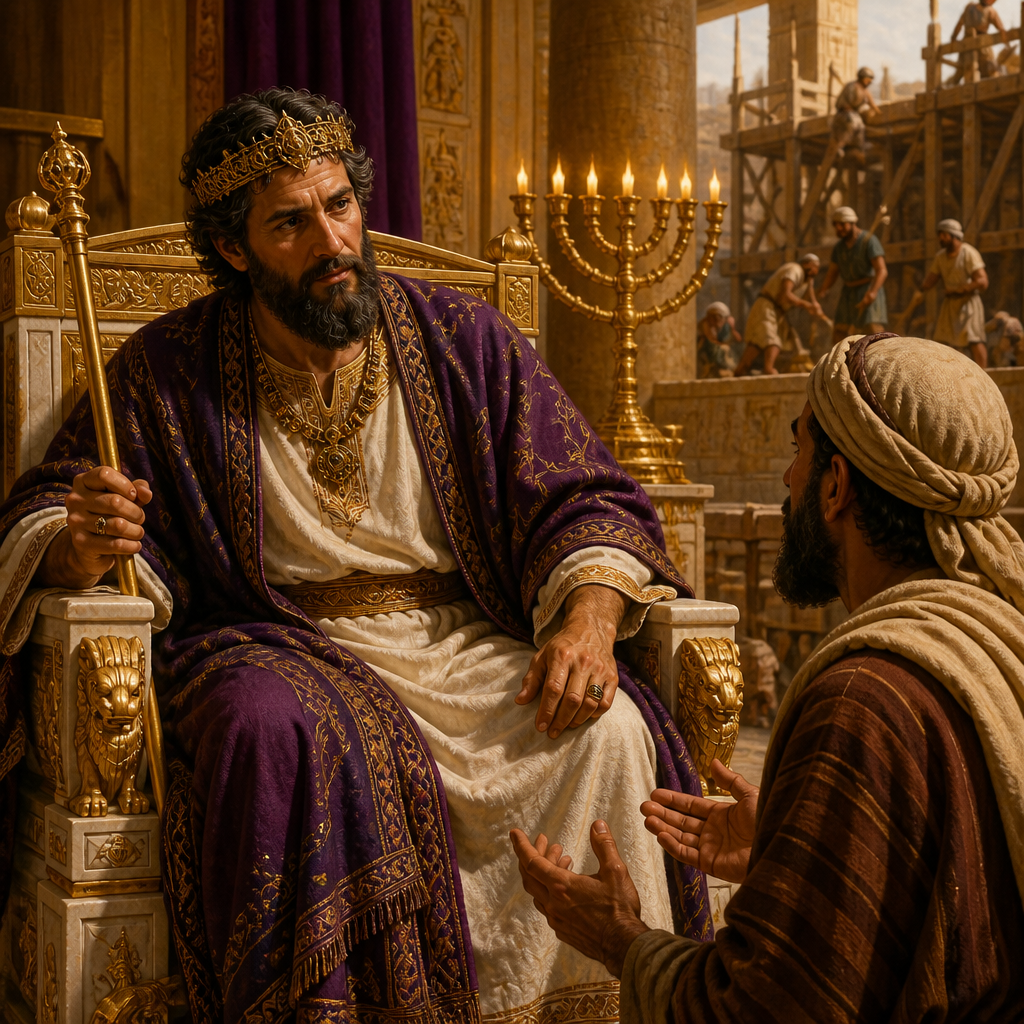
Hiram (also referred to as Huram or Huram-abi) was a highly skilled artisan of Phoenician and Israelite descent who served as the primary metalworker for King Solomon’s Temple. While often overshadowed by the monarch who commissioned the project, Hiram was the creative force behind the massive bronze structures that defined the Temple’s courtyard and interior, transforming raw materials into liturgical art.
Recruited from the city of Tyre, Hiram was not merely a laborer but a master of metallurgy, specifically working in burnished bronze. His contributions were essential to the transition of Israelite worship from the portable Tabernacle to the permanent, grand architecture of the United Monarchy. His work represents the pinnacle of ancient Near Eastern craftsmanship applied to the service of the God of Israel.
Background and Family
The biblical record identifies Hiram as a man of mixed heritage, which likely contributed to his unique position as a bridge between the Phoenician expertise of Tyre and the religious requirements of Israel. According to the accounts in 1 Kings and 2 Chronicles, Hiram’s mother was a widow from the tribe of Naphtali (or Dan, as mentioned in associated texts), while his father was a man of Tyre, a city renowned for its industrial and maritime prowess. This lineage placed him in a strategic position to serve King Solomon, who sought the best international talent to decorate the House of the LORD.
Hiram is described in the text of 2 Chronicles as a "skillful man endowed with creativity" and wisdom. The title "Huram-abi," used in some translations, likely reflects a term of honor or a formal title rather than a distinct surname, suggesting he was a master or "father" of his craft. He arrived in Jerusalem during the mid-10th century BC, specifically to oversee the metallurgical aspects of the Temple construction.
Major Life Events
Upon his arrival in Jerusalem at the request of King Solomon, Hiram took charge of the foundry work required for the Temple. His primary medium was bronze, and his output was prodigious. The biblical text in 1 Kings 7 and 2 Chronicles 4 details his specific creations, which included two massive bronze pillars named Jachin and Boaz, a "Sea" of cast metal (a giant basin supported by twelve bronze oxen), and ten mobile bronze stands for washing.
The scripture emphasizes that Hiram was responsible for the final finishing of the project: "So Huram finished all the work that he had undertaken for King Solomon in the house of the LORD" (1 Kings 7:40). His workspace was located in the plain of the Jordan, between Succoth and Zarethan, where the clay ground was suitable for the heavy casting of bronze vessels. The scale of his work was so vast that the weight of the bronze used was never fully calculated, illustrating the immense resources at his disposal and the magnitude of his task.
Relationship to Other Biblical Figures
Hiram’s primary relationship recorded in the text is his professional connection to King Solomon. Solomon, recognized as the wealthiest and wisest king of the United Monarchy, recognized that the spiritual center of his kingdom required a level of aesthetic excellence that necessitated external expertise. Hiram acted as Solomon’s chief artistic consultant and executor for the Temple’s metalwork.
Unlike the soldiers or political advisors of the era, Hiram’s relationship with the crown was defined by the "spirit of wisdom" in craftsmanship. He operated under the king's mandate but maintained a level of autonomy over the foundry process, ensuring that every shovel, pot, and sprinkling bowl met the high standards required for the "burnished bronze" that would reflect the glory of the sanctuary.
Spiritual Significance
In the context of the United Monarchy, Hiram represents the sanctification of human skill and international cooperation for divine purposes. His work on the Temple vessels—specifically the pots, shovels, and bowls—turned utilitarian objects into holy instruments. By using his "creativity" (2 Chronicles 2:13) to build the House of God, Hiram serves as a New Testament-style archetype of the "body of work" where different talents contribute to a single spiritual goal.
The fact that he was of partial Israelite descent but trained in the secular excellence of Tyre suggests a theological theme of the "nations" bringing their glory into the worship of Yahweh. His precision in completing the work to the last detail mirrors the earlier work of Bezalel in the Tabernacle, underscoring that the beauty of the Temple was not just in its gold and stone, but in the masterfully crafted bronze tools that facilitated the daily sacrifices and rituals of the priesthood.
Spiritual Significance
Hiram serves as the definitive craftsman of the United Monarchy, bridging the gap between raw material and sacred space. His role demonstrates that the construction of the First Temple was a collaborative effort requiring specialized technical knowledge that complemented Solomon's vision and resources. The detailed listing of his work in 1 Kings and 2 Chronicles highlights the importance of craftsmanship in biblical worship.
Theologically, Hiram’s work in 'burnished bronze' symbolizes the endurance and purity required for the instruments of the sanctuary. His ability to 'finish the work' (1 Kings 7:40) places him in a small group of individuals in scripture noted for their faithfulness in completing massive divine mandates, ensuring the Temple was functional for the sacrificial system.
Frequently Asked Questions
What materials did Hiram primarily work with?
Hiram was a master of metallurgy who worked primarily with bronze. The Bible specifies that he produced items made of 'burnished' or 'polished' bronze for the Temple.
What were the most famous objects Hiram created?
He is best known for casting the two great bronze pillars, Jachin and Boaz, and the 'Bronze Sea,' a massive basin that sat on twelve bronze oxen.
Where did Hiram perform his metal casting?
He performed the casting in the Jordan Valley, specifically in the clay ground between Succoth and Zarethan, which provided the necessary molds for large-scale bronze work.
Was Hiram an Israelite?
He was of mixed heritage; his mother was from the tribe of Naphtali (or Dan), but his father was a man of Tyre, making him a resident of Syria/Phoenicia by nationality.
Does the name 'Huram-abi' refer to the same person?
Yes, 'Huram' and 'Huram-abi' are variations of the name Hiram used in the book of 2 Chronicles to refer to this specific artisan.
Connected Figures
Categories
Mentions by Book
- 1 Kings3
- 2 Chronicles3
Others Named Hiram
Hiram, King of Tyre2 Samuel 5:11
A Phoenician monarch who served as a critical ally to both King David and King Solomon, providing essential materials and labor for the construction of the Jerusalem Temple.