Hadad the Edomite
A prince of the royal house of Edom who escaped David’s conquest and returned from Egypt to become a major adversary of King Solomon.
Hadad the Edomite was a member of the royal family of Edom who rose to prominence as a significant political antagonist during the reign of King Solomon. According to the biblical narrative in 1 Kings, Hadad was a survivor of a brutal military campaign led by Joab, the commander of King David’s army, which resulted in the near-total destruction of the male population in Edom.
During his exile in Egypt, Hadad achieved an extraordinary status, eventually marrying into the Egyptian royal family. His story serves as a theological and political marker in the Bible, signifying the beginning of the fragmentation of Solomon’s empire as divine judgment for Solomon’s later apostasy. Hadad’s life is defined by his survival, his high-level international alliances, and his lifelong commitment to reclaiming his nation’s independence from Israelite control.
Background and Family
Hadad was a member of the royal line of Edom. His early life was marked by the violent expansion of the United Monarchy of Israel under King David. During David's reign, the commander Joab spent six months in Edom with the intent of eliminating every male in the territory. Hadad, described as "still just a young boy" at the time, was rescued by a group of his father’s servants. They fled the slaughter, traveling through Midian and Paran before seeking asylum in Egypt.
While in Egypt, Hadad’s status as a displaced royal earned him the favor of the Pharaoh. The Egyptian ruler provided Hadad with a house, a food allowance, and land. This relationship was eventually formalized through marriage; the Pharaoh gave Hadad the sister of Queen Tahpenes as a wife. From this union, Hadad fathered a son named Genubath, who was raised in the Pharaoh’s palace alongside the Pharaoh’s own children.
Major Life Events
The defining moment of Hadad’s career was his decision to leave the comfort of the Egyptian court to return to his homeland. Upon hearing of the deaths of King David and the commander Joab, Hadad requested leave from the Pharaoh. Despite the Pharaoh’s confusion—asking what Hadad lacked in Egypt that would make him want to return to a ruined country—Hadad insisted on departing.
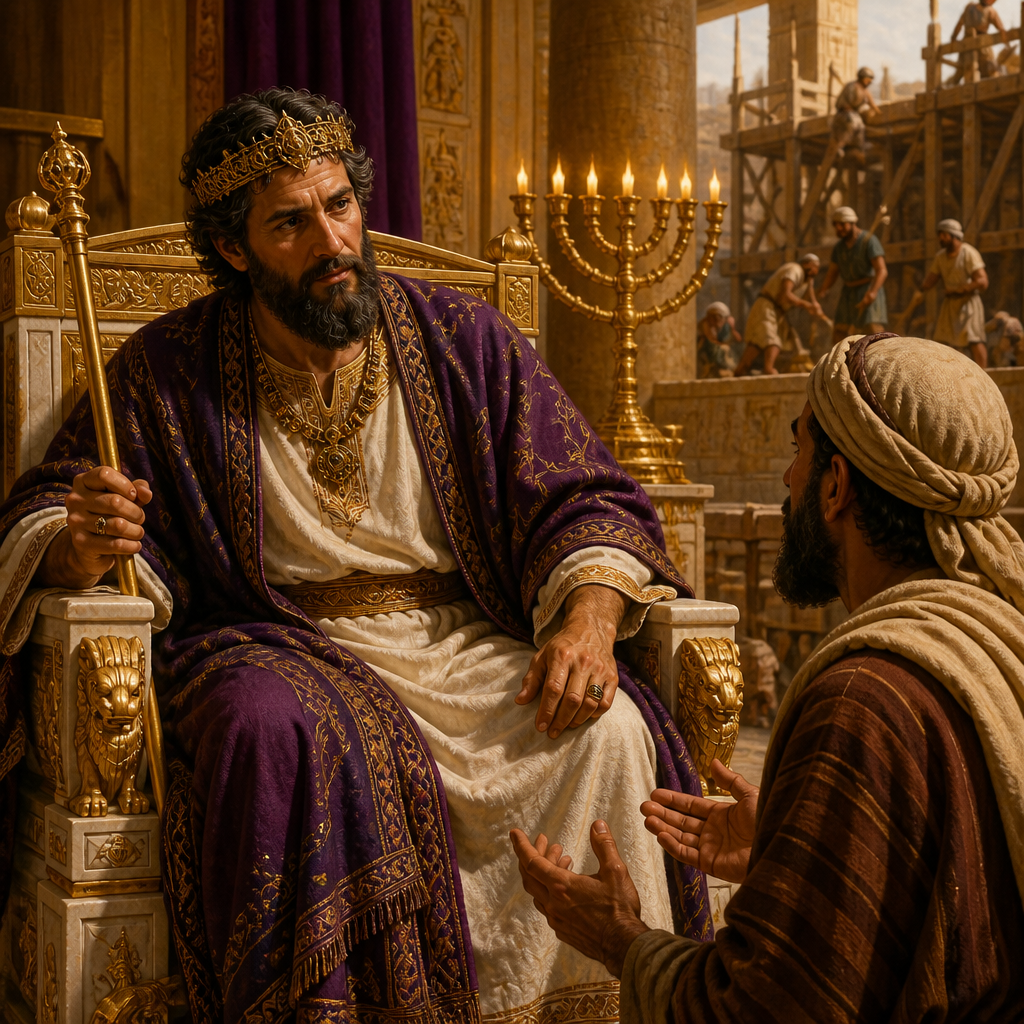
Upon his return to the Levant, Hadad established himself as a persistent threat to the peace of Solomon’s later years. The text indicates that he became an "adversary" (Hebrew: satan) raised up by God against Solomon. While the specific military engagements are not detailed in the same depth as other biblical wars, 1 Kings 11:25 notes that he caused significant trouble for Israel, effectively ending the period of absolute peace that had characterized the early part of Solomon's reign.
Relationship to Other Biblical Figures
Hadad’s primary relationship was one of enmity toward the house of David. He represents the lingering consequences of David’s military policies and Joab’s ruthless execution of war. Conversely, his relationship with the Egyptian Pharaoh highlights the shifting geopolitical landscape of the 10th century BC, where Egypt served as a sanctuary for those opposed to Israelite hegemony. His son, Genubath, represents the integration of the Edomite royal line into the Egyptian social fabric, though his later life is not recorded in scripture.
Spiritual Significance
In the theological framework of 1 Kings, Hadad is not merely a political rebel but a divine instrument. The text explicitly states that "the LORD raised up against Solomon an adversary, Hadad the Edomite" (1 Kings 11:14). This framing is crucial; it indicates that Solomon’s security and the peace of his kingdom were contingent upon his faithfulness to the covenant. When Solomon turned to the gods of his foreign wives, the internal security of the United Monarchy began to fail. Hadad’s persistent hostility serves as a physical manifestation of the broken relationship between Solomon and Yahweh, acting as a harbinger of the eventual division of the kingdom.
Spiritual Significance
Hadad the Edomite serves as a key theological indicator of the decline of the United Monarchy. His presence in the narrative demonstrates that the security and peace enjoyed by Solomon were gifts from God that could be withdrawn. As a 'satan' (adversary) raised by God, Hadad illustrates the biblical theme that geopolitical shifts are often reflections of spiritual realities. His story also provides historical context for the long-standing animosity between Edom and Israel, which would persist for centuries.
Frequently Asked Questions
Why did Hadad flee to Egypt?
He fled to Egypt as a child to escape the slaughter of Edomite males by Joab, the commander of King David's army.
Who was Hadad's wife?
He married the sister of Queen Tahpenes, who was the wife of the Egyptian Pharaoh.
What does the Bible call Hadad in relation to Solomon?
The Bible calls him an 'adversary' (or *satan*) whom the LORD raised up against Solomon.
What was the name of Hadad's son?
His son was named Genubath, who was weaned by Queen Tahpenes and raised in the Pharaoh's palace.
Why did Hadad return to Edom?
He returned after he heard that King David and his commander Joab were dead, seeking to reclaim his place in his own country.
Connected Figures



Categories
Mentions by Book
- 1 Kings5
Family & Relationships
Child
1 Kings 11:14
Spouse / partner
1 Kings 11:14
Spouse / partner
1 Kings 11:19
Others Named Hadad the Edomite
Hadad, Husband of Mehetabel1 Chronicles 1:50
Hadad was the last listed king of Edom prior to the rise of the Israelite monarchy, ruling from the city of Pau with his wife Mehetabel.
Hadad son of Bedad, King of EdomGenesis 36:35
An early Edomite king who gained prominence by defeating the Midianites in the territory of Moab before the establishment of the Israelite monarchy.
Hadad, Son of Ishmael1 Chronicles 1:30
Hadad was one of the twelve sons of Ishmael and a grandson of the patriarch Abraham, serving as a tribal chieftain in the Arabian peninsula.