Abinadab, Custodian of the Ark
A resident of Kiriath-jearim whose household served as the sanctuary for the Ark of the Covenant for twenty years following its return from the Philistines.
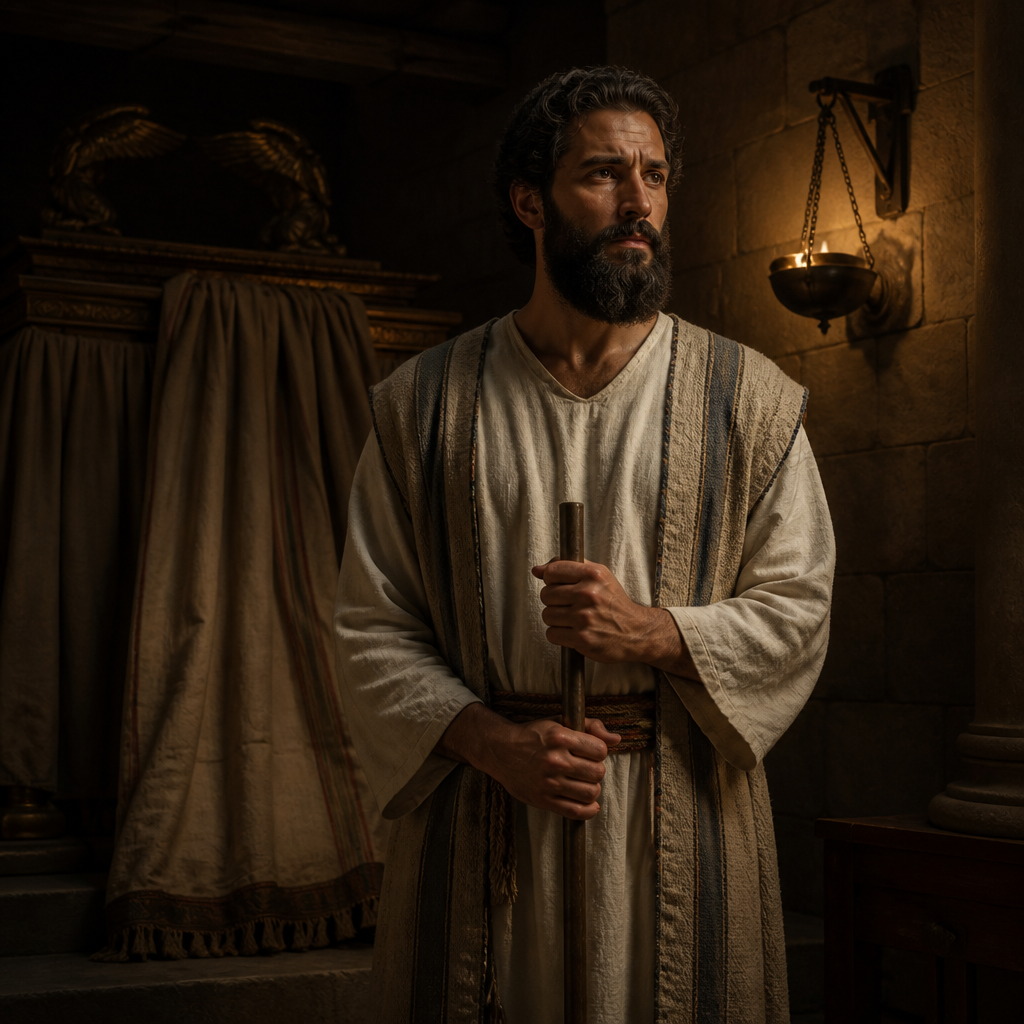
Abinadab was a resident of Kiriath-jearim during the transition from the Period of the Judges to the United Monarchy. His primary distinction in the biblical narrative is his role as the caretaker of the Ark of the Covenant, the most sacred object of the Israelite faith. Following a period of divine judgment upon the men of Beth-shemesh, the Ark was brought to Abinadab’s home, where it remained for two decades.
His household, situated on a hill in Kiriath-jearim, became a temporary center of religious gravity for Israel during the reign of Saul and the early reign of David. Abinadab’s family was intimately involved in the preservation and eventual transportation of the Ark, with his sons being consecrated or assigned to manage its care and movement.
Background and Family
Abinadab resided in Kiriath-jearim, a city located on the border between the tribes of Judah and Benjamin. While the biblical text does not explicitly state his tribal lineage, the city’s associations with the Gibeonites and its location within the territory of Judah suggest he was a man of significant standing within his community. Abinadab is identified as the father of at least three sons: Eleazar, Uzzah, and Ahio.
His family assumed a quasi-priestly or Levite-adjacent role by necessity and community appointment. When the Ark arrived from Beth-shemesh, the men of Kiriath-jearim chose Abinadab’s house as the most appropriate location for its stay. They specifically consecrated his son, Eleazar, to guard the Ark, implying that the family was viewed as ritually fit or sufficiently respected to oversee the presence of the Lord.
Major Life Events
The Arrival of the Ark
The Ark of the Covenant had been captured by the Philistines but was returned to Israel after a series of plagues afflicted the Philistine cities. However, the men of Beth-shemesh were struck down by God for looking into the Ark, prompting them to send word to Kiriath-jearim to take the relic away. According to 1 Samuel 7:1, the men of Kiriath-jearim brought the Ark to the house of Abinadab "on the hill." This location served as the Ark's resting place for twenty years, a period during which the house of Abinadab became a de facto sanctuary.
The Transfer to Jerusalem
After King David established his capital in Jerusalem, he sought to bring the Ark to the city to centralize Israelite worship. David and his men went to the house of Abinadab to retrieve it. The Ark was placed on a "new cart," a method of transport that deviated from the Mosaic Law's requirement that the Ark be carried by Levites using poles. Abinadab’s sons, Uzzah and Ahio, were tasked with guiding the cart. During the procession, the oxen stumbled, and Uzzah reached out to steady the Ark, resulting in his immediate death by the hand of God (2 Samuel 6:6-7; 1 Chronicles 13:9-10). This tragic event concluded the Abinadab family’s long-term stewardship of the Ark.
Relationship to Other Biblical Figures
Abinadab’s relationship with the central authorities of Israel appears to have been one of cooperative service. While the text does not record direct dialogue between Abinadab and Samuel or David, his house was the focal point for their most sacred religious efforts. His sons, Uzzah and Ahio, represent the tragic intersection of well-intentioned service and the strict requirements of divine holiness. The narrative transition from Abinadab’s house to the house of Obed-edom the Gittite marks the end of Abinadab's mention in the historical record.
Spiritual Significance
The story of Abinadab emphasizes the theme of proximity to the holy. For twenty years, his household lived in the shadow of the Ark without incident, suggesting a lifestyle of reverence and obedience. However, the subsequent judgment on his son Uzzah serves as a sobering reminder that long-term familiarity with the things of God does not excuse one from following His specific commands regarding worship and holiness. Abinadab stands as a figure of faithful, quiet stewardship during a tumultuous era of transition for the nation of Israel.
Spiritual Significance
Abinadab serves as a transitional figure between the chaos of the Judges and the establishment of the Davidic monarchy. His household provided stability for Israel’s religious life at a time when the Tabernacle at Shiloh had fallen and the central sanctuary was not yet established. His role highlights the importance of the 'house on the hill' as a sanctuary of necessity.
Theologically, the inclusion of his family in the Ark's history serves as a cautionary tale regarding the handling of the sacred. While Abinadab is credited with providing a home for God’s presence, the eventual disaster involving his sons underscores the biblical principle that proximity to the divine presence requires strict adherence to divine protocol.
Frequently Asked Questions
How long was the Ark of the Covenant in Abinadab’s house?
The Ark remained in Abinadab's house for twenty years (1 Samuel 7:2) before King David attempted to move it to Jerusalem.
Where did Abinadab live?
He lived in Kiriath-jearim, specifically in a house located on a hill.
Who were the sons of Abinadab?
The Bible mentions three sons: Eleazar (who was consecrated to guard the Ark), and Uzzah and Ahio (who guided the cart when David moved the Ark).
Was Abinadab a priest?
The Bible does not explicitly identify Abinadab as a priest or a Levite, though his family performed duties usually reserved for Levites, and his son Eleazar was consecrated for the service.
What happened to Abinadab's family when the Ark was moved?
During the move, his son Uzzah was struck dead by God for touching the Ark to steady it after the oxen stumbled.
Connected Figures

Categories
Mentions by Book
- 2 Samuel2
- 1 Chronicles1
- 1 Samuel1
Family & Relationships
Child
1 Samuel 7:1
Child
1 Samuel 7:1
Child
1 Samuel 7:1
Others Named Abinadab
Abinadab, Son of Jesse1 Samuel 16:8
The second-born son of Jesse and elder brother of King David who served in the army of King Saul during the Philistine wars.
Abinadab, Father of Ben-abinadab1 Kings 4:11
A figure of the United Monarchy period recognized solely as the father of one of King Solomon’s twelve regional deputies.
Abinadab, Son of King Saul1 Samuel 31:2
A prince of the tribe of Benjamin and son of King Saul who died alongside his father and brothers during the Battle of Mount Gilboa.