Joktan
A foundational patriarch and son of Eber, Joktan is the progenitor of thirteen Arabian tribes in the post-Flood era.
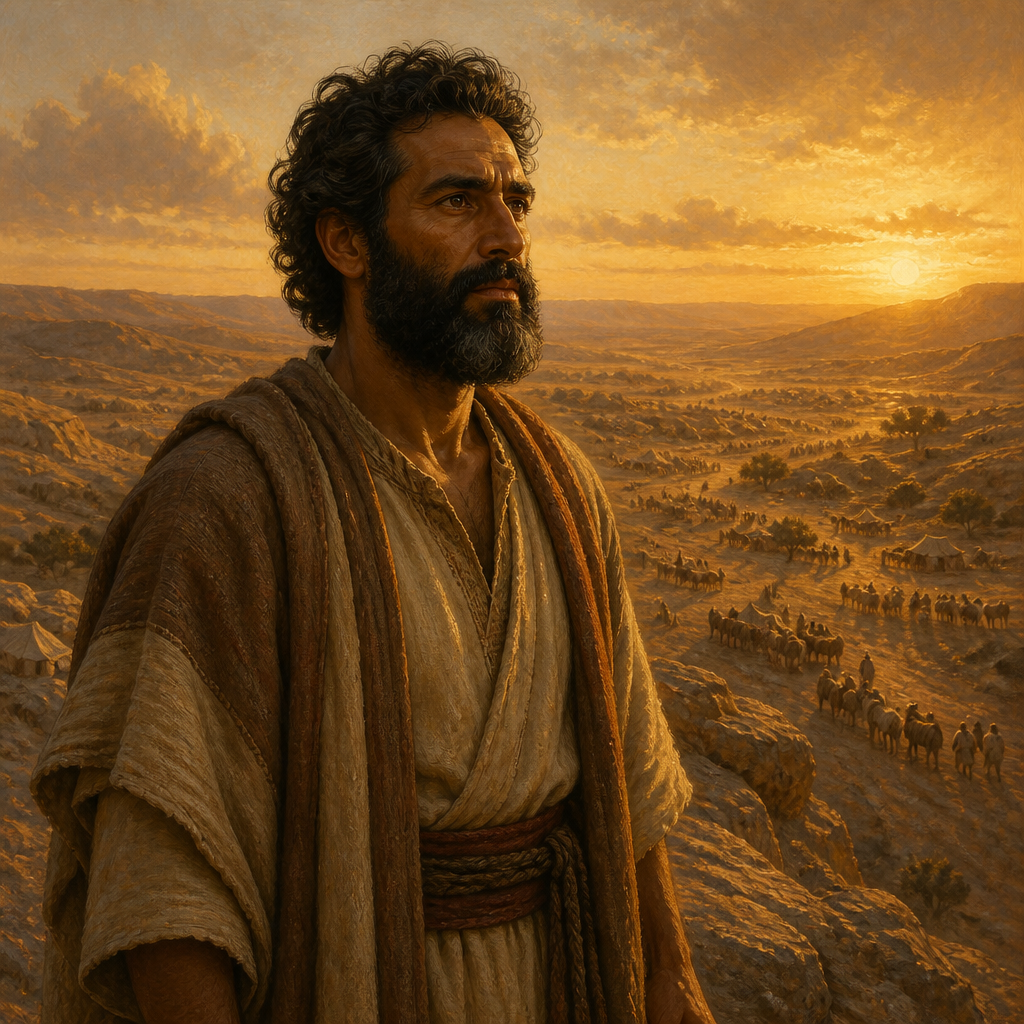
Joktan was a significant biblical patriarch appearing in the Table of Nations following the Great Flood. As the son of Eber and the brother of Peleg, Joktan represents a primary branch of the Shemite lineage. His name in Hebrew, Yoqtan, is often interpreted as meaning 'small' or 'diminished,' though in the context of the biblical narrative, his influence is expansive as he is credited with fathering thirteen sons who established various tribal territories.
His place in the genealogy of Genesis 10 and 1 Chronicles 1 highlights the rapid diversification of humanity in the generations following Noah. While his brother Peleg is associated with the division of the earth, Joktan is associated with the settlement of the Arabian peninsula. The biblical record serves primarily to document the geographic and ethnic distribution of his descendants, mapping the early post-diluvian world.
Background and Family
Joktan is positioned within the lineage of Shem, the son of Noah, specifically within the fifth generation following the Flood. According to Genesis 10:25 and 1 Chronicles 1:19, he was the son of Eber. The biblical text makes a distinct point of mentioning his sibling relationship: "Two sons were born to Eber: One was named Peleg, because in his days the earth was divided, and his brother was named Joktan." This indicates that while Peleg’s line is often the focus of the messianic genealogy leading toward Abraham, Joktan’s line represents a massive lateral expansion of the Semitic people.
Joktan’s immediate family is one of the most extensively listed in the Table of Nations. The scriptures record that he was the father of thirteen sons: Almodad, Sheleph, Hazarmaveth, Jerah, Hadoram, Uzal, Diklah, Obal, Abimael, Sheba, Ophir, Havilah, and Jobab. The sheer number of named descendants suggests that Joktan was a figure of immense communal importance, serving as the biological and cultural foundation for a large network of tribes.
Major Life Events
There are no narrative accounts of Joktan’s personal actions, speeches, or travels in the Masoretic text. His life is defined entirely by his role as a progenitor during the transition from the unified post-Flood family to a world of diverse nations. The biblical record focuses on the result of his life: the establishment of specific territories.
Genesis 10:30 provides the geographic boundaries for the Joktanite settlement, stating that their territory extended "from Mesha toward Sephar, in the eastern hill country." Biblical scholars generally identify these locations within the southern and eastern regions of the Arabian Peninsula. This settlement pattern distinguishes the Joktanites from the descendants of Peleg, who remained more central to the Mesopotamian and Levantine regions.
Relationship to Other Biblical Figures
Joktan’s most significant relationship is with his father, Eber, and his brother, Peleg. The mention of the earth being "divided" in the days of Peleg is a crucial chronological marker. While scholars debate whether this refers to the linguistic division at the Tower of Babel or a physical geological shift, Joktan stands as the counter-narrative to Peleg. While Peleg's name implies a split or division, Joktan’s legacy is one of multiplication and expansion into new frontiers.
Furthermore, Joktan’s descendants include names that reappear later in the biblical narrative in different contexts, most notably Sheba, Havilah, and Ophir. While these later references (such as the Queen of Sheba or the gold of Ophir) may refer to the regions settled by Joktan’s sons rather than the individuals themselves, the foundational link remains rooted in Joktan’s patriarchal authority.
Spiritual Significance
Within the broader framework of the Old Testament, Joktan represents the fulfillment of the divine command to "be fruitful and multiply and fill the earth" (Genesis 9:1). His inclusion in the genealogy of 1 Chronicles 1 serves to validate the historical ethnic landscape of the ancient Near East and reinforces the idea that all nations are ultimately related through the line of Noah.
Though Joktan is not the ancestor of the Israelites—that distinction belongs to his brother Peleg—his presence in the sacred text ensures that the surrounding Arabian nations are recognized as having a common Semitic ancestry. The preservation of his thirteen sons' names highlights the meticulous nature of early biblical record-keeping and the theological emphasis on the sovereign hand of God in the distribution of peoples across the globe.
Spiritual Significance
Joktan is theologically significant as the primary progenitor of the southern Semitic (Arabian) tribes. His genealogy in Genesis 10 serves to map the ethnic and linguistic spread of humanity after the Tower of Babel, illustrating how the descendants of Noah fulfilled the mandate to populate the earth. By contrasting his line with that of his brother Peleg, the Bible clarifies the distinct heritage of the Arabian tribes versus the Abrahamic lineage.
His record also preserves the names of early civilizations such as Sheba and Ophir, which would later become famous for their wealth and interaction with the Kingdom of Israel. Joktan thus acts as a bridge between the early post-Flood world and the established geopolitical landscape of the ancient Near East.
Frequently Asked Questions
Who was Joktan's father?
Joktan was the son of Eber, an early patriarch in the line of Shem.
How many sons did Joktan have?
Joktan had thirteen sons: Almodad, Sheleph, Hazarmaveth, Jerah, Hadoram, Uzal, Diklah, Obal, Abimael, Sheba, Ophir, Havilah, and Jobab.
Where did Joktan's descendants settle?
According to Genesis 10:30, they settled in the region spanning from Mesha toward Sephar in the eastern hill country, generally identified with the Arabian Peninsula.
How is Joktan related to Peleg?
Joktan was the brother of Peleg. While Peleg is the ancestor of Abraham, Joktan is the ancestor of several Arabian tribes.
What does the name Joktan mean?
The name Joktan (Yoqtan) is derived from a Hebrew root meaning 'small,' 'short,' or 'diminished.'
Connected Figures

Categories
Mentions by Book
- 1 Chronicles3
- Genesis3
Family & Relationships
Child
Genesis 10:25
Child
Genesis 10:25
Child
Genesis 10:25
Child
Genesis 10:25
Child
Genesis 10:25
Child
Genesis 10:25
Child
Genesis 10:25
Child
Genesis 10:25
Child
Genesis 10:25
Child
Genesis 10:25
Child
Genesis 10:25
Child
Genesis 10:25
Child
Genesis 10:25
Sibling
Genesis 10:25
Parent
Eber, Son of ShelahDisputed
Genesis 10:21
Sibling
Genesis 10:25