Shebaniah, Levite of the Restoration
A Levite leader in the post-exilic community who led the Israelites in corporate confession and signed the national covenant under Nehemiah.
Shebaniah was a prominent Levite who served the Jewish community in Jerusalem during the mid-5th century BC, following the return from Babylonian captivity. He is specifically identified in the historical record of Nehemiah as one of the liturgical leaders who facilitated the spiritual renewal of the people after the completion of the city walls. His presence was central to the collective movement of repentance and the formalization of the community's commitment to the Mosaic Law.
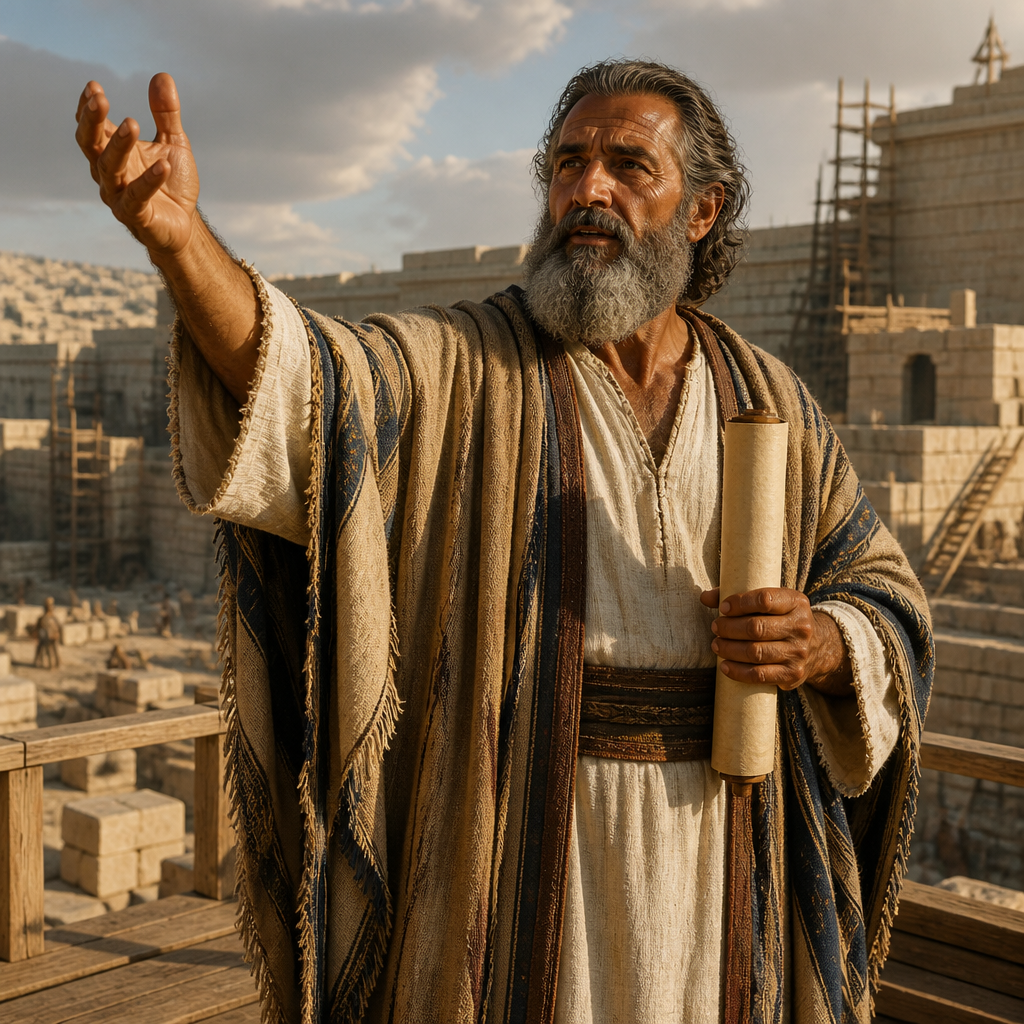
Operating during the era of the Exile and Return, Shebaniah held a position of religious authority. He was responsible for both vocalizing the prayers of the people and standing as a legal witness to the covenant between Israel and Yahweh. His specific role involved leading the assembly from a raised platform, highlighting his status as a teacher and spiritual mediator during one of the most critical transitions in Jewish history.
Background and Family
Shebaniah was a member of the tribe of Levi, the class designated for religious service in Israel. While the biblical text in Nehemiah 9 and 10 does not provide his specific genealogy or parentage, his inclusion in the list of those who stood on the "raised platform" indicates he was a recognized leader among the Levites. He lived and worked in Jerusalem during the governorship of Nehemiah, a period characterized by the physical and spiritual reconstruction of the Jewish state after decades of exile in Babylon.
Major Life Events
Shebaniah’s biblical record is concentrated within the events of the Great Assembly following the Feast of Tabernacles in the year 444 BC.
The Cry for Mercy
According to Nehemiah 9:4, Shebaniah was one of the Levites who stood upon the stairs or a specially constructed wooden platform. In this high-profile setting, he joined other leaders in crying out "in a loud voice to the LORD their God." This was not a private prayer but a public, corporate act of intercession on behalf of a nation that had recently rediscovered the requirements of the Law and felt the weight of their ancestors' transgressions.
The Call to Worship
Following the initial cry, Shebaniah is again listed in Nehemiah 9:5 as one of the leaders who commanded the assembly to stand and bless the Lord. He participated in the recitation of the longest recorded prayer in the Bible—a sweeping historical review of God’s faithfulness from the time of Abraham through the Exodus and the monarchy, contrasted against Israel’s repeated rebellions. Shebaniah was instrumental in directing the people’s focus toward the "glorious name" of God, which is "exalted above all blessing and praise."
The Signing of the Covenant
In the aftermath of this liturgical confession, the leaders of Israel decided to formalize their repentance through a written document, often referred to as the "Firm Covenant." Nehemiah 10:10 records Shebaniah as one of the "associates" who set their seal upon this document. By signing this oath, Shebaniah pledged himself and his house to walk in God’s Law, to avoid intermarriage with neighboring pagan nations, and to ensure the proper maintenance of the Temple services.
Relationship to Other Biblical Figures
Shebaniah is consistently grouped with other prominent Levites of the Restoration, most notably Jeshua, Bani, Kadmiel, and Sherebiah. These men functioned as a cohesive unit of spiritual educators. Under the civil leadership of Nehemiah and the spiritual oversight of Ezra the Scribe, Shebaniah acted as a bridge between the administrative decrees of the governor and the religious life of the common people.
Spiritual Significance
Shebaniah represents the restorative role of the Levites in the post-exilic community. His primary significance lies in his role as a catalyst for national repentance. By standing on the platform and leading the liturgy, he modeled the necessity of public confession and the verbal acknowledgment of God's sovereignty. His signature on the covenant serves as a testament to the transition from oral tradition to a community strictly governed by the written Word of God. He embodies the servant-leader who facilitates the reconciliation of a broken people to their Creator through prayer and formal commitment.
Spiritual Significance
Shebaniah serves as a vital example of the liturgical and instructional role played by the Levites during the Restoration. His involvement in the public reading of the Law and the subsequent national confession emphasizes the importance of structured worship and the vocalization of faith in sustaining a religious community.
Theologically, Shebaniah’s participation in the sealing of the covenant in Nehemiah 10 highlights the concept of corporate responsibility. By signing the document, he moved beyond mere emotion or verbal prayer into a binding legal and spiritual commitment, showing that true repentance in the biblical tradition often culminates in a tangible change of behavior and a formal realignment with divine commands.
Frequently Asked Questions
What does the name Shebaniah mean?
The name Shebaniah (Hebrew: Shebanyahu) is generally understood to mean 'Yahweh has grown' or 'Yahweh has brought me back,' though some scholars suggest 'Prospered by Yahweh.'
What was Shebaniah's specific role in Nehemiah 9?
He was one of the Levites who stood on a raised platform to lead the people in a loud cry of prayer to God and subsequently called the assembly to stand and bless the Lord.
Did Shebaniah sign the covenant with Nehemiah?
Yes, he is listed in Nehemiah 10:10 as one of the Levites who affixed their seal to the 'Firm Covenant' to follow the Law of Moses.
Which tribe did Shebaniah belong to?
He was a member of the tribe of Levi, specifically designated as a Levite in the texts of Nehemiah 9:4-5.
In what city did Shebaniah perform his duties?
He served in Jerusalem, specifically during the period when the walls had been rebuilt under Nehemiah’s leadership.
Connected Figures
Nehemiah
Governor / Leader
Jeshua
Levitical Associate
Kadmiel
Levitical Associate
Sherebiah
Levitical Associate
Categories
Mentions by Book
- Nehemiah3
Others Named Shebaniah
Shebaniah, Signatory of the CovenantNehemiah 10:12
A prominent leader or head of a family who signed the binding covenant to follow the Law of Moses during the reforms of Nehemiah.
Shebaniah, Priest of the Post-Exilic ReturnNehemiah 10:4
A prominent priest who returned from the Babylonian exile and served as a representative head of his paternal house during the reconstruction of Jerusalem.
Shebaniah, Priest of the Divided Monarchy1 Chronicles 15:24
A prominent Levite priest appointed by King David to blow the sacred trumpet during the historic transport of the Ark of the Covenant to Jerusalem.