Kadmiel
Who was Kadmiel in the Bible?
A prominent Levite leader who returned from the Babylonian exile to assist in the reconstruction of the Temple and the spiritual reformation of Jerusalem.
Kadmiel was a significant Levite during the era of the Jewish return from the Babylonian exile in the late 6th and 5th centuries BC. As a member of the clerical class responsible for the liturgical and physical maintenance of the House of God, Kadmiel played a pivotal role in the restoration of Israel’s religious life following the decree of Cyrus the Great. He is consistently listed among the leading Levites who accompanied Zerubbabel and later assisted Nehemiah in the governance of the community.
His legacy is primarily defined by his dual contributions to the community: the physical supervision of the Temple construction and the spiritual leadership of the people through public prayer and praise. Kadmiel represented a family line that maintained its ancestral calling despite decades of displacement in Babylon, serving as a vital link between the pre-exilic traditions of David and the post-exilic reality of the Second Temple period.
Background and Family
Kadmiel was a Levite whose genealogy is linked to the line of Hodaviah (also spelled Hodevah). The biblical record in Ezra 2:40 and Nehemiah 7:43 identifies him as a contemporary of Jeshua (the Levite, not to be confused with the High Priest of the same name). Upon the completion of the seventy years of Babylonian captivity, Kadmiel was among the 74 Levites from these specific families who made the arduous journey back to Judah.
While the specific tribe is the Tribe of Levi, his precise familial connections are detailed through his relationship to Jeshua. In the genealogical lists, they are often paired, suggesting a close ancestral or functional link between their households. By the time of the later reforms under Nehemiah, Kadmiel is identified as the father of a son also named Jeshua (Nehemiah 12:24), indicating the continuation of his name and office through subsequent generations of Temple service.
Major Life Events
The Supervision of the Temple
One of Kadmiel’s most significant historical contributions occurred during the second year of the return (c. 536 BC). As recorded in Ezra 3:9, Kadmiel joined with other Levites to supervise the laborers working on the foundation of the Temple. This was a period of intense logistical and spiritual pressure, as the returnees faced opposition from neighboring groups and the daunting task of clearing the ruins of Solomon’s Temple. Kadmiel’s role was not merely administrative; the Levites were tasked with ensuring that the reconstruction adhered to the sanctity required for a dwelling place of God.
The Great Confession and Covenant
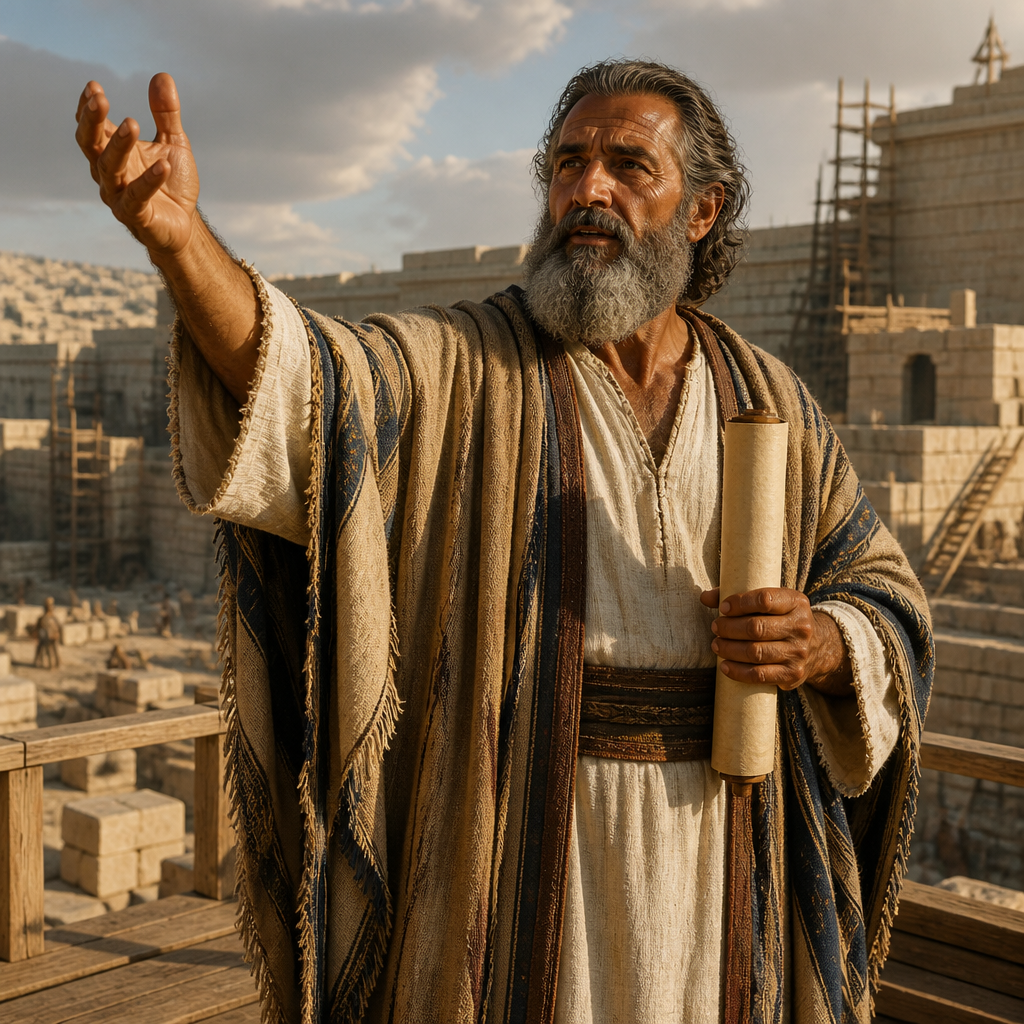
Kadmiel appears prominently during the spiritual revival led by Ezra and Nehemiah following the completion of Jerusalem’s walls (c. 444 BC). In Nehemiah 9, Kadmiel is listed as one of the Levites who stood on the "raised platform" to lead the assembly in a loud, public cry to the LORD. This event was a marathon of corporate repentance, where the Levites recounted the history of God's faithfulness versus Israel's rebellion. Kadmiel was specifically named as one of the leaders who exhorted the people, saying, “Stand up and bless the LORD your God from everlasting to everlasting” (Nehemiah 9:5).
Following this prayer, Kadmiel was among those who set their seal—a formal, legal commitment—to the written covenant. This document, described in Nehemiah 10, bound the community to abstain from intermarriage with pagans, to observe the Sabbath, and to provide financial support for the Temple services.
Relationship to Other Biblical Figures
Kadmiel worked in close concert with the primary leaders of the restoration. In the early years, he served under the civil leadership of Zerubbabel and the spiritual oversight of the High Priest Joshua. In the liturgical records, he is frequently paired with Sherebiah and Jeshua. Nehemiah 12:24 notes that these men led the "songs of thanksgiving," standing across from their associates to perform antiphonal praise—a tradition that traces its liturgical origins back to the prescriptions of King David. This indicates that Kadmiel was considered a guardian of the Davidic musical and worship traditions.
Spiritual Significance
The life of Kadmiel illustrates the theme of continuity. Despite the trauma of the exile, he preserved the identity of his house and the specifics of his calling. The biblical narrative uses Kadmiel to emphasize that the restoration of Israel was not merely a political event but a liturgical one. By standing on the platform to lead the people in prayer, Kadmiel bridged the gap between the Law of Moses and the practical life of the post-exilic community. His signature on the covenant signifies the Levites' role as the moral compass of the nation, ensuring that the mistakes of the past—which led to the exile—were not repeated in the new era of the Second Temple.
Kadmiel serves as a model of the 'faithful remnant.' His presence in both the early lists of Ezra and the later accounts of Nehemiah highlights the role of the Levites in maintaining the spiritual infrastructure of Israel during its most fragile period of reconstruction. He is significant for his involvement in the 'Great Prayer' of Nehemiah 9, which is one of the longest and most comprehensive historical recitations in the Bible.
Theologically, Kadmiel represents the restoration of worship. His work in supervising the Temple foundation and leading the musical responses in the liturgy shows that the post-exilic community prioritized the presence of God as the center of their national identity. His inclusion in the sealing of the covenant underscores the importance of leadership accountability in biblical governance.
Frequently Asked Questions
What was Kadmiel's primary role in the Bible?
Kadmiel was a Levite leader who supervised the rebuilding of the Temple and led the people in liturgical worship and public confession of sin.
When did Kadmiel live?
He lived during the Post-Exilic Period, specifically during the return from Babylon starting around 538 BC and continuing through the reforms of Nehemiah in the mid-5th century BC.
Did Kadmiel sign the covenant with Nehemiah?
Yes, Kadmiel is listed in Nehemiah 10:9 as one of the Levites who placed his seal on the formal written agreement to follow God's Law.
Who was Kadmiel's son?
According to Nehemiah 12:24, he had a son named Jeshua who also became a leader among the Levites.
What family line did Kadmiel belong to?
He was a descendant of Hodaviah (also referred to as Hodevah), a Levite family mentioned in the genealogical records of Ezra and Nehemiah.
Family & Relationships
 KadmielThis page
Children
 Jeshua, Son of KadmielSonNehemiah 12:24Stated
Connected Figures
Family
Son · Nehemiah 12:24
A Levite leader in post-exilic Jerusalem who directed antiphonal worship and thanksgiving during the era of the Second Temple.
Exile and ReturnFirst: Nehemiah 12:241 versesLeader of the LevitesLevi
Categories
Mentions by Book
- Ezra2
- Nehemiah6
Scripture References
All 8 indexed verses, in canonical order, from the Berean Standard Bible.
Ezra · 2
- Ezra 2:40
The Levites: the descendants of Jeshua and Kadmiel (through the line of Hodaviah), 74.
- Ezra 3:9
So Jeshua and his sons and brothers, Kadmiel and his sons (descendants of Yehudah), and the sons of Henadad and their sons and brothers—all Levites—joined together to supervise those working on the house of God.
Nehemiah · 6
- Nehemiah 7:43
The Levites: the descendants of Jeshua (through Kadmiel, through the line of Hodevah), 74.
- Nehemiah 9:4
And the Levites—Jeshua, Bani, Kadmiel, Shebaniah, Bunni, Sherebiah, Bani, and Chenani—stood on the raised platform and cried out in a loud voice to the LORD their God.
- Nehemiah 9:5
Then the Levites—Jeshua, Kadmiel, Bani, Hashabneiah, Sherebiah, Hodiah, Shebaniah, and Pethahiah—said, “Stand up and bless the LORD your God from everlasting to everlasting: Blessed be Your glorious name, and may it be exalted above all blessing and praise.
- Nehemiah 10:9
The Levites: Jeshua son of Azaniah, Binnui of the sons of Henadad, Kadmiel,
- Nehemiah 12:8
The Levites were Jeshua, Binnui, Kadmiel, Sherebiah, Judah, and Mattaniah, who, with his associates, led the songs of thanksgiving.
- Nehemiah 12:24
The leaders of the Levites were Hashabiah, Sherebiah, and Jeshua son of Kadmiel, along with their associates, who stood across from them to give praise and thanksgiving as one section alternated with the other, as prescribed by David the man of God.