Sallu, Priest of the Return
A prominent head of a priestly family who returned to Jerusalem from the Babylonian exile during the leadership of Zerubbabel and Jeshua.
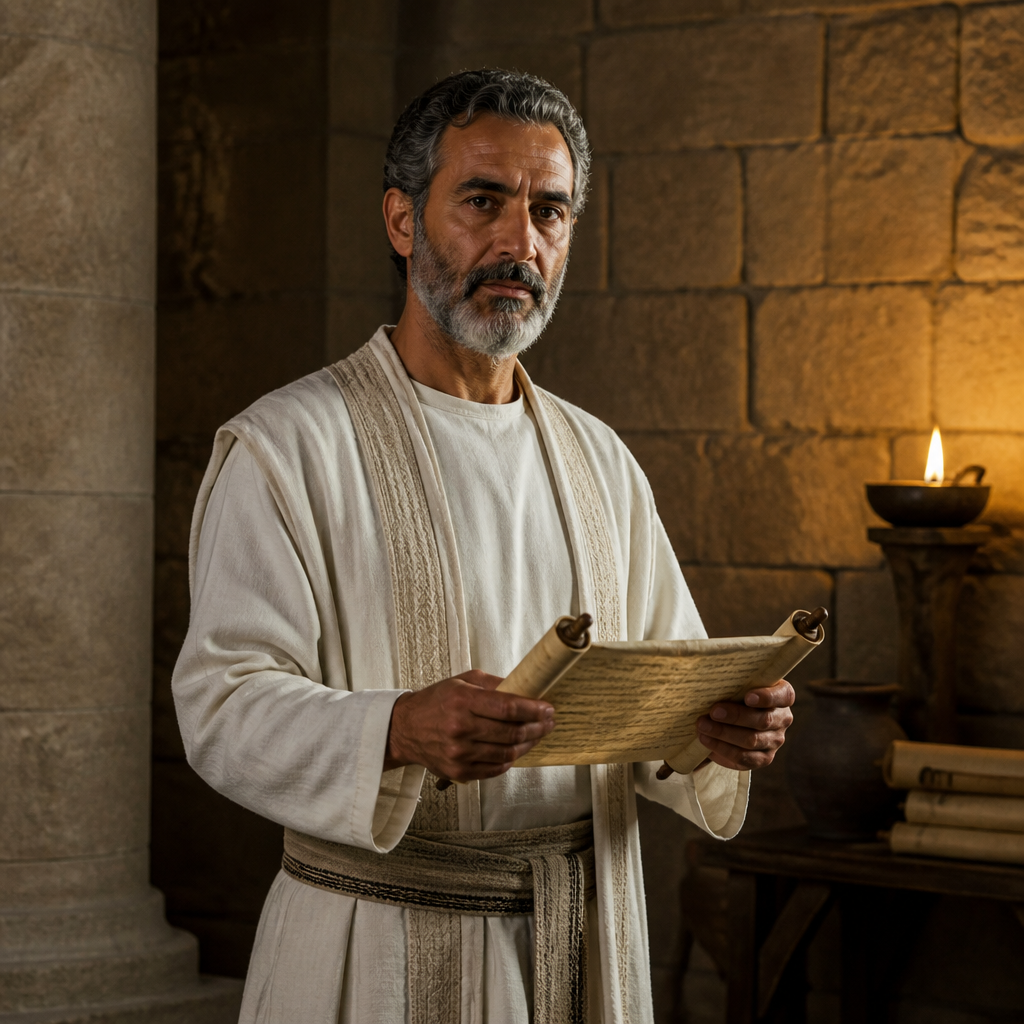
Sallu was a significant figure among the Jewish priesthood during the critical period of the Post-Exilic return to Judah. He is identified as one of the 'heads of the priests' who accompanied Zerubbabel, the governor, and Jeshua, the high priest, in the initial wave of returnees from Babylon. His role was foundational in re-establishing the sacrificial system and religious order in the reconstructed Jerusalem.
While his individual actions are not detailed in narrative form, his inclusion in the genealogical records of Nehemiah 12 underscores his status as a leader of a paternal house. His lineage continued to serve in the Temple into the next generation, maintaining the continuity of the Aaronic priesthood through the transition from exile to the Second Temple era.
Background and Family
Sallu appears in the biblical record within the context of the Restoration, specifically the period following the decree of Cyrus the Great in 538 BC. As a priest, Sallu belonged to the tribe of Levi and the house of Aaron, though his specific sub-lineage is not detailed beyond his own name as the head of a father's house. During this era, the identification of valid priestly lineages was of paramount importance to ensure the ritual purity and legitimacy of the Temple service. Sallu was among those who could prove their ancestry, allowing him to serve as a leader among his peers.
In the lists provided by the chronicler, Sallu is associated with other prominent priestly leaders such as Amok, Hilkiah, and Jedaiah. These men represented the ecclesiastical backbone of the community that returned to Zion to rebuild the altar and eventually the Temple itself.
Major Life Events
The primary historical event involving Sallu was the migration from Babylon to Jerusalem. This journey, occurring around 537 BC, was a physically and spiritually demanding trek across hundreds of miles of desert. Upon arrival, Sallu and his associates were tasked with the immediate restoration of the religious life of Israel. According to Nehemiah 12:7, he was one of the 'heads of the priests and their associates in the days of Jeshua.' This indicates that he served during the high priesthood of Jeshua (also known as Joshua), the son of Jozadak.
By the following generation, the records show a slight shift in the orthography of the family name. In the days of Joiakim (the son and successor of Jeshua), the head of Sallu’s priestly house is listed as Kallai. In this register (Nehemiah 12:20), the name is recorded as 'Sallai.' Scholars generally agree this is a spelling variant of the same family line established by Sallu.
Relationship to Other Biblical Figures
Sallu’s primary associations are professional and communal. He is linked directly to Jeshua, the first High Priest of the return, and Zerubbabel, the Davidic descendant who led the people. He is also grouped with Amok, Hilkiah, and Jedaiah, suggesting these families may have had specific shared responsibilities or geographic proximity within the tribal allotments of the priests around Jerusalem.
Spiritual Significance
The significance of Sallu lies in his role as a 'remnant-bearer.' His willingness to leave the established (though captive) life in Babylon to return to the ruins of Jerusalem reflects a commitment to the covenantal promises of God. As a priest, his life was dedicated to the mediation between God and the people through the sacrificial system.
Furthermore, Sallu represents the preservation of the divine order. Despite the trauma of the exile and the destruction of the first Temple, the priestly lines remained intact. Sallu serves as a link in the chain that connects the pre-exilic worship of Solomon's Temple to the post-exilic worship of the Second Temple, ensuring that the 'daily sacrifice' could be offered once more in accordance with the Law of Moses.
Spiritual Significance
Sallu's inclusion in the Nehemiah genealogies serves to validate the continuity of the Levitical priesthood after the Babylonian Captivity. His presence among the leaders who returned with Zerubbabel emphasizes the importance of organized religious leadership in the rebuilding of the Jewish state.
Theologically, Sallu represents the 'holy seed' returning to the land. By maintaining his family's identity through seventy years of exile, he enabled the restoration of the liturgical life of Israel, which was essential for the community's spiritual identity and its preparation for future generations.
Frequently Asked Questions
When did Sallu live?
Sallu lived during the late 6th century BC, specifically during the time of the first return from Babylonian exile (c. 538–520 BC).
What was Sallu's occupation?
Sallu was a priest and a leader (head) of a priestly family.
Are Sallu and Sallai the same person?
Nehemiah 12:20 mentions 'Sallai' in the context of the next generation of the family founded by 'Sallu' (Nehemiah 12:7). Most scholars consider Sallai to be the same family name, with Kallai serving as the head of that house in the next generation.
Which biblical book mentions this Sallu?
This specific Sallu is mentioned only in the book of Nehemiah, chapter 12.
Connected Figures
Jeshua
High Priest during Sallu's service
Zerubbabel
Governor and leader of the return
Kallai
Successor as head of his priestly house
Categories
Mentions by Book
- Nehemiah2
Others Named Sallu
Sallu, son of Meshullam and son of JoedNehemiah 11:7
A descendant of Benjamin who settled in Jerusalem during the Post-Exilic period under the leadership of Nehemiah.
Sallu, Son of Meshullam1 Chronicles 9:7
A prominent Benjamite who was among the first of the returning exiles to resettle in Jerusalem after the Babylonian captivity.