Rephaiah, Ruler of a Half-District of Jerusalem
A high-ranking administrative leader in post-exilic Jerusalem who oversaw the reconstruction of a section of the city wall under Nehemiah.
Rephaiah, the son of Hur, was a significant civic leader during the Post-Exilic Period. He held the prestigious position of 'ruler of a half-district of Jerusalem,' a title that indicates he was part of the Judean administrative elite responsible for civil governance during the Persian oversight of the region.
His primary biblical appearance occurs during the mid-5th century BC, specifically within the record of the restoration of Jerusalem's defenses. As a leader of the local citizenry, Rephaiah mobilized resources and labor to support Nehemiah’s project to secure the city against surrounding hostile forces. His contribution is documented within the formal list of wall builders, situating him among the noble families who prioritized the spiritual and physical fortification of the Jewish capital.
Background and Family
The biblical record identifies Rephaiah as the son of Hur. While the text does not explicitly state his tribal affiliation, his position as a ruler within Jerusalem suggests he was of the tribe of Judah or Benjamin, the primary groups that returned to the land following the Babylonian captivity. His father, Hur, is not detailed further in the Nehemiah account, but the mention of the father’s name serves to establish Rephaiah’s legitimacy and standing within the community of the returnees.
Rephaiah served as the "ruler of a half-district of Jerusalem" (Nehemiah 3:9). This administrative division implies that Jerusalem was divided into two administrative sectors for the purpose of the reconstruction effort. Rephaiah oversaw one half, while Shallum son of Hallohesh oversaw the other. This structure highlights Rephaiah’s high social status and his authority over the residents of his specific jurisdiction.
Major Life Events
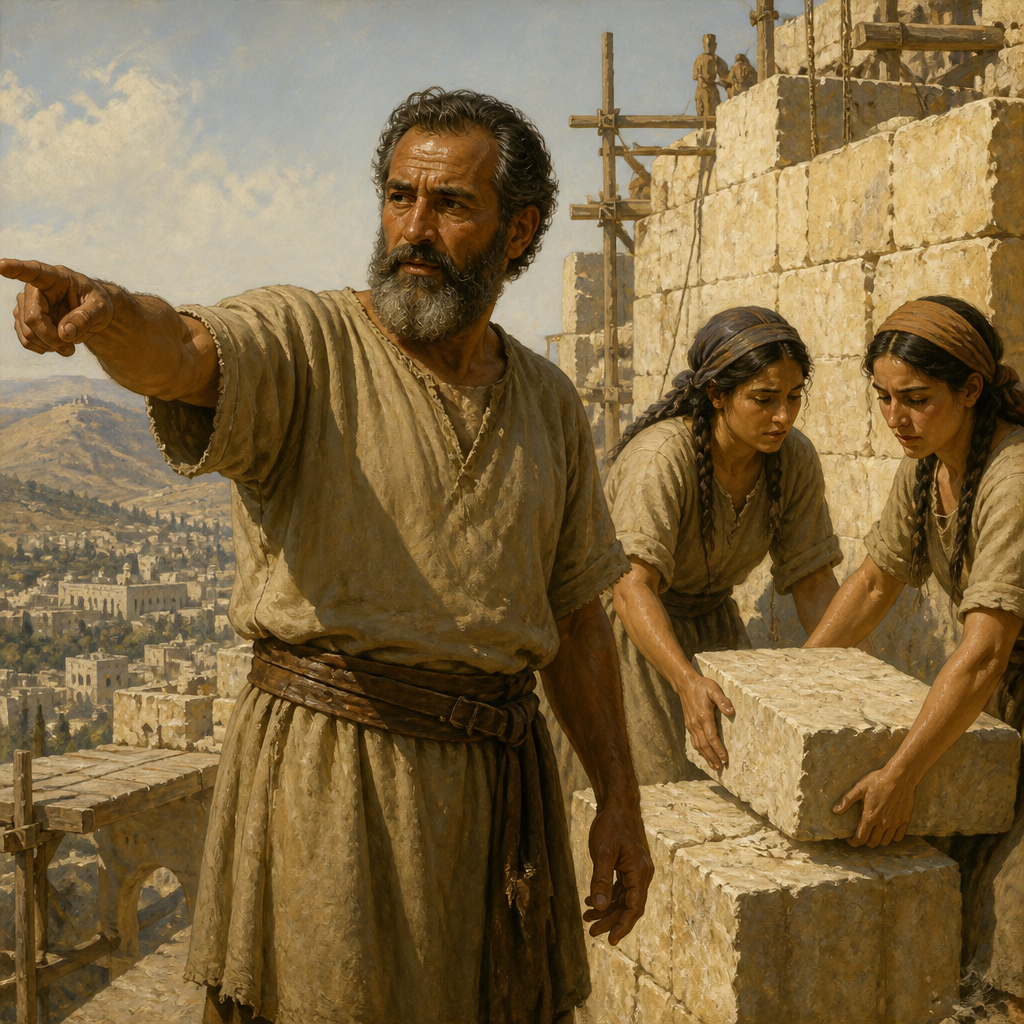
The defining moment of Rephaiah’s recorded life is his participation in the rebuilding of the walls of Jerusalem in approximately 444 BC. After the Babylonian destruction in 586 BC, the city’s defenses remained in ruins for over a century until Nehemiah received permission from Artaxerxes I to rebuild them.
Rephaiah is noted for working "next to" the group led by Jedaiah son of Harumaph. The text specifies that Rephaiah and his associates "made repairs" on a designated portion of the wall. In the context of Nehemiah 3, these repairs were not merely symbolic; they involved heavy masonry, the setting of beams, and the hanging of massive gates. As a district ruler, Rephaiah would have been responsible for organizing the craftsmen, laborers, and finances from his district to ensure their section of the wall was completed to standard.
Relationship to Other Biblical Figures
Rephaiah worked in direct cooperation with Nehemiah, the governor of Judah. He is positioned in the narrative alongside other civic and religious leaders, including the High Priest Eliashib and various district governors. His peers in the reconstruction included Shallum, the ruler of the other half-district of Jerusalem. This horizontal relationship shows a unified front among the Judean aristocracy to fulfill the mandate of restoring the Holy City.
Spiritual Significance
Though his mention is brief, Rephaiah represents the principle of dedicated leadership during times of national restoration. His willingness to labor physically on the wall, despite his high administrative rank, serves as a biblical example of servant-leadership. In the post-exilic community, the act of rebuilding the wall was considered a spiritual act of devotion to God, signaling the end of the city's reproach and the re-establishment of a visible, secure center for Jewish worship. Rephaiah’s inclusion in the "Nehemiah 3 Roll of Honor" ensures his legacy as one who helped transition the nation from a state of ruin to a state of renewed covenantal identity.
Spiritual Significance
Rephaiah is significant as a representative of the administrative class that supported the restoration of Jerusalem. His role proves that the rebuilding of the city was not solely the work of Nehemiah or the priesthood, but involved the coordinated effort of civil governors and district leaders. His participation validates the importance of secular leadership working in harmony with spiritual mandates to achieve national stability.
Furthermore, Rephaiah’s presence in the text underscores the historical reliability of the Nehemiah account. The inclusion of specific district titles and familial lineages like 'son of Hur' points to a meticulous record-keeping process intended to document the legitimate heirs and leaders of the post-exilic period.
Frequently Asked Questions
What was Rephaiah's job in Jerusalem?
Rephaiah was the ruler of a half-district of Jerusalem, an administrative position that involved governing a portion of the city and its surrounding area during the Persian period.
Which part of the wall did Rephaiah repair?
While the exact location isn't named by a specific gate, Nehemiah 3:9 places his work detail 'next to' Jedaiah son of Harumaph, contributing to the contiguous repair of the city's defenses.
Who was Rephaiah's father?
He is identified as the son of Hur.
During which historical period did Rephaiah live?
He lived during the Post-Exilic Period (Exile and Return), specifically during the time when Nehemiah was governor of Judah (mid-5th century BC).
Is Rephaiah mentioned in any other books of the Bible?
No, this specific Rephaiah, the district ruler and son of Hur, is only mentioned in the book of Nehemiah.
Connected Figures
Nehemiah
Governor and supervisor of the wall project
Hur
Father
Shallum son of Hallohesh
Peer (Ruler of the other half-district of Jerusalem)
Categories
Mentions by Book
- Nehemiah1
Family & Relationships
Parent
Nehemiah 3:9
Others Named Rephaiah
Rephaiah, Son of Tola1 Chronicles 7:2
A head of a family within the tribe of Issachar and a descendant of Tola, recognized for his lineage of mighty men of valor.
Rephaiah, Descendant of David1 Chronicles 3:21
Rephaiah was a noble of the tribe of Judah and a grandson of Zerubbabel, serving as a vital link in the Davidic royal lineage during the Divided Monarchy era.
Rephaiah, Son of Ishi1 Chronicles 4:42
Rephaiah was one of the four Simeonite leaders who spearheaded a military expedition to Mount Seir to conquer and settle the territory during the Divided Monarchy.