Shallum, Son of Hallohesh
Who was Shallum, Son of Hallohesh, in the Bible?
A district ruler in Jerusalem who assisted Nehemiah in rebuilding the city walls alongside his daughters during the post-exilic return.
This is one of 13 people named Shallum in the Bible. See all 13 →
Shallum, son of Hallohesh, was a prominent Jewish official during the mid-5th century BC, serving as a ruler of a half-district of Jerusalem. His name, which means 'retribution' or 'peaceable,' appears in the records of the restoration of Jerusalem's infrastructure following the Babylonian exile. He is uniquely noted in the biblical text for the collaborative nature of his labor during the reconstruction effort led by Nehemiah.
Operating under the authority of the Persian Empire but driven by religious and nationalistic devotion, Shallum took responsibility for a specific section of the city's defenses. His contribution is distinguished by the explicit mention of his daughters’ involvement, highlighting a rare moment of recorded female participation in the physical labor of the wall's restoration.
Background and Family
Shallum was the son of Hallohesh, a man whose name suggests a connection to 'the whisperer' or 'the enchanter.' As a 'ruler of the other half-district of Jerusalem,' Shallum held a significant administrative position in the local government of the Persian province of Yehud. This title indicates that Jerusalem was divided into two administrative sectors for the purpose of the rebuilding project, with Shallum overseeing one and Rephaiah son of Hur overseeing the other (Nehemiah 3:9). While his tribal lineage is not explicitly stated in the text of Nehemiah 3:12, his status as a leader in Jerusalem implies he was of the tribe of Judah or Benjamin, the primary tribes that returned to the region after the edict of Cyrus the Great.
Major Life Events
The primary historical record of Shallum occurs during the systematic rebuilding of the walls of Jerusalem in 444 BC. Following the arrival of Nehemiah, the Jewish community was organized into specific teams to repair different gates and sections of the wall. Shallum was assigned the section adjacent to the men of Gibeon and Mizpah and near the section repaired by the sons of Hassenaah.
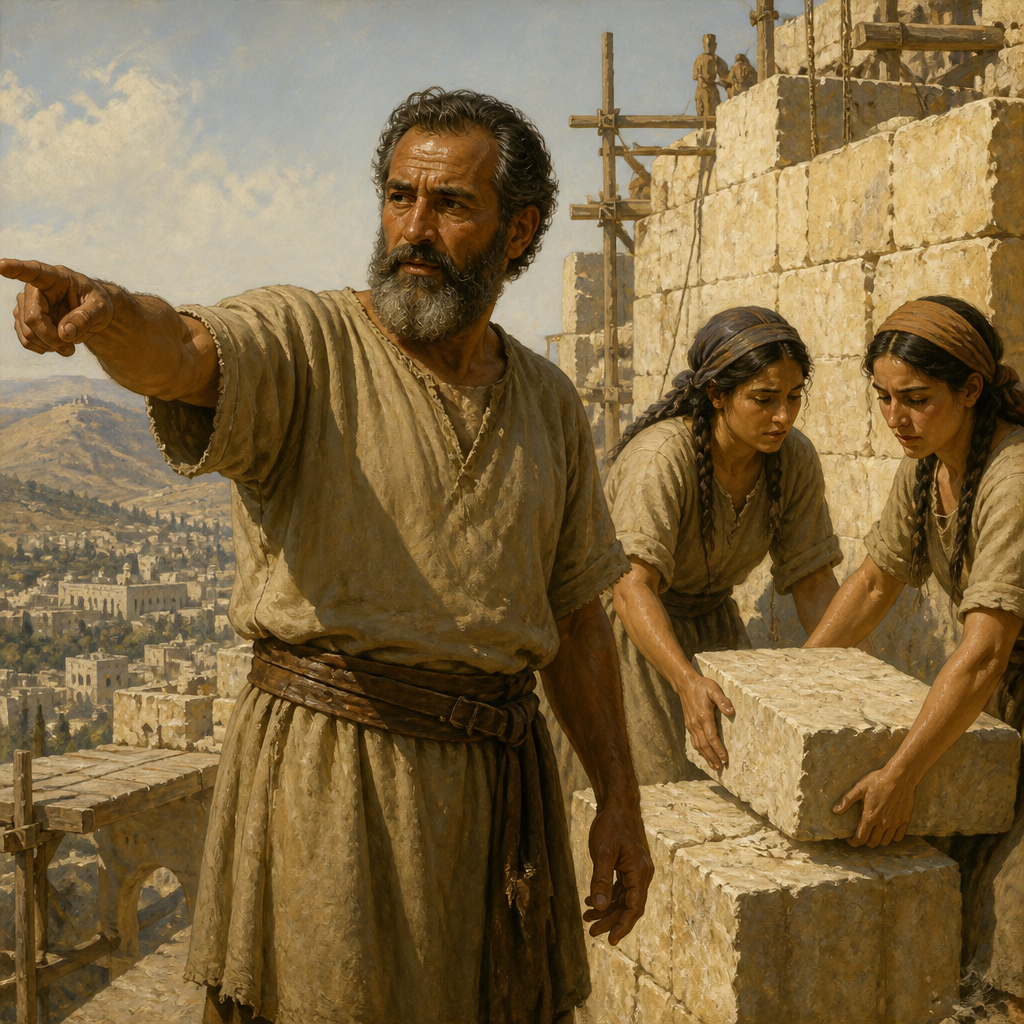
Nehemiah 3:12 records: "And next to them, Shallum son of Hallohesh, ruler of the other half-district of Jerusalem, made repairs, with the help of his daughters." This detail is significant because, while the list of builders in Nehemiah 3 primarily focuses on male heads of households, craftsmen, and priests, Shallum’s daughters are the only women specifically mentioned as active participants in the physical construction of the wall. This suggests either a lack of male heirs in Shallum's immediate household or a particularly high level of zeal for the restoration of the holy city that transcended traditional gender roles of the period.
Relationship to Other Biblical Figures
Shallum operated under the direct leadership of Nehemiah, the governor appointed by Artaxerxes I. He worked in close proximity to other civic leaders, such as Rephaiah son of Hur and Malchijah son of Rechab. As a district ruler, he would have been part of the aristocratic and administrative class that coordinated the logistics of the returnees, ensuring that the labor was not only performed but also defended against the threats of Sanballat and Tobiah.
Spiritual Significance
Although Shallum appears in only one verse, his inclusion in the text serves a specific theological and historical purpose. He represents the communal effort required to restore the covenant community's safety and identity. The mention of his daughters provides a biblical precedent for the inclusion of all members of the community—regardless of gender—in the work of God’s kingdom. Shallum’s willingness to engage his entire family in manual labor, despite his high social standing as a district ruler, underscores a theme of humility and shared sacrifice that defines the Post-Exilic Period.
Shallum son of Hallohesh is significant as a model of civic and religious cooperation. His role as a district ruler demonstrates that the leadership of Jerusalem was fully committed to Nehemiah’s reforms. More notably, he is the only builder in the Nehemiah 3 list recorded as working alongside his daughters, providing a rare scriptural example of women contributing to the physical infrastructure of the Jewish state during the restoration.
His presence in the text reinforces the concept that the rebuilding of Jerusalem was a total community effort. It suggests that the urgency of the task—securing the city against surrounding enemies—overrode social conventions, leading to a unified front of workers from various backgrounds and family structures.
Frequently Asked Questions
What was Shallum's job in Jerusalem?
Shallum was the 'ruler of the other half-district of Jerusalem,' a high-ranking administrative position in the local government during the Persian period.
Who helped Shallum repair the wall of Jerusalem?
Shallum made repairs to the wall with the help of his daughters, a unique detail in the list of builders provided in Nehemiah 3.
When did Shallum live?
Shallum lived during the Post-Exilic Period, specifically during the time of Nehemiah’s governorship around 444 BC.
What does the name Shallum mean?
The name Shallum is derived from a Hebrew root meaning 'peaceable,' 'requital,' or 'retribution.'
Family & Relationships
Parents
 HalloheshFatherNehemiah 3:12Stated
 Shallum, Son of HalloheshThis page
Connected Figures
Family
Father · Nehemiah 3:12
A Jewish leader during the Post-Exilic period who participated in the reconstruction of Jerusalem's walls and the formal renewal of the covenant under Nehemiah.
Exile and ReturnFirst: Nehemiah 3:122 versesCovenant Signatory
Categories
Mentions by Book
- Nehemiah1
Scripture References
All 1 indexed verse, in canonical order, from the Berean Standard Bible.
Nehemiah · 1
- Nehemiah 3:12
And next to them, Shallum son of Hallohesh, ruler of the other half-district of Jerusalem, made repairs, with the help of his daughters.
Others Named Shallum
Compare all 13 bearers →Shallum, Son of Shaul1 Chronicles 4:25
Shallum was a member of the Tribe of Simeon and the son of Shaul, whose lineage is preserved in the genealogical records of 1 Chronicles.
Shallum, Father of Hilkiah1 Chronicles 6:12
A high-ranking priest of the line of Zadok who served during the Divided Monarchy and fathered the High Priest Hilkiah.
Shallum, Levite Gatekeeper of the Return1 Chronicles 9:17
A prominent Levite chief gatekeeper and head of a family whose descendants served at the Temple during the post-exilic return from Babylon.
Shallum of the Sons of BaniEzra 10:42
A returning exile from the family of Bani who was among those addressed by Ezra for taking a foreign wife.
Shallum son of Jabesh2 Kings 15:10
The fifteenth king of Israel, Shallum son of Jabesh ascended the throne through assassination and reigned for only one month in Samaria during the Divided Monarchy.
Shallum, Father of MaaseiahJeremiah 35:4
Shallum was a Levite doorkeeper during the Divided Monarchy whose son Maaseiah held a chamber in the Temple during the time of the prophet Jeremiah.
Shallum, Gatekeeper of the ReturnEzra 10:24
A Levite gatekeeper during the post-exilic return under Ezra who was among those addressed for taking foreign wives.
Shallum, Son of Sismai1 Chronicles 2:40
Shallum was a member of the Tribe of Judah and a descendant of Jerahmeel whose lineage is preserved in the genealogical records of 1 Chronicles.
Shallum, Uncle of JeremiahJeremiah 32:7
Shallum was the paternal uncle of the prophet Jeremiah and the father of Hanamel during the final years of the Divided Monarchy.
Shallum, Father of Jehizkiah2 Chronicles 28:12
An Ephraimite leader during the Exile and Return whose son, Jehizkiah, played a critical role in showing mercy to Judean captives during the reign of King Pekah.
Shallum, Keeper of the Wardrobe2 Kings 22:14
A high-ranking royal official in the kingdom of Judah and the husband of Huldah the prophetess during the reign of King Josiah.
Shallum, Son of Col-hozehNehemiah 3:15
Shallum, son of Col-hozeh, was a district ruler of Mizpah who oversaw the reconstruction of the Fountain Gate and its adjacent structures during the return to Jerusalem.