Poratha
Who was Poratha in the Bible?
Poratha was one of the ten sons of Haman the Agagite, executed during the events of the Jewish defense against their enemies in the Persian capital of Susa.
Poratha is a minor figure mentioned in the Old Testament Book of Esther. He is identified as one of the ten sons of Haman, the high-ranking Persian official who plotted the genocide of the Jewish people during the reign of King Xerxes. Poratha lived during the Exilic Period, specifically during the time of the Jewish diaspora in the Persian Empire around the 5th century BC.
His role in the biblical narrative is confined to the aftermath of the Jewish victory over those who sought to destroy them. Following the downfall of his father, Haman, Poratha and his nine brothers were caught up in the violent resolution of the conflict initiated by their father's decree. The mention of his name serves as a genealogical and historical record of the total downfall of Haman’s house.
Background and Family
Poratha was a member of the house of Haman the Agagite, the son of Hammedatha. His father, Haman, rose to a position of supreme authority under the Persian King Xerxes, second only to the king himself. As an Agagite, Poratha is traditionally linked to the lineage of Agag, the king of the Amalekites, who were historical adversaries of Israel. This ancestral background colors the biblical presentation of Poratha as part of a family inherently opposed to the survival of the Jewish people.
He was one of ten brothers: Parshandatha, Dalphon, Aspatha, Adalia, Aridatha, Parmashta, Arisai, Aridai, and Vaizatha. While the Bible does not explicitly name his mother, Jewish tradition often identifies her as Zeresh, Haman's wife, who is depicted in the text as encouraging Haman’s pride and his plot against Mordecai.
Major Life Events
The biblical record concerning Poratha is limited to his death. His life was shaped by his father’s attempt to annihilate the Jews through a royal decree. When the plot was reversed through the intervention of Queen Esther and Mordecai, Haman was executed. However, the decree for the Jews' destruction remained legal, leading to a day of armed conflict.
On the thirteenth day of the month of Adar, the Jews in Susa defended themselves against their enemies. According to Esther 9:7-10, during this defense, the Jews slew five hundred men in the citadel of Susa, including the ten sons of Haman. Poratha is specifically listed as one of those killed. Following the battle, at the specific request of Queen Esther, the bodies of Poratha and his brothers were hanged on the gallows as a public display of the finality of Haman's defeat and a deterrent against further rebellion.
Relationship to Other Biblical Figures
Poratha’s primary relationship is that of a son to Haman. The biblical text emphasizes this collective identity by listing all ten sons together, reinforcing the concept of corporate responsibility and the complete erasure of Haman’s legacy. He is also defined by his relationship to his siblings, appearing in the middle of the list of brothers in Esther 9:8. His existence is inextricably tied to the rise and fall of his father’s house and its conflict with Mordecai and the Jewish community.
Spiritual Significance
In the context of the Book of Esther, Poratha serves as a symbol of the ultimate failure of those who oppose God’s people. His death and subsequent hanging represent the fulfillment of justice against a family that sought the unprovoked destruction of an entire nation. The inclusion of his name in the Megillah (the Scroll of Esther) ensures that he is remembered not for individual deeds, but as a component of the total victory of the Jewish people during the festival of Purim. His end illustrates the biblical theme that the schemes of the wicked often return upon their own heads and their descendants.
Poratha's inclusion in the list of Haman's sons highlights the total collapse of the Agagite house and the fulfillment of the reversal of fortunes (peripeteia) that characterizes the Book of Esther. His execution marks the end of a lineage that represented the ultimate threat to the Jewish people during the Persian exile.
Theological reflections on Poratha often center on the concept of judgment reaching the 'house' of the oppressor. His name is ritually recited in a single breath during the public reading of the Megillah in Jewish liturgy to signify that Haman's sons died simultaneously, emphasizing a swift and complete divine judgment.
Frequently Asked Questions
Who was Poratha's father?
Poratha was the son of Haman the Agagite, the primary antagonist in the Book of Esther.
How did Poratha die?
He was killed by the Jews in the citadel of Susa while they were defending themselves against their enemies on the 13th of Adar.
What happened to Poratha's body after his death?
His body, along with those of his nine brothers, was hanged on the gallows at the request of Queen Esther.
Why is Poratha mentioned by name in the Bible?
He is mentioned to provide a historical record of the total destruction of Haman's descendants, ensuring the audience knows that Haman's legacy was completely severed.
Where in the Bible is Poratha found?
Poratha is mentioned only once, in Esther 9:8.
Family & Relationships
Parents
 PorathaThis page
Connected Figures
Family

Father · Esther 9:7–10
A high-ranking Persian official under King Xerxes who orchestrated a failed genocidal plot against the Jewish people during the post-exilic period.
Exile and ReturnFirst: Esther 3:148 versesGrand Vizier of the Persian Empire

Mother · Esther 6:13
The wife of Haman the Agagite who advised the construction of a gallows for Mordecai and later prophesied her husband's downfall.

Brother · Esther 9:8
Adalia was one of the ten sons of Haman the Agagite, executed by the Jews during the events of Purim in Shushan.
Exile and ReturnFirst: Esther 9:85 versesSon of Haman

Brother · Esther 9:8–9
One of the ten sons of Haman the Agagite, executed by the Jews in Susa during the events of Purim.
Exile and ReturnFirst: Esther 9:95 versesSon of a Persian official

Brother · Esther 9:8
Aridatha was one of the ten sons of Haman the Agagite, executed during the Jewish defense in Susa as recorded in the Book of Esther.

Brother · Esther 9:8–9
Arisai was one of the ten sons of Haman the Agagite, executed by the Jews in Susa during the events recorded in the Book of Esther.
Exile and ReturnFirst: Esther 9:95 versesSon of a Persian official

Brother · Esther 9:7–8
Aspatha was one of the ten sons of Haman the Agagite, executed during the Jewish defense in Shushan as recorded in the Book of Esther.
Exile and ReturnFirst: Esther 9:75 versesPrince of the Agagites

Brother · Esther 9:7–8
Dalphon was one of the ten sons of Haman the Agagite, executed by the Jews in Susa following his father's failed genocidal plot against them during the reign of King Xerxes.
Exile and ReturnFirst: Esther 9:75 versesSon of a Persian official

Brother · Esther 9:8–9
Parmashta was one of the ten sons of Haman the Agagite, executed during the events of Purim in Susa.
Exile and ReturnFirst: Esther 9:95 versesPersian Nobleman

Brother · Esther 9:7–8
The eldest son of Haman the Agagite, executed along with his brothers during the Jewish defense in Susa during the reign of King Ahasuerus.
Exile and ReturnFirst: Esther 9:75 versesSon of a High Official
Brother · Esther 9:8–9
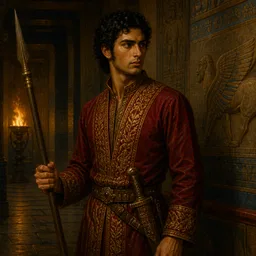
Vaizatha was the youngest son of Haman the Agagite, executed alongside his brothers during the Jewish defense in Susa following the failure of Haman's genocidal plot.
Exile and ReturnFirst: Esther 9:95 versesPersian Noble
Categories
Mentions by Book
- Esther5
Scripture References
All 5 indexed verses, in canonical order, from the Berean Standard Bible.
Esther · 5
- Esther 6:13Partial
Haman told his wife Zeresh and all his friends everything that had happened. His advisers and his wife Zeresh said to him, “Since Mordecai, before whom your downfall has begun, is Jewish, you will not prevail against him—for surely you will fall before him.”
Cited as evidence on a family card; added so References, Key Verses and Mentions by Book share one index.
- Esther 9:7Partial
including Parshandatha, Dalphon, Aspatha,
Cited as evidence on a family card; added so References, Key Verses and Mentions by Book share one index.
- Esther 9:8
Poratha, Adalia, Aridatha,
- Esther 9:9Partial
Parmashta, Arisai, Aridai, and Vaizatha.
Cited as evidence on a family card; added so References, Key Verses and Mentions by Book share one index.
- Esther 9:10Partial
They killed these ten sons of Haman son of Hammedatha, the enemy of the Jews, but they did not lay a hand on the plunder.
Cited as evidence on a family card; added so References, Key Verses and Mentions by Book share one index.