Hammedatha
Who was Hammedatha in the Bible?
Hammedatha was the father of Haman the Agagite, the primary antagonist of the book of Esther during the Persian Exile.
Hammedatha is a figure mentioned in the Old Testament book of Esther, functioning primarily as a genealogical marker for one of the Bible's most notorious villains, Haman. His name appears five times in the biblical record, consistently linked to his son's identification as the "Agagite." Living during the Exilic and Post-Exilic period under the Persian Empire, Hammedatha represents a lineage that the biblical narrative positions in direct opposition to the Jewish people.
While the text provides no specific details regarding Hammedatha's personal actions, his identity is crucial for establishing the historical and spiritual friction between the house of Israel and the house of Haman. His name is of Persian origin, possibly meaning "given by the Moon" or "double gift," reflecting the cultural environment of the Achaemenid Empire where he and his family resided during the reign of King Xerxes (Xerxes).
Background and Family
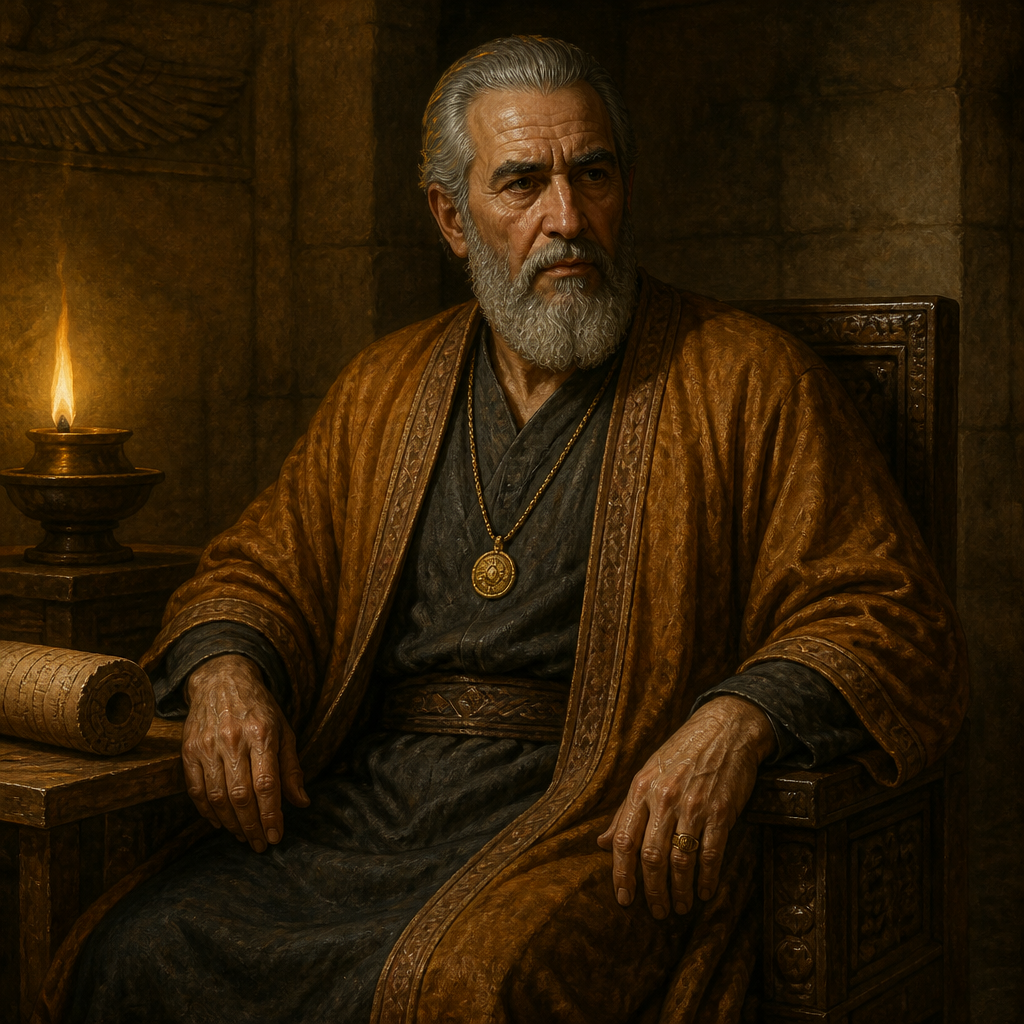
Hammedatha appears within the historical context of the Persian Empire during the 5th century BC. He is specifically identified as the father of Haman, the high-ranking official who serves as the chief antagonist in the narrative of Queen Esther. The biblical text consistently attaches the descriptor "the Agagite" to Haman's lineage through Hammedatha (Esther 3:1).
This designation is significant to biblical scholars as it suggests a connection to Agag, the king of the Amalekites who was spared by King Saul but later executed by the prophet Samuel (1 Samuel 15). If this ancestral link is literal, Hammedatha was a descendant of the ancient enemies of Israel, the Amalekites. This heritage provides the theological and historical framework for the intense animosity Haman harbored against Mordecai and the Jewish exiles living in Susa and the surrounding provinces.
Major Life Events
The Bible does not record the personal life events, birth, or death of Hammedatha. His presence in the text is entirely functional, serving to introduce Haman’s pedigree. He is first mentioned in Esther 3:1, where King Xerxes honors Haman by elevating him to a position of authority above all other princes. The repetition of the phrase "Haman son of Hammedatha" throughout the book (Esther 3:10; 8:5; 9:24) emphasizes that Haman's identity and his subsequent plot to annihilate the Jews were inextricably linked to his family origin.
Relationship to Other Biblical Figures
Hammedatha’s primary relationship is that of a father to Haman. The biblical record also notes that he was the grandfather of Haman’s ten sons, who were eventually executed following the failure of Haman's genocidal plot (Esther 9:10). While Hammedatha himself is not recorded as interacting with Mordecai or Queen Esther, his name is invoked in the official decrees and historical summaries that describe the conflict between Haman and the Jewish people. Esther 8:5 records the Queen herself mentioning Hammedatha's name while petitioning the King to revoke the letters written by "the scheming Haman son of Hammedatha."
Spiritual Significance
In the context of the Book of Esther, Hammedatha serves as a symbol of the enduring conflict between the descendants of Israel and the descendants of Amalek. The recurring mention of his name reinforces the "Agagite" identity, reminding the reader of the ancient struggle mentioned in Exodus 17:16, where the Lord promised to be at war with Amalek from generation to generation. By identifying the enemy of the Jews as the son of Hammedatha the Agagite, the author of Esther frames the events in Susa not merely as a political dispute, but as a continuation of a long-standing spiritual and ethnic struggle. Hammedatha stands as the link between the ancient enemies of the Israelites and the immediate threat faced by the exiles in Persia.
Hammedatha's significance lies in his role as the progenitor of Haman the Agagite. His name serves as a formal identifier in the Persian court records cited within the Book of Esther, providing the genealogical weight necessary to connect Haman to the Amalekite people. This connection is vital for understanding the thematic depth of the Purim story, as it transforms a court intrigue into a fulfillment of historical prophecy regarding the erasure of Amalek's memory.
Furthermore, his name appears in the context of legal and royal decrees, illustrating the integration of non-Persian families into the high echelons of the Achaemenid government. Though he is a silent figure, the consistent use of his name in the narrative ensures that the reader never forgets the specific heritage of the man who sought to destroy the Jewish people.
Frequently Asked Questions
What does the name Hammedatha mean?
The name is likely of Old Persian origin, interpreted by many scholars to mean 'given by the Moon' or 'he who gives the law.'
Was Hammedatha alive during the events of the book of Esther?
The Bible does not specify whether Hammedatha was alive or deceased during Haman's plot; he is only mentioned as Haman's father.
Is Hammedatha an Amalekite?
The text calls his son Haman an 'Agagite,' which traditionally links Hammedatha to the lineage of Agag, the king of the Amalekites.
How many times is Hammedatha mentioned in the Bible?
Hammedatha is mentioned five times, all within the book of Esther.
Family & Relationships
 HammedathaThis page
Children
 HamanSonEsther 3:1Stated
Connected Figures
Family
Son · Esther 3:1
A high-ranking Persian official under King Xerxes who orchestrated a failed genocidal plot against the Jewish people during the post-exilic period.
Exile and ReturnFirst: Esther 3:148 versesGrand Vizier of the Persian Empire
Categories
Mentions by Book
- Esther5
Scripture References
All 5 indexed verses, in canonical order, from the Berean Standard Bible.
Esther · 5
- Esther 3:1
After these events, King Xerxes honored Haman son of Hammedatha, the Agagite, elevating him to a position above all the princes who were with him.
- Esther 3:10
So the king removed the signet ring from his finger and gave it to Haman son of Hammedatha, the Agagite, the enemy of the Jews.
- Esther 8:5
“If it pleases the king,” she said, “and if I have found favor in his sight, and the matter seems proper to the king, and I am pleasing in his sight, may an order be written to revoke the letters that the scheming Haman son of Hammedatha, the Agagite, wrote to destroy the Jews in all the king’s provinces.
- Esther 9:10
They killed these ten sons of Haman son of Hammedatha, the enemy of the Jews, but they did not lay a hand on the plunder.
- Esther 9:24
For Haman son of Hammedatha, the Agagite, the enemy of all the Jews, had plotted against the Jews to destroy them and had cast the Pur (that is, the lot) to crush and destroy them.