Aridatha
Who was Aridatha in the Bible?
Aridatha was one of the ten sons of Haman the Agagite, executed during the Jewish defense in Susa as recorded in the Book of Esther.
Aridatha was a son of Haman, the high-ranking Persian official who plotted the genocide of the Jewish people during the reign of King Xerxes. His name appears specifically in the ninth chapter of the Book of Esther within a list of Haman's ten sons. As a member of the house of Haman, Aridatha was part of a lineage identified with the Agagites, traditional enemies of the Israelites.
His role in the biblical narrative is brief but significant as a marker of the total downfall of Haman’s house. Following the exposure of Haman's plot by Queen Esther and the subsequent elevation of Mordecai, the king granted the Jews the right to defend themselves against those who sought their harm. Aridatha was among those killed during the conflict in the citadel of Susa.
Background and Family
Aridatha was one of the ten sons of Haman, the son of Hammedatha the Agagite. While his mother is not explicitly named in the verse listing his death, the narrative previously identifies Zeresh as Haman's wife and the mother of his many children (Esther 5:10-11). Aridatha’s brothers included Parshandatha, Dalphon, Aspatha, Poratha, Adalia, Parmashta, Arisai, Aridai, and Vaizatha.
The family was of high social standing in the Persian Empire due to Haman’s position as the king’s chief minister. However, their lineage is biblically linked to the Amalekites (via the designation 'Agagite'), a group historically noted for their opposition to the people of Israel. This ancestral tension forms the backdrop for the conflict that led to the family's demise during the post-exilic period.
Major Life Events
The life of Aridatha is defined by the political and ethnic crisis precipitated by his father’s decree to annihilate the Jewish population of Persia. When the decree was counteracted by a second edict allowing the Jews to defend themselves, the citadel of Susa became a site of military engagement. On the thirteenth day of the month of Adar, Aridatha and his nine brothers were killed by the Jewish defenders (Esther 9:7-9).
Following their deaths, Queen Esther requested that the bodies of Haman’s ten sons be hanged upon the gallows. This request was granted by King Xerxes, and the public display of Aridatha’s body served as a visual testament to the failure of Haman’s conspiracy and the protection of the Jewish people.
Relationship to Other Biblical Figures
Aridatha is primarily defined by his relationship to his father, Haman. In the Book of Esther, the ten sons are often treated as a singular unit representing the extension of Haman’s malice and pride. His brothers—specifically Parshandatha, Dalphon, Aspatha, Poratha, Adalia, Parmashta, Arisai, Aridai, and Vaizatha—are recorded alongside him in the only verse where his name appears.
Spiritual Significance
In biblical hermeneutics, Aridatha’s inclusion in the list of the slain represents the principle of divine justice and the complete eradication of an existential threat to God's people. The detailed naming of each son in Esther 9:7-9 is often highlighted in Jewish tradition; in the reading of the Megillah, the names of the ten sons are traditionally read in a single breath to signify that they died together as a result of their shared association with Haman’s sin. Aridatha serves as a historical witness to the theme of 'peripeteia' or 'reversal' that characterizes the Book of Esther: the gallows intended for the innocent Mordecai became the site of the downfall of Haman and his heirs.
Aridatha’s significance lies in his inclusion in the genealogical record of Haman’s house. His death and subsequent hanging symbolize the total fulfillment of justice against those who conspired to commit genocide. Within the context of Purim, Aridatha represents the collateral end of an era of persecution.
Teologially, his mention ensures that the historical record of the Jewish victory in Susa is precise. By naming each son, the text emphasizes that Haman’s legacy was completely severed, preventing any future claim to power by his immediate descendants.
Frequently Asked Questions
Who was Aridatha's father?
Aridatha was the son of Haman the Agagite, the antagonist of the Book of Esther.
How did Aridatha die?
He was killed by the Jews in the citadel of Shushan on the 13th of Adar while they were defending themselves against their enemies.
Was Aridatha's body hanged?
Yes, after he was killed in battle, King Ahasuerus granted Esther's request to have the bodies of Haman's ten sons hanged on the gallows.
What does the name Aridatha mean?
The name is of Old Persian origin, though its exact meaning is debated; some scholars suggest it relates to 'birth of Ari' or 'noble birth'.
How many brothers did Aridatha have?
He had nine brothers who are listed alongside him in Esther 9:7-10.
Family & Relationships
Parents
 AridathaThis page
Connected Figures
Family

Father · Esther 9:7–10
A high-ranking Persian official under King Xerxes who orchestrated a failed genocidal plot against the Jewish people during the post-exilic period.
Exile and ReturnFirst: Esther 3:148 versesGrand Vizier of the Persian Empire

Mother · Esther 6:13
The wife of Haman the Agagite who advised the construction of a gallows for Mordecai and later prophesied her husband's downfall.

Brother · Esther 9:8
Adalia was one of the ten sons of Haman the Agagite, executed by the Jews during the events of Purim in Shushan.
Exile and ReturnFirst: Esther 9:85 versesSon of Haman

Brother · Esther 9:8–9
One of the ten sons of Haman the Agagite, executed by the Jews in Susa during the events of Purim.
Exile and ReturnFirst: Esther 9:95 versesSon of a Persian official

Brother · Esther 9:8–9
Arisai was one of the ten sons of Haman the Agagite, executed by the Jews in Susa during the events recorded in the Book of Esther.
Exile and ReturnFirst: Esther 9:95 versesSon of a Persian official

Brother · Esther 9:7–8
Aspatha was one of the ten sons of Haman the Agagite, executed during the Jewish defense in Shushan as recorded in the Book of Esther.
Exile and ReturnFirst: Esther 9:75 versesPrince of the Agagites

Brother · Esther 9:7–8
Dalphon was one of the ten sons of Haman the Agagite, executed by the Jews in Susa following his father's failed genocidal plot against them during the reign of King Xerxes.
Exile and ReturnFirst: Esther 9:75 versesSon of a Persian official

Brother · Esther 9:8–9
Parmashta was one of the ten sons of Haman the Agagite, executed during the events of Purim in Susa.
Exile and ReturnFirst: Esther 9:95 versesPersian Nobleman

Brother · Esther 9:7–8
The eldest son of Haman the Agagite, executed along with his brothers during the Jewish defense in Susa during the reign of King Ahasuerus.
Exile and ReturnFirst: Esther 9:75 versesSon of a High Official

Brother · Esther 9:8
Poratha was one of the ten sons of Haman the Agagite, executed during the events of the Jewish defense against their enemies in the Persian capital of Susa.
Brother · Esther 9:8–9
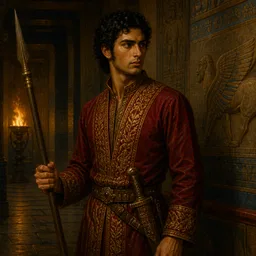
Vaizatha was the youngest son of Haman the Agagite, executed alongside his brothers during the Jewish defense in Susa following the failure of Haman's genocidal plot.
Exile and ReturnFirst: Esther 9:95 versesPersian Noble
Categories
Mentions by Book
- Esther5
Scripture References
All 5 indexed verses, in canonical order, from the Berean Standard Bible.
Esther · 5
- Esther 6:13Partial
Haman told his wife Zeresh and all his friends everything that had happened. His advisers and his wife Zeresh said to him, “Since Mordecai, before whom your downfall has begun, is Jewish, you will not prevail against him—for surely you will fall before him.”
Cited as evidence on a family card; added so References, Key Verses and Mentions by Book share one index.
- Esther 9:7Partial
including Parshandatha, Dalphon, Aspatha,
Cited as evidence on a family card; added so References, Key Verses and Mentions by Book share one index.
- Esther 9:8
Poratha, Adalia, Aridatha,
- Esther 9:9Partial
Parmashta, Arisai, Aridai, and Vaizatha.
Cited as evidence on a family card; added so References, Key Verses and Mentions by Book share one index.
- Esther 9:10Partial
They killed these ten sons of Haman son of Hammedatha, the enemy of the Jews, but they did not lay a hand on the plunder.
Cited as evidence on a family card; added so References, Key Verses and Mentions by Book share one index.