Mishael, Supporter of Ezra
Mishael was a prominent Jewish leader who stood beside Ezra the scribe during the public reading of the Law in post-exilic Jerusalem.
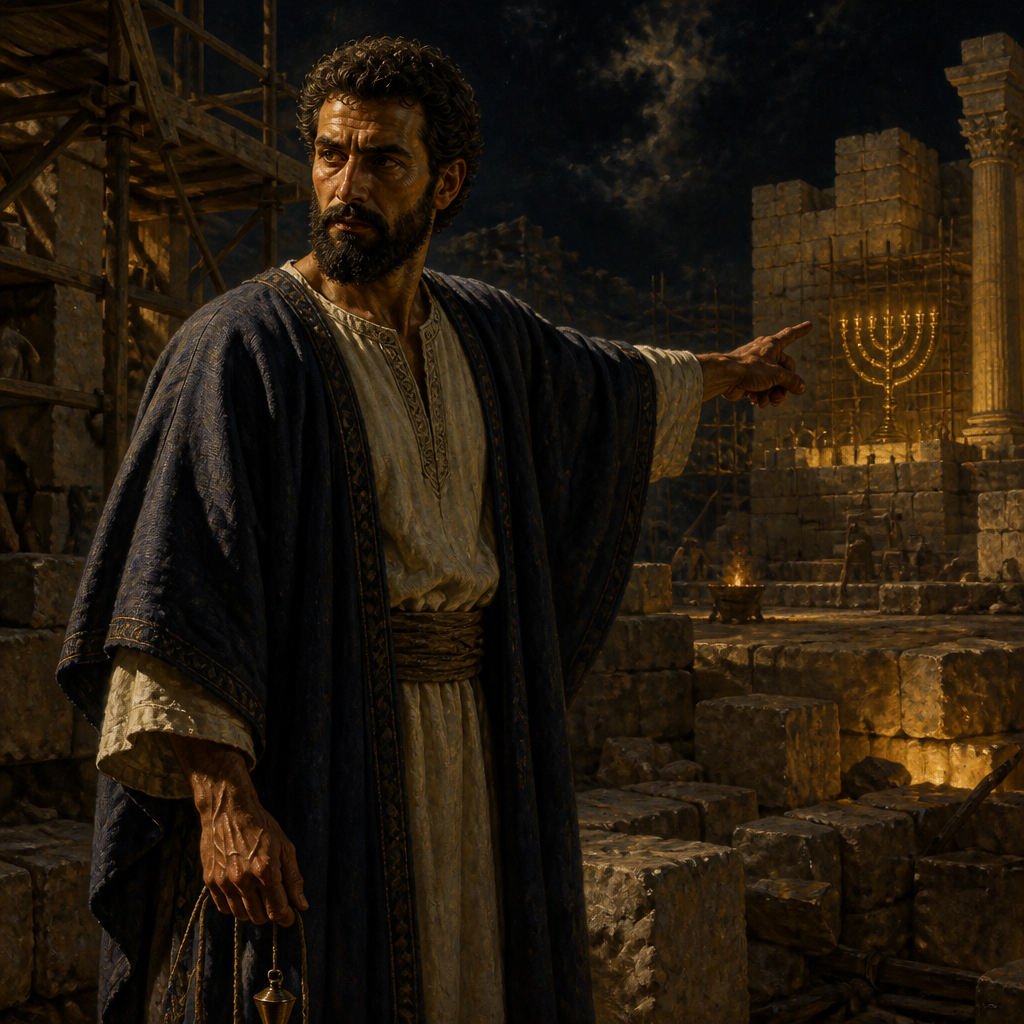
Mishael was a Jewish leader active during the Post-Exilic Period, specifically during the governance of Nehemiah and the spiritual reforms of Ezra. His presence is recorded during a pivotal moment in Israel's history: the first mass public reading of the Torah following the return from the Babylonian captivity. As the community sought to re-establish its identity through the Mosaic covenant, Mishael served as one of the formal witnesses to this spiritual renewal.
While his specific genealogy and tribal affiliation are not provided in the biblical record, his inclusion among the group standing on the wooden platform with Ezra suggests he was a man of significant social or religious standing. He is positioned among the thirteen men—six on Ezra's right and seven on his left—who lent authority and support to the reading of the Law before the gathered assembly in the square by the Water Gate.
Background and Family
The biblical record for this specific Mishael is found exclusively in the Book of Nehemiah. The text does not provide his lineage, father’s name, or tribal descent. However, based on the context of Nehemiah 8, he was part of the community of "returnees" who had traveled from Babylon to Judea to rebuild Jerusalem and its spiritual life. His presence on the elevated platform (a "high wooden platform built for this occasion") indicates he was likely a priest, a Levite, or a prominent lay leader recognized by the community and Ezra himself.
Major Life Events
The single recorded event involving Mishael occurs in Nehemiah 8:4 during the Feast of Trumpets (Rosh Hashanah) in the mid-5th century BC. After the walls of Jerusalem had been successfully rebuilt under Nehemiah's supervision, the people gathered "as one man" to hear the Word of God.
Ezra the scribe ascended a wooden podium to read the Law of Moses. Mishael was selected to stand on Ezra’s left hand as a formal attendant. The text lists him alongside Pedaiah, Malchijah, Hashum, Hash-baddanah, Zechariah, and Meshullam. This arrangement was not merely for logistics but served as a public endorsement of the Law. By standing with Ezra, Mishael and his colleagues signaled the leadership's unified commitment to the scriptures and provided a visual representation of the community's return to covenantal obedience.
Relationship to Other Biblical Figures
Mishael is directly associated with Ezra the scribe, the central religious reformer of the post-exilic era. He is also listed among twelve other leaders who shared the platform. To Ezra’s right were Mattithiah, Shema, Anaiah, Uriah, Hilkiah, and Maaseiah. Mishael stood in the second group of seven on the left side. While he worked in the same era as the governor Nehemiah, his role in this specific passage is liturgical and supportive rather than administrative.
Spiritual Significance
The significance of Mishael lies in his role as a witness. In the Hebrew tradition, the validity of a public act often rested on the presence of credible witnesses. Mishael served as a human pillar supporting the re-introduction of the Torah to a generation that had largely forgotten its requirements during the exile. His presence helped facilitate the subsequent spiritual revival, which led the people to weep in conviction, celebrate with joy, and eventually renew their formal covenant with God. Though his individual words are not recorded, his posture—standing by the Word—remains his enduring biblical legacy.
Spiritual Significance
Mishael represents the supportive leadership necessary for spiritual reformation. His role demonstrates that the work of restoring a nation's spiritual foundations required more than just a single leader like Ezra; it required a visible collective of committed individuals who were willing to stand publicly for the authority of Scripture.
Theologically, Mishael is part of the 'remnant' that preserved the identity of Israel after the judgment of the exile. By standing on the platform, he participated in the transition of Israel from a kingdom into a 'people of the book,' emphasizing the shift toward personal and communal study of the Law as the primary means of relating to God in the post-temple-destruction era.
Frequently Asked Questions
What does the name Mishael mean?
The name Mishael (מִישָׁאֵל) is Hebrew for 'Who is what God is?' or 'Who is like God?'
Was Mishael a priest?
The Bible does not explicitly state Mishael's occupation. However, because he stood on the platform with Ezra to handle the Law, most scholars believe he was either a priest, a Levite, or a highly respected elder of the people.
Where did Mishael stand during the reading of the Law?
According to Nehemiah 8:4, Mishael stood on the left side of Ezra the scribe on a specially constructed wooden platform.
How many times is this Mishael mentioned in the Bible?
This specific Mishael is mentioned only once, in Nehemiah 8:4.
Connected Figures
Ezra
Leader and scribe whom Mishael supported
Nehemiah
Contemporary governor of Judah
Pedaiah
Colleague who stood next to him on the platform
Zechariah
Colleague on the left side of Ezra
Categories
Mentions by Book
- Nehemiah1
Others Named Mishael
Mishael, Son of UzzielExodus 6:22
A Levite during the Exodus who was tasked by Moses to remove the bodies of Nadab and Abihu from the sanctuary after they were struck down by God.
Mishael, Companion of DanielDaniel 1:6
Mishael was a noble youth from Judah who was taken into Babylonian captivity and miraculously survived a fiery furnace after refusing to worship a golden idol.