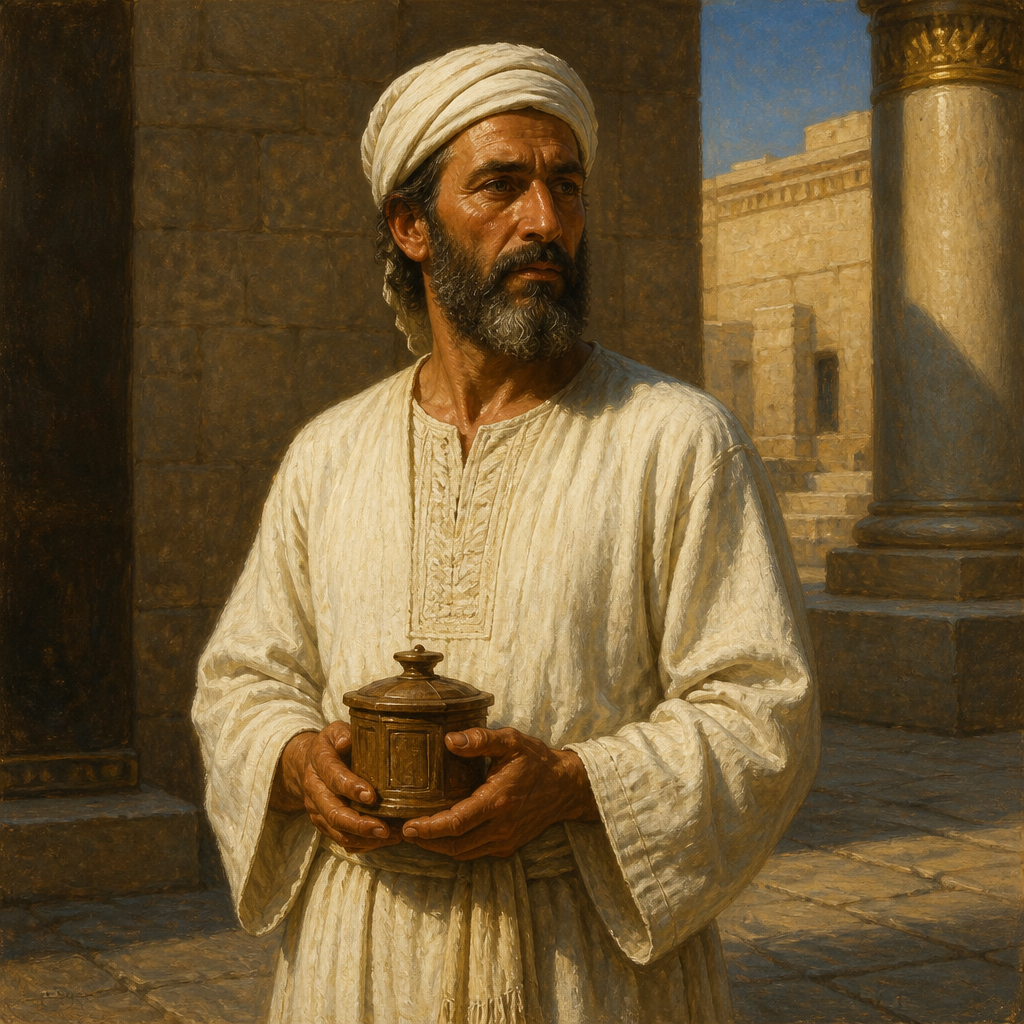
Jachin, Priest of the Post-Exilic Period
A prominent Levite priest who returned to Jerusalem following the Babylonian exile to reestablish the temple service.
Jachin was a priest of the Tribe of Levi who played a vital role in the restoration of the Jewish community in Jerusalem after the Babylonian captivity. Following the decree of Cyrus the Great, Jachin was among the first groups of Israelites to return to the ancestral city of Jerusalem, answering the call to rebuild the cultural and spiritual heart of the nation. As a member of the priestly class, his presence was essential for the resumption of ritual sacrifices and the administration of the Temple.
His mention in the biblical record is found within the formal census lists of the post-exilic community. These genealogies were not mere administrative logs; they served as the legal and spiritual verification of an individual's right to serve in the sanctuary and claim their ancestral inheritance. In the records of 1 Chronicles and Nehemiah, Jachin is identified as a leader among the priests who took up residence in Jerusalem during this fragile period of reconstruction.
Background and Family
Jachin was a member of the Tribe of Levi, specifically belonging to the priestly line. While the biblical text in 1 Chronicles 9 and Nehemiah 11 does not provide a detailed list of his immediate ancestors or descendants, his placement alongside other major priestly families—such as those of Jedaiah and Jehoiarib—suggests he was a man of significant status. In the context of the Exile and Return, maintaining a pure lineage was of paramount importance. To serve in the rebuilt Temple, a priest had to prove his descent from Aaron, and Jachin's inclusion in these sacred registries confirms his legitimate standing and authority within the Levitical order.
Major Life Events
The life of Jachin is defined by the transition from the Exilic Period to the Post-Exilic Period (roughly late 6th century BC to 5th century BC). After decades of displacement in Babylon, the Jewish people were permitted to return to Judea. Jachin was among those who chose to leave the relative stability of Babylon for the ruins of Jerusalem.
According to 1 Chronicles 9:10 and Nehemiah 11:10, Jachin was one of the priests who settled in Jerusalem. This was a courageous act, as the city was still largely unfortified and surrounded by hostile neighbors. His primary responsibility was the "service of the house of God." This involved the daily rituals, the maintenance of the sanctuary, and the teaching of the Law to the returning exiles. His presence helped ensure that the worship of Yahweh continued according to the ancient prescriptions given to Moses.
Relationship to Other Biblical Figures
In the lists provided by the chronicler and Nehemiah, Jachin is closely associated with Jedaiah and Jehoiarib (or Joiarib). These names represent the leading priestly houses that oversaw the spiritual governance of the city. While the text does not describe personal interactions between these men, their collective listing indicates a shared burden of leadership. Together, they formed the ecclesiastical backbone of the community during the time when Zerubbabel was governor and Joshua was High Priest.
Spiritual Significance
The significance of Jachin lies in his commitment to the restoration of the Covenant. By returning to Jerusalem, he signaled that the exile had not broken the relationship between God and His people. As a priest, Jachin acted as a mediator, ensuring that the "burnt offerings" and "sacrifices of praise" were once again rising from the holy mountain.
His name, which in Hebrew means "He will establish," is deeply symbolic of the era in which he lived. It reflects the theological hope of the remnant: that God would re-establish the throne of David and the sanctity of the Temple. Though the biblical record of his personal life is sparse, his inclusion in the Holy Scripture serves as a permanent memorial to those who prioritized the worship of God over their own comfort in a foreign land.
Spiritual Significance
The theological importance of Jachin lies in the preservation of the priestly office during a period of national upheaval. His return to Jerusalem demonstrated the continuity of the Aaronic priesthood from the pre-exilic era to the Second Temple period, ensuring that the law and the cultic requirements of the Mosaic covenant were maintained.
Furthermore, Jachin represents the 'faithful remnant' mentioned by the prophets. His presence in the genealogies of 1 Chronicles and Nehemiah validates the legitimacy of the post-exilic community's worship, proving that the spiritual life of Israel survived the judgment of the exile and was being formally reconstituted by God.
Frequently Asked Questions
What tribe did Jachin belong to?
Jachin belonged to the Tribe of Levi and was specifically of the priestly line.
When did Jachin live?
He lived during the Exile and Return period, specifically serving in Jerusalem after the Babylonian captivity ended (c. 538 BC and following).
What were Jachin's primary duties?
As a priest in Jerusalem, he was responsible for the service of the house of God, which included ritual sacrifices and temple administration.
In which books of the Bible is this Jachin mentioned?
He is mentioned in 1 Chronicles 9:10 and Nehemiah 11:10.
Who were Jachin's associates?
He is frequently listed alongside other leading priests, most notably Jedaiah and Jehoiarib.
Connected Figures
Jedaiah
Fellow priest in the post-exilic return
Jehoiarib
Fellow priest in the post-exilic return
Nehemiah
Governor during the period Jachin's house was recorded
Categories
Mentions by Book
- 1 Chronicles1
- Nehemiah1
Others Named Jachin
Jachin, Priest of the Divided Monarchy1 Chronicles 24:17
A Levite priest who was assigned to the twenty-first division of temple service during the reorganization of the priesthood under King David.
Jachin, Son of SimeonGenesis 46:10
Jachin was a son of Simeon and a grandson of the patriarch Jacob, serving as the ancestral head of the Jachinite clan during the Egyptian sojourn and the Exodus.