Hodaviah, Levite of the Return
A Levite whose descendants were among the first group of exiles to return from Babylon to Jerusalem under Zerubbabel to rebuild the Temple.
Hodaviah was a prominent Levite whose lineage played a crucial role in the post-exilic restoration of Israel. He is primarily identified through his descendants, who were part of the initial wave of returnees from the Babylonian Captivity around 538 BC. His family line is specifically linked to the house of Jeshua and Kadmiel, two significant leaders among the Levites who facilitated the spiritual and structural reorganization of the Jewish community in Jerusalem.
While Hodaviah himself may have lived during the latter years of the exile, his legacy is defined by the participation of his household in the reconstruction of the Temple of Solomon. The record of his descendants is preserved in the census of the returning exiles, a document essential for establishing the genealogical purity and functional roles of the priesthood and Levites in the Second Temple era.
Background and Family
Hodaviah, whose name means "Praise of Yahweh" or "Give Thanks to Yahweh," was a member of the tribe of Levi. In the biblical record concerning the return from exile, he is positioned as the progenitor of a specific branch of Levites. According to Ezra 2:40, his descendants were associated with the houses of Jeshua and Kadmiel. This genealogical link is vital, as the Levites were the only tribe designated by Mosaic Law to perform the sacred duties of the sanctuary, including its physical maintenance and the leading of musical worship.
In the parallel list found in Nehemiah 7:43, the name appears with a slight orthographic variation as "Hodevah" (הוֹדְוָה). Such variations are common in ancient Hebrew texts, often resulting from phonetic spelling or scribal transcription differences, yet they refer to the same ancestral figure. The genealogical record notes that 74 descendants of this line returned to Judah, a relatively small but significant number committed to the restoration efforts.
Major Life Events
The biblical narrative does not record the specific actions of Hodaviah himself, focusing instead on the "sons of Hodaviah" (or the line of Hodaviah). These descendants were part of the group that journeyed from Babylon to Jerusalem following the decree of Cyrus the Great.
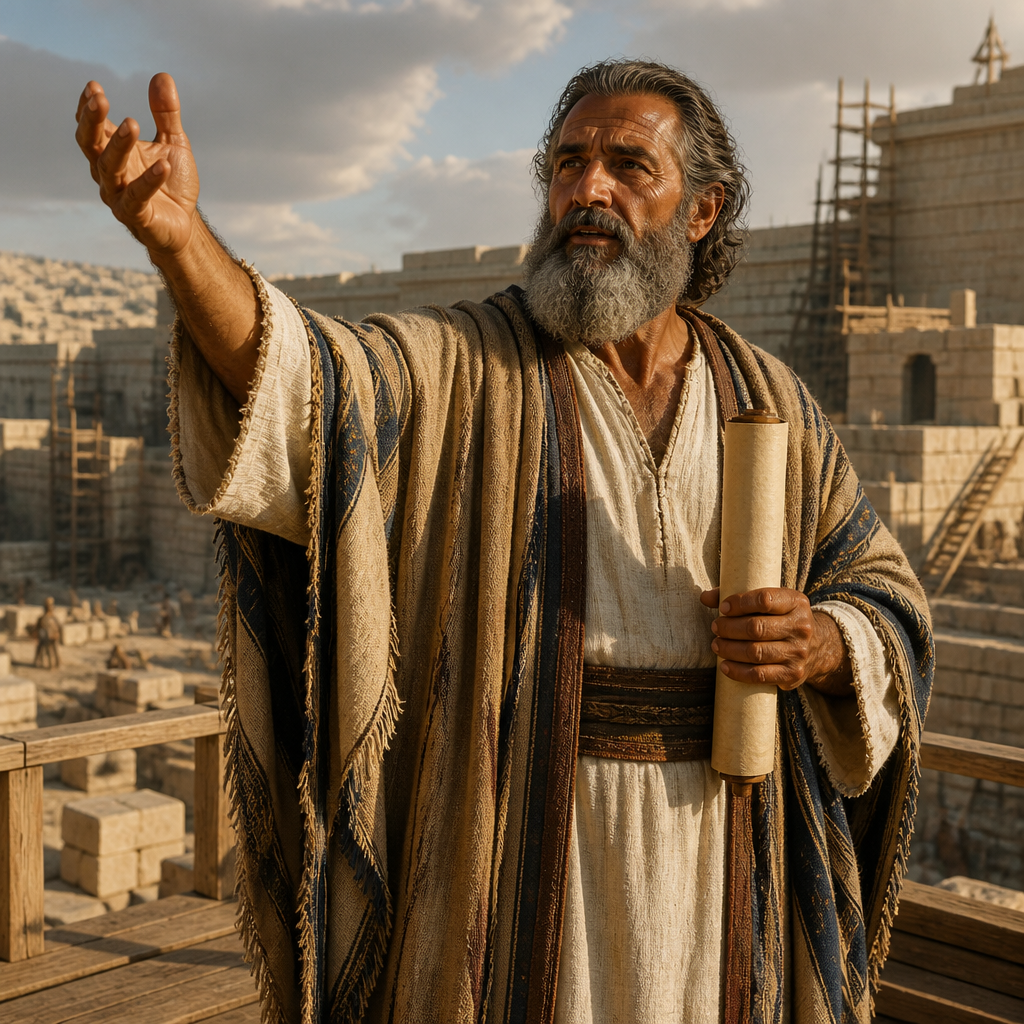
In the second year after their arrival in Jerusalem (c. 536 BC), these Levites were called upon to supervise the workmen restoring the foundations of the Temple. Ezra 3:9 records that the descendants of Hodaviah (referred to here as the "descendants of Yehudah," which many scholars identify as a variant or corruption of Hodaviah in this specific context) joined together with Jeshua and Kadmiel to oversee the builders of the house of God. This was a moment of intense national and spiritual significance, marked by both great shouting for joy and the weeping of the elders who remembered the first Temple.
Relationship to Other Biblical Figures
Hodaviah is inextricably linked to Jeshua and Kadmiel. While the text refers to the "sons of Jeshua and Kadmiel, through the line of Hodaviah," it suggests a familial or administrative sub-grouping within the larger Levite structure. These figures worked directly under Zerubbabel, the governor, and Joshua the High Priest. The collaboration mentioned in Ezra 3:9 highlights a unified front among the Levite families, ensuring that the labor performed on the Temple met the required sanctified standards.
Spiritual Significance
The significance of Hodaviah lies in the preservation of the Levite heritage during the seventy years of Babylonian captivity. Despite the displacement and the absence of a standing Temple, Hodaviah’s family maintained their identity and their genealogies. Their return signifies the faithfulness of the remnant that prioritized the worship of God over their established lives in Babylon.
Within the narrative of Ezra and Nehemiah, Hodaviah represents the "living stones" of the restoration. His descendants provided the necessary manpower and spiritual oversight to transition Israel from a state of ruin to a functioning theo-centric community once again. The inclusion of his name in the sacred census underscores the biblical theme that every individual and family within the covenant community has a documented place and a specific calling in the work of God’s kingdom.
Spiritual Significance
Theologically, Hodaviah represents the continuity of the covenant and the preservation of the Levitical office through the trauma of the Exile. By maintaining his genealogy, his family ensured that the re-established Temple worship in Jerusalem was conducted by those divinely authorized to do so. His presence in the biblical record serves as a testament to God's providence in keeping the lines of service intact for the restoration of the sacrificial system.
Furthermore, the mention of his descendants in the work of supervising the Temple foundation emphasizes the importance of communal effort and spiritual oversight. Hodaviah’s legacy is one of institutional stability and liturgical devotion, providing a bridge between the pre-exilic traditions of Israel and the new reality of the Second Temple period.
Frequently Asked Questions
Was Hodaviah present at the rebuilding of the Temple?
The Bible mentions the 'sons' or descendants of Hodaviah as being present. It is more likely that Hodaviah was an ancestor whose lineage returned to Jerusalem, rather than the individual himself being physically present during the construction.
What does the name Hodaviah mean?
The name is Hebrew for 'Praise of Yahweh' or 'Majesty of Yahweh,' reflecting a common theme of thanksgiving in Levite naming conventions.
Why is he called Hodevah in the Book of Nehemiah?
Hodevah is considered a scribal variant or a different spelling of the same Hebrew name. Biblical scholars treat these as the same individual in the context of the return from exile.
How many of Hodaviah's descendants returned from Babylon?
According to Ezra 2:40 and Nehemiah 7:43, seventy-four Levites from the lines of Jeshua and Kadmiel (through Hodaviah) returned to Jerusalem.
Connected Figures
Jeshua
Levitical leader associated with his lineage
Kadmiel
Levitical leader associated with his lineage
Zerubbabel
Leader of the return to Jerusalem
Categories
Mentions by Book
- Ezra2
- Nehemiah1
Others Named Hodaviah
Hodaviah, Benjamite of the Return1 Chronicles 9:7
A Benjamite ancestor whose descendants were among the first to resettle Jerusalem following the Babylonian Exile.
Hodaviah, Son of Elioenai1 Chronicles 3:24
Hodaviah was a royal descendant of the Davidic line within the Tribe of Judah, listed as the first of seven sons born to Elioenai during the Divided Monarchy.
Hodaviah, Warrior of Manasseh1 Chronicles 5:24
A prominent tribal leader and mighty man of valor within the half-tribe of Manasseh during the Divided Monarchy.