Hashabiah, Ruler of a Half-District of Keilah
A local Judean leader who organized the reconstruction of a portion of Jerusalem's walls during the governorship of Nehemiah.
Hashabiah was a prominent administrative official during the Post-Exilic Period, specifically serving as the ruler of a half-district of Keilah. His historical identity is defined by his participation in the massive civic project to rebuild the walls of Jerusalem under the leadership of Nehemiah. This period was characterized by the return of Jewish exiles from Babylon and the subsequent efforts to re-establish Jerusalem as a fortified and functional capital.
While Hashabiah held a position of regional authority in Keilah—a town located in the Shephelah (the lowlands) of Judah—he traveled to the capital to oversee his district's contribution to the city's defense. His presence in the biblical record serves as evidence of the organized, collaborative nature of the restoration efforts, where leaders from various Judean towns contributed labor and resources to secure the holy city.
Background and Family
Hashabiah is identified in the biblical record as the "ruler of a half-district of Keilah" (Nehemiah 3:17). The city of Keilah was ancient and storied, famously associated with David’s exploits while he was fleeing from King Saul centuries earlier. By the time of the Exile and Return, Keilah remained an important settlement in the tribal territory of Judah.
The administrative structure of the province of Yehud (Judah) under Persian oversight involved dividing regions into smaller districts. Hashabiah’s title indicates he was one of the primary civil administrators for this area. While his specific lineage and tribe are not explicitly detailed in the verse, his association with the Levites in the same passage suggests he likely belonged to the tribe of Levi, as the text groups his repair efforts alongside those of Rehum son of Bani and other Levites.
Major Life Events
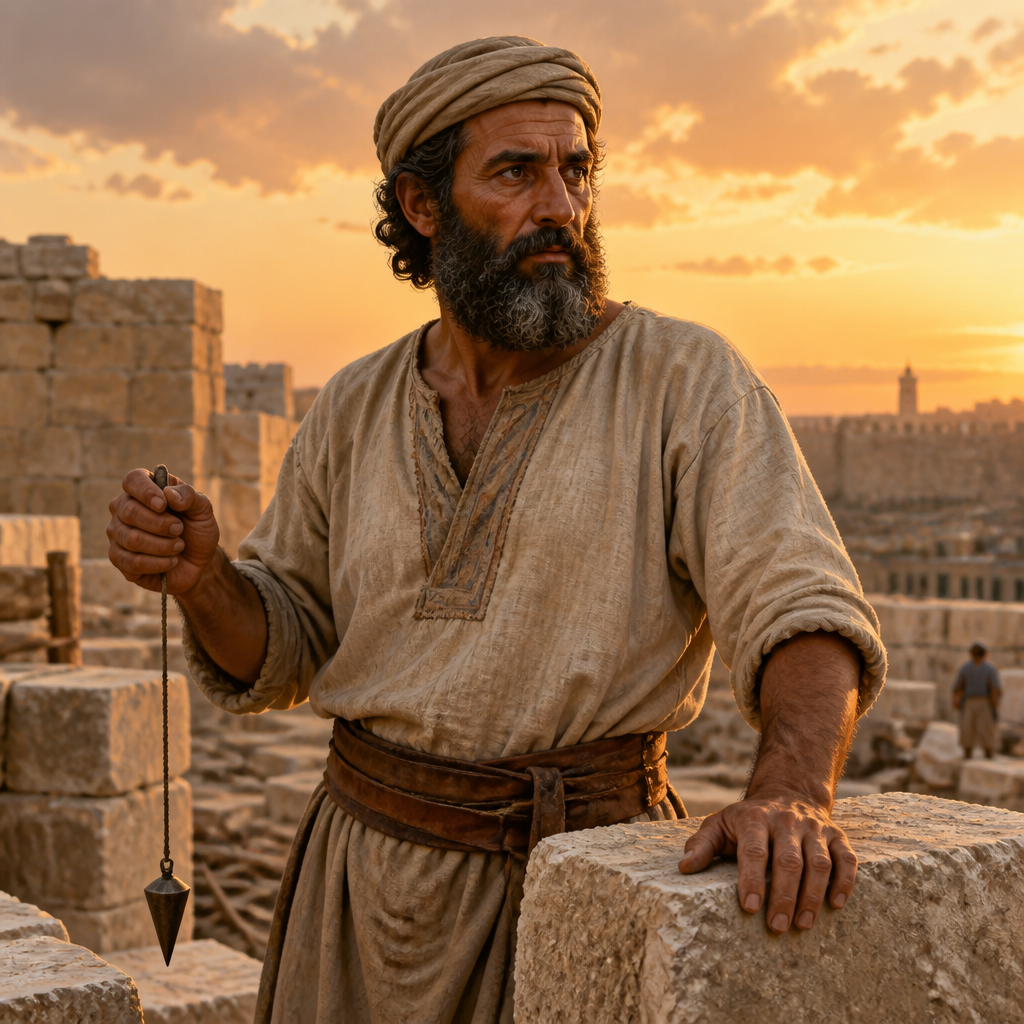
The single recorded event of Hashabiah’s life occurs in the mid-5th century BC, during the twentieth year of King Artaxerxes I of Persia. Following the arrival of Nehemiah in Jerusalem, a massive mobilization began to repair the city’s breached walls and burned gates. Hashabiah was part of the strategic labor force that divided the wall into sections for different families and regional groups to repair.
Hashabiah’s specific assignment was to make repairs for his district. He worked alongside another ruler of Keilah, Bavvai son of Henadad, who oversaw the other half of the district. This dual-leadership structure for Keilah demonstrates the granular level of organization Nehemiah employed to ensure every portion of the wall had a dedicated supervisor. Hashabiah’s role was both managerial and likely physical, as the "rulers" of these districts were expected to lead by example and ensure the quality and speed of the construction in their assigned sector.
Relationship to Other Biblical Figures
Hashabiah worked in close proximity to several other post-exilic leaders. The text places him "next to" Rehum son of Bani, a Levite. This proximity was not merely social but spatial; the work on the wall was organized as a continuous chain. To one side of Hashabiah’s crew was the group under Rehum, and to the other side was the section overseen by Bavvai.
His primary relationship of authority was to Nehemiah, the governor, who coordinated the entire project. While Hashabiah is not recorded as having a direct dialogue with the governor, his compliance with the building plan identifies him as a loyalist to the restoration cause and a key figure in the regional administration of Judah.
Spiritual Significance
The spiritual significance of Hashabiah lies in his commitment to the community of faith over regional isolationism. As a ruler of Keilah, he could have focused solely on the security and prosperity of his own town. Instead, he led his people to the capital to rebuild the walls of Jerusalem. This act symbolized the recognition that the spiritual and political health of the entire nation was tied to the restoration of the Temple city.
In the context of the book of Nehemiah, Hashabiah represents the "faithful remnant"—those who returned from exile and dedicated their resources to rebuilding the heritage of Israel. His mention in the "Wall-Builders' List" serves as a permanent memorial to his service. The theological emphasis of this record is that God’s work is accomplished through the specific, named efforts of individuals who occupy mundane administrative roles but use their influence for the benefit of the people of God.
Spiritual Significance
Hashabiah’s significance is found in his role as a regional administrator who prioritized the restoration of Jerusalem's defenses. His presence in the biblical text highlights the logistical sophistication of the post-exilic community and the unity between the various districts of Judah. By leading a half-district of Keilah in the repair work, he demonstrated that the security of the holy city was a collective responsibility of all Judeans, not just those living within the city limits.
Theologically, Hashabiah embodies the principle of stewardship. He used his secular authority and the manpower of his district to fulfill a spiritual mandate. His inclusion in Nehemiah 3 underscores the biblical theme that God remembers and honors those who labor for the restoration of His community, even when their deeds are recorded in a single line of history.
Frequently Asked Questions
What does the name Hashabiah mean?
The name Hashabiah (Chashabyahu) is of Hebrew origin and means 'Yahweh has considered' or 'Yahweh has taken account of.'
Where was the district of Keilah located?
Keilah was located in the lowlands (Shephelah) of Judah, northwest of Hebron. It was a fortified town that played a role in the history of David and later became an administrative district under Persian rule.
Why were there two rulers for the district of Keilah?
During the post-exilic period, larger districts were often divided into two 'half-districts' for administrative efficiency. Hashabiah ruled one half, while Bavvai son of Henadad ruled the other.
What part of the Jerusalem wall did Hashabiah help rebuild?
Nehemiah 3:17 places Hashabiah's work in the section repaired by the Levites, specifically following the section worked on by Rehum son of Bani.
Was Hashabiah a Levite?
While the text does not explicitly state his tribe, he is mentioned in a list of Levites making repairs, and he worked directly alongside Rehum, who is identified as a Levite, suggesting he likely shared that lineage.
Connected Figures
Nehemiah
Governor and leader of the wall reconstruction
Bavvai
Colleague who ruled the other half-district of Keilah
Rehum
Levite who worked on the wall section adjacent to him
Categories
Mentions by Book
- Nehemiah1
Others Named Hashabiah
Hashabiah, Hebronite Official1 Chronicles 26:30
A capable Hebronite official who oversaw 1,700 men in the administration of Israelite affairs west of the Jordan during the Divided Monarchy.
Hashabiah, Priest of HilkiahNehemiah 12:21
A priest and family head during the time of High Priest Joiakim, representing the ancestral house of Hilkiah in post-exilic Jerusalem.
Hashabiah, Ancestor of Shemaiah1 Chronicles 9:14
A Levite of the Merarite clan during the period of the Exile and Return whose lineage is recorded in the genealogical registers of post-exilic Jerusalem.
Hashabiah, Ancestor of UzziNehemiah 11:22
A Levite descendant of Asaph who lived during the period of the Exile and Return and served as an ancestor to the overseer of the Levites in Jerusalem.
Hashabiah, Levite Leader under EzraEzra 8:19
A prominent Levite leader and priest who assisted Ezra during the return to Jerusalem and participated in the covenant renewal under Nehemiah.
Hashabiah, Levite of the Divided Monarchy1 Chronicles 6:45
A Levite of the Merarite clan during the Divided Monarchy, noted in the genealogies of the temple musicians.
Hashabiah, Son of Kemuel1 Chronicles 27:17
A Levite leader who served as the tribal chief over the tribe of Levi during the administrative reorganization of Israel under King David.
Hashabiah, Officer of the Levites2 Chronicles 35:9
A high-ranking Levite officer who donated significant livestock for King Josiah’s historic Passover celebration during the Divided Monarchy.
Hashabiah, Levite of the United Monarchy1 Chronicles 25:3
A Levite musician and son of Jeduthun who was appointed by King David to lead the twelfth division of sanctuary music during the United Monarchy.