Eliashib, High Priest of the Sheep Gate
The first high priest of the post-exilic return to participate in Nehemiah’s reconstruction of the Jerusalem walls, specifically rebuilding the Sheep Gate.
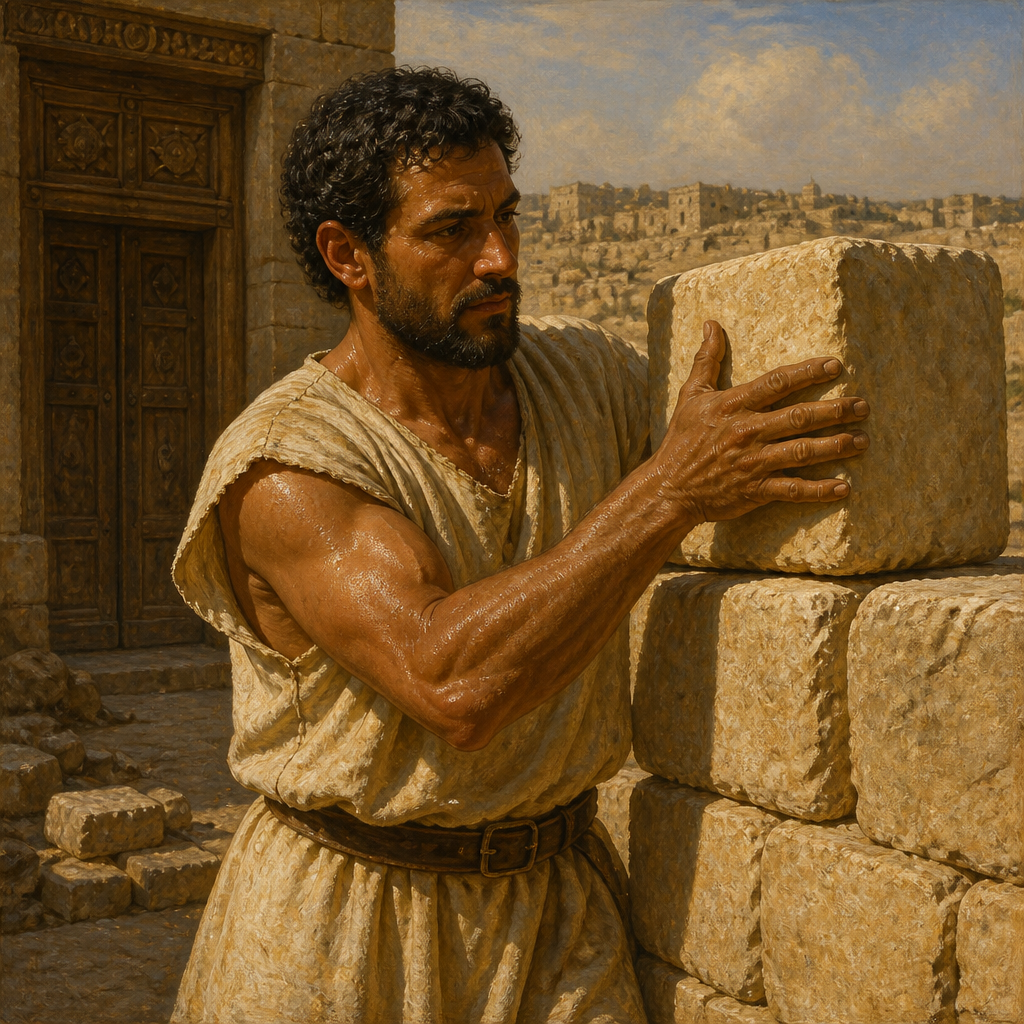
Eliashib (fl. c. 444 BC) was a prominent high priest during the Post-Exilic Period who played a foundational role in the restoration of Jerusalem’s defenses under the leadership of Nehemiah. As the religious head of the community, his participation in the physical labor of rebuilding the city provided both practical progress and spiritual validation for the project. He is most noted for his specific work on the northern wall of the city.
His involvement is documented within the detailed registers of Nehemiah 3, which outlines the systematic distribution of labor among the returning exiles. Eliashib is portrayed as a leader who led by example, working alongside his fellow priests to secure the holiness and safety of the city and its temple.
Background and Family
The biblical record identifies Eliashib as the high priest during the time of Nehemiah’s governorship in Jerusalem. While his specific tribal lineage is not detailed in the specific verses of Nehemiah 3, his status as the high priest confirms his descent from the line of Aaron and the tribe of Levi. He lived during the era of the Return from Exile, a time when the Jewish remnant was struggling to re-establish its identity and security under Persian hegemony.
Major Life Events
Eliashib’s most significant recorded action occurs at the very beginning of the wall-building project (Nehemiah 3:1). As the high priest, he was the first to respond to Nehemiah’s call to action. He and his fellow priests took responsibility for the reconstruction of the Sheep Gate. This gate was located on the north side of Jerusalem, near the temple complex, and was historically the entrance through which sacrificial animals were brought into the city.
Eliashib’s work was characterized by religious consecration. The text notes that after rebuilding the gate and installing its doors, the priests "dedicated it." They continued their labor as far as the Tower of the Hundred and the Tower of Hananel. This act of dedication set a spiritual tone for the entire construction effort, framing the wall not merely as a military fortification but as a sacred boundary for the holy city.
Further references in Nehemiah 3 provide geographical markers based on Eliashib’s residence. His house was a significant landmark in the city, situated along the eastern wall. The text notes that Baruch son of Zabbai repaired a section extending to the doorway of Eliashib’s house (Nehemiah 3:20), and Meremoth son of Uriah repaired the section spanning the entire length of the house (Nehemiah 3:21). This suggests that the high priest’s residence was of considerable size or importance within the city layout.
Relationship to Other Biblical Figures
Eliashib is primarily associated with Nehemiah, the governor sent by Artaxerxes I. His willingness to labor physically alongside Nehemiah indicates a level of cooperation between the civil and religious authorities of the time. He also worked in close proximity to Baruch son of Zabbai and Meremoth son of Uriah, who were responsible for the wall sections adjacent to the high priest's own property.
Spiritual Significance
The spiritual significance of Eliashib in these passages lies in his role as a bridge between the altar and the wall. By being the first to build, he demonstrated that the security of Jerusalem was an extension of its worship. The dedication of the Sheep Gate and the nearby towers served as a public testimony that the restoration of Israel was under divine sanction. His presence in the workforce served to motivate the common people, showing that no one, regardless of their high religious office, was exempt from the manual labor required to restore the community.
Spiritual Significance
Eliashib represents the active participation of the priesthood in the physical restoration of Israel. His leadership in rebuilding the Sheep Gate is theologically significant because it linked the security of the city with the requirements of the sacrificial system. By dedicating the walls as they were built, he transformed a construction project into an act of worship. His prominence in the narrative also serves as a historical marker for the topographical layout of Jerusalem during the mid-5th century BC.
Frequently Asked Questions
What gate did Eliashib rebuild?
Eliashib and his fellow priests rebuilt the Sheep Gate, located on the north side of Jerusalem near the temple.
Was Eliashib a priest?
Yes, he is specifically identified as the high priest in the book of Nehemiah.
Did Eliashib work alone?
No, the Bible records that he worked alongside his fellow priests to build and dedicate the Sheep Gate and the adjacent towers.
Where was Eliashib's house located?
His house was located along the city wall; it was used as a landmark for other builders like Baruch and Meremoth to define their work sections.
Connected Figures
Nehemiah
Governor and leader of the wall reconstruction
Baruch son of Zabbai
Fellow builder who repaired the wall near Eliashib's house
Meremoth son of Uriah
Fellow builder who repaired the wall along Eliashib's house
Categories
Mentions by Book
- Nehemiah3
Others Named Eliashib
Eliashib, Son of JoiakimNehemiah 12:10
A high priest of the Tribe of Levi during the Post-Exilic period who presided over the temple and the levitical records in Jerusalem.
Eliashib, the Priest and Relative of TobiahNehemiah 13:4
A post-exilic priest who committed a significant sacrilege by providing the foreigner Tobiah the Ammonite a private chamber within the Temple courts.
Eliashib, Descendant of BaniEzra 10:36
A returning exile from the family of Bani who was identified by Ezra for having married a foreign woman during the post-exilic restoration.
Eliashib, Son of Elioenai1 Chronicles 3:24
Eliashib was a descendant of the royal line of Judah and the son of Elioenai, mentioned in the genealogical records of the Davidic dynasty.
Eliashib, Priest of the Divided Monarchy1 Chronicles 24:12
A priest during the Divided Monarchy who was selected by lot to serve as the head of the eleventh priestly division in the sanctuary.
Eliashib, the Temple SingerEzra 10:24
A Levite singer during the Post-Exilic period who was among those required to address the issue of foreign marriages following the return from Babylon.
Eliashib, Parent of JehohananEzra 10:6
The father of Jehohanan, a man whose private chamber in the Temple complex served as a place of mourning for the scribe Ezra.
Eliashib, Descendant of ZattuEzra 10:27
A returning exile from the family of Zattu who was among those listed in the time of Ezra for having taken a foreign wife.