Zedekiah son of Chenaanah
Who was Zedekiah son of Chenaanah in the Bible?
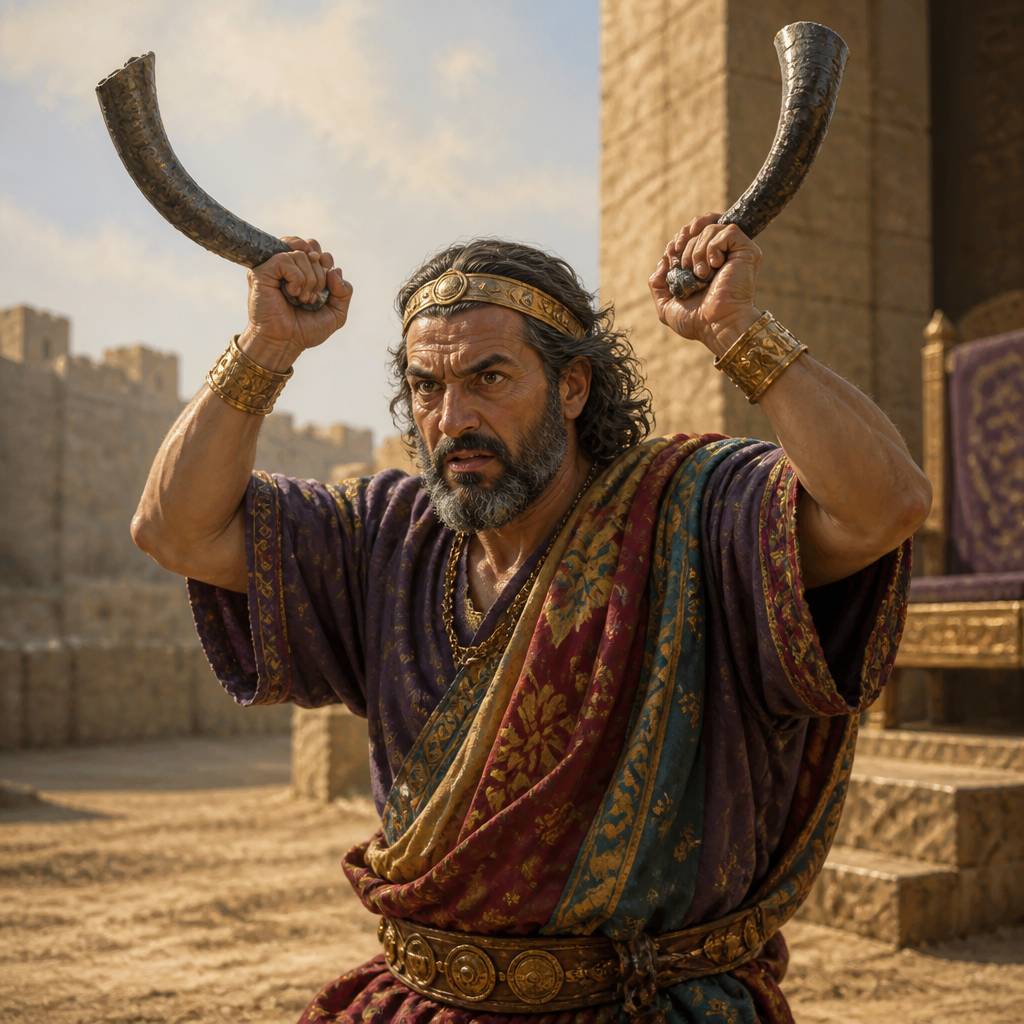
A false prophet during the Divided Monarchy who used iron horns to symbolically predict victory for King Ahab of Israel before opposing the true prophet Micaiah.
This is one of 6 people named Zedekiah in the Bible. See all 6 →
Zedekiah son of Chenaanah was a prominent figure within the court of King Ahab of Israel during the mid-9th century BC. He functioned as a leader among the four hundred prophets whom Ahab consulted regarding the military campaign to retake Ramoth-gilead from the Arameans. Unlike the prophets of Yahweh who sought divine truth regardless of political consequences, Zedekiah is characterized in the biblical narrative as a court prophet who provided favorable, albeit false, assurances to the monarchy.
His role is defined by a dramatic display of symbolic prophecy and a sharp, physical confrontation with the prophet Micaiah son of Imlah. Zedekiah’s actions represent the broader conflict between institutionalized religious figures who sought to please the king and solitary prophets who spoke the difficult words of God. His influence was significant enough that he led the consensus of the prophetic guild against the solitary warning of Micaiah.
Background and Family
Zedekiah was the son of Chenaanah, though the biblical record provides no further details regarding his specific tribe or ancestry. He emerged during the Divided Monarchy, specifically during the joint military planning session between King Ahab of Israel and King Jehoshaphat of Judah. Zedekiah was not an isolated figure but rather the apparent leader or spokesman for a group of four hundred prophets who served the northern court at Samaria. His position suggests a high degree of social and political status, as he had direct access to the kings and the authority to perform prophetic demonstrations in the public square near the gate of Samaria.
Major Life Events
The primary account of Zedekiah occurs in 1 Kings 22 and its parallel in 2 Chronicles 18. As Ahab and Jehoshaphat sat on their thrones, Zedekiah performed a piece of prophetic street theater. He fashioned for himself a pair of iron horns—symbols of immense power and strength in the ancient Near East—and declared, "This is what the LORD says: 'With these you shall gore the Arameans until they are finished off'" (1 Kings 22:11). This visual aid was intended to bolster Ahab's confidence and provide a divine mandate for the upcoming battle.
However, when the prophet Micaiah son of Imlah was summoned at Jehoshaphat’s request, he delivered a contrary vision, predicting the death of Ahab and the scattering of the Israelite army. Micaiah further revealed a vision of the heavenly court, claiming that a "lying spirit" had entered the mouths of Ahab's prophets—specifically mentioning that this spirit would entice the king to his ruin. Enraged by this public contradiction, Zedekiah approached Micaiah and struck him in the face. He challenged Micaiah’s authority, demanding to know how the Spirit of the LORD could have passed from him to speak to Micaiah.
Relationship to Other Biblical Figures
Zedekiah’s relationship with King Ahab was one of mutual reinforcement; he provided the spiritual justification the king desired for his geopolitical ambitions. Conversely, his relationship with Micaiah was one of violent antagonism. Micaiah’s response to Zedekiah’s physical assault was a chilling prophecy of Zedekiah’s own fate. Micaiah told him that he would discover the truth of the matter on the day he would have to flee into an inner room to hide, presumably from the fallout of the failed military campaign and the death of the king.
Spiritual Significance
In the biblical tradition, Zedekiah son of Chenaanah serves as a cautionary archetype of the "court prophet." He represents the danger of religious leaders who allow their message to be shaped by political power rather than divine revelation. His use of the name of the LORD (Yahweh) to baptize the king's personal desires highlights the theme of spiritual deception. The contrast between Zedekiah’s ornate, choreographed performance with iron horns and Micaiah’s unwelcome truth illustrates the biblical tension between popular religious consensus and the often-solitary voice of true prophecy. Zedekiah’s ultimate legacy is one of leading a monarch to his death through false hope.
Zedekiah son of Chenaanah is theologically significant as a representative of the 'lying spirit' that permeated the prophetic guild during the reign of Ahab. His narrative illustrates the complexity of discerning true prophecy from false, especially when the false prophet uses the correct liturgical language and occupies a high social office. His physical assault on Micaiah demonstrates the typical reaction of institutionalized religious power when confronted by uncomfortable truth.
The inclusion of his story in both Kings and Chronicles emphasizes the gravity of his error. It serves as a scriptural warning that religious fervor and symbolic demonstrations are not necessarily indicators of divine truth. Zedekiah’s failure to accurately discern the spirit of the age led not only to his own eventual disgrace but to the catastrophic defeat of the nation and the death of its king.
Frequently Asked Questions
What did the iron horns represent in Zedekiah's prophecy?
In ancient Near Eastern symbolism, horns represented military strength and power. By making iron horns, Zedekiah was visually demonstrating that King Ahab would possess unstoppable force to 'gore' and destroy the Aramean army.
Why did Zedekiah strike Micaiah?
Zedekiah struck Micaiah because Micaiah publicly contradicted Zedekiah's prophecy and claimed that a lying spirit was speaking through the court prophets. Zedekiah viewed this as a direct challenge to his spiritual authority and his claim to possess the Spirit of the LORD.
Was Zedekiah a prophet of Baal or Yahweh?
According to the text, Zedekiah claimed to speak in the name of the LORD (Yahweh). However, Micaiah’s vision suggests that while he used Yahweh's name, he was actually under the influence of a deceiving spirit permitted by God to bring about Ahab's judgment.
What happened to Zedekiah after the battle of Ramoth-gilead?
The Bible does not record the specific end of Zedekiah's life. However, Micaiah prophesied that Zedekiah would eventually be forced to hide in an 'inner room' in fear, suggesting he faced disgrace or persecution following the fulfillment of Micaiah's warning and Ahab's death.
Who was Zedekiah's father?
His father was a man named Chenaanah. No other biblical information is provided about Chenaanah's lineage or status.
Family & Relationships
Parents
 Chenaanah, Father of ZedekiahFather1 Kings 22:11Stated
 Zedekiah son of ChenaanahThis page
Connected Figures
Family
Father · 1 Kings 22:11
Chenaanah was the father of the false prophet Zedekiah, who misled King Ahab and King Jehoshaphat regarding the battle at Ramoth-gilead.
Categories
Mentions by Book
- 1 Kings2
- 2 Chronicles2
Scripture References
All 4 indexed verses, in canonical order, from the Berean Standard Bible.
1 Kings · 2
- 1 Kings 22:11
Now Zedekiah son of Chenaanah had made for himself iron horns and declared, “This is what the LORD says: ‘With these you shall gore the Arameans until they are finished off.’”
- 1 Kings 22:24
Then Zedekiah son of Chenaanah went up, struck Micaiah in the face, and demanded, “Which way did the Spirit of the LORD go when He departed from me to speak with you?”
2 Chronicles · 2
- 2 Chronicles 18:10
Now Zedekiah son of Chenaanah had made for himself iron horns and declared, “This is what the LORD says: ‘With these you shall gore the Arameans until they are finished off.’”
- 2 Chronicles 18:23
Then Zedekiah son of Chenaanah went up, struck Micaiah in the face, and demanded, “Which way did the Spirit of the LORD go when He departed from me to speak with you?”
Others Named Zedekiah son of Chenaanah
Compare all 6 bearers →Zedekiah, Son of Jehoiakim1 Chronicles 3:16
A descendant of the Davidic royal line listed in the genealogy of King Jehoiakim during the Divided Monarchy.
Zedekiah son of MaaseiahJeremiah 29:21
A false prophet during the Divided Monarchy who was executed by Nebuchadnezzar for prophesying lies to the Jewish exiles in Babylon.
Zedekiah of the SealNehemiah 10:1
A prominent leader or official among the Judean returnees who co-signed Nehemiah’s covenant to faithfully observe the Law of God after the Babylonian exile.
Zedekiah son of HananiahJeremiah 36:12
A Judean official during the reign of King Jehoiakim who was present during the reading of Jeremiah’s scroll.
Zedekiah, Last King of Judah2 Kings 24:17
The final king of the Kingdom of Judah who reigned during the Babylonian siege of Jerusalem and oversaw the city's eventual destruction.