Jerahmeel, Son of Hammelech
A high-ranking official or prince under King Jehoiakim of Judah who was ordered to arrest the prophet Jeremiah and his scribe Baruch.
Jerahmeel, identified specifically as the son of Hammelech (or "son of the king"), was a royal official during the turbulent final decades of the Kingdom of Judah. He appears in the biblical record during the reign of King Jehoiakim, a period characterized by intense political and spiritual conflict as the Babylonian Empire asserted its dominance over the Levant. Jerahmeel functioned as an instrument of the royal court's executive power, tasked with suppressing the prophetic warnings of Jeremiah.
His role is highlighted in the context of the king’s rejection of the divine word. When Jehoiakim famously burned the scroll containing Jeremiah’s prophecies, Jerahmeel was one of the men commissioned to seize the prophet and his scribe. Despite his proximity to the throne and his authority to lead an arrest party, his efforts were ultimately thwarted by divine intervention.
Background and Family
Jerahmeel lived during the Divided Monarchy, specifically serving in the court of King Jehoiakim of Judah (reigned c. 609–598 BC). The biblical text refers to him as ben hammelek (Jeremiah 36:26). While some translations render this literally as "son of the king," identifying him as a biological prince of the Davidic line, many scholars suggest the term may also denote a specific administrative title or a member of the broader royal household. If he was indeed a literal son of Jehoiakim, he would have been a man of significant social status and political influence within the Jerusalem establishment. He is noted as a sibling of Malchijah, who is recorded as an ancestor to certain priestly lines.
Major Life Events
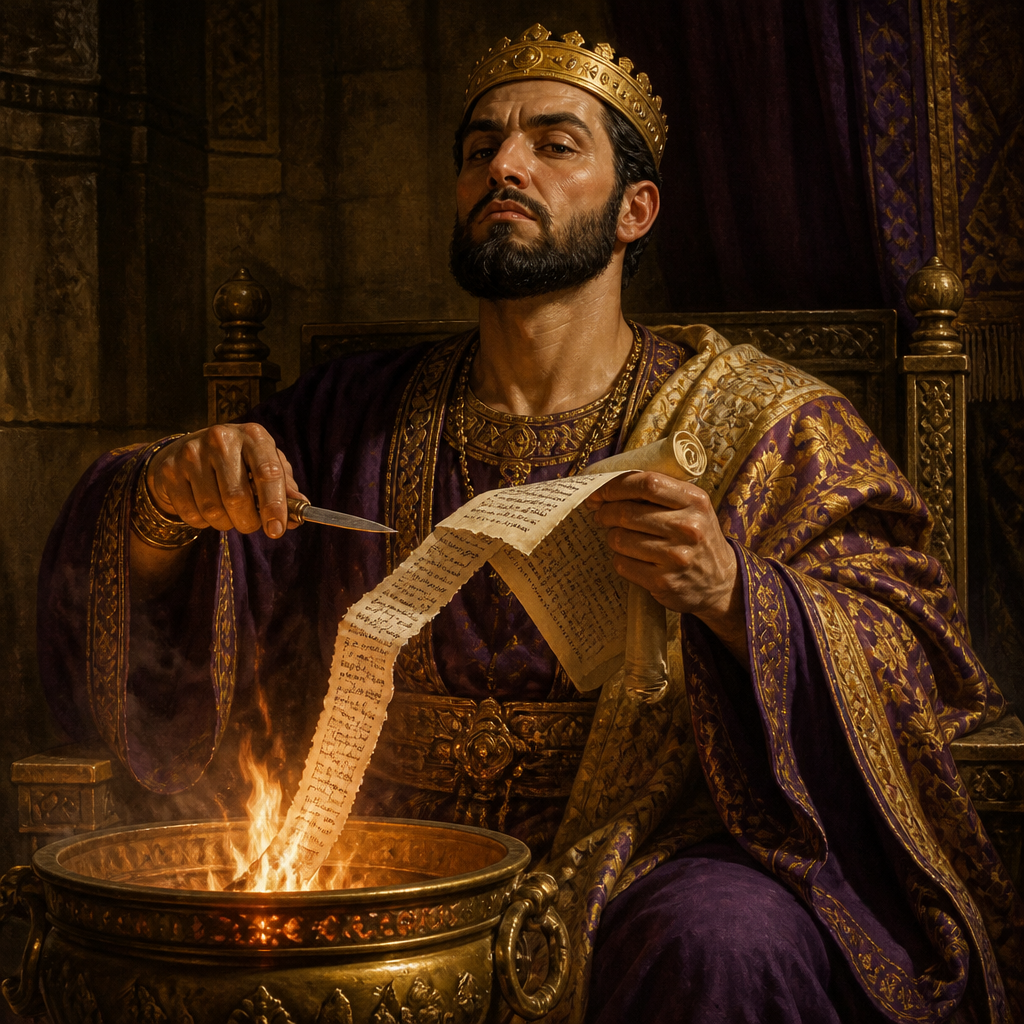
The single but significant appearance of Jerahmeel in the biblical narrative occurs in Jeremiah 36. This chapter details a pivotal moment in Judah's history: the prophet Jeremiah, having been barred from the temple, dictated his prophecies of judgment to his scribe Baruch. When these words were eventually read before King Jehoiakim, the king reacted with open defiance, cutting the scroll with a scribe’s knife and casting the pieces into a fire brazier.
Following this act of desecration, the king moved to silence the source of the message. Jerahmeel was commanded, along with Seraiah son of Azriel and Shelemiah son of Abdeel, to arrest Baruch and Jeremiah. This command marks Jerahmeel as a key antagonist to the prophetic office, representing the state’s attempt to suppress the unpopular message of impending Babylonian conquest and the necessity of repentance.
Relationship to Other Biblical Figures
Jerahmeel’s primary interaction is defined by his opposition to Jeremiah and Baruch. While the king issued the order, Jerahmeel was the operative responsible for the manhunt. He worked in tandem with other court officials like Seraiah and Shelemiah, suggesting a coordinated effort by the Judahite nobility to eliminate the dissent posed by the prophets. Despite the resources at his disposal as a "son of the king," the text concludes this pursuit with the brief but definitive statement: "But the LORD had hidden them" (Jeremiah 36:26). This sets Jerahmeel as a foil to God’s protection, illustrating that even royal authority is limited when countered by divine will.
Spiritual Significance
In the broader theological context of the Book of Jeremiah, Jerahmeel represents the "arm of the flesh"—the human power structures that resist the word of God. His failed mission serves as a narrative proof of God’s sovereignty over human rulers. While Jehoiakim could burn the physical scroll and Jerahmeel could attempt to imprison the messenger, they could not halt the fulfillment of the prophecy itself. Jerahmeel stands as a historical reminder of the friction between the political interests of the Divided Monarchy and the spiritual demands of the Covenant, demonstrating that no amount of royal pedigree or administrative power can subvert the purposes of the Lord.
Spiritual Significance
Jerahmeel represents the official state opposition to the prophetic word during the final years of the Kingdom of Judah. As a member of the royal household, his attempt to arrest Jeremiah underscores the complete breakdown in the relationship between the Davidic monarchy and the God of Israel, highlighting the king's preference for political suppression over spiritual repentance. His failure to locate the prophet, despite his authority, serves as a scriptural example of divine protection over those who speak the truth.
Frequently Asked Questions
Was Jerahmeel a prince of Judah?
The Bible refers to him as the 'son of the king' (Hammelech). While this could mean he was a literal son of King Jehoiakim, it was also a title for royal officials or members of the extended royal family.
Who did Jerahmeel try to arrest?
Under the orders of King Jehoiakim, Jerahmeel attempted to seize the prophet Jeremiah and his scribe, Baruch.
Why did Jerahmeel fail to find Jeremiah?
According to Jeremiah 36:26, Jerahmeel failed because 'the LORD had hidden' Jeremiah and Baruch, indicating divine intervention protected them from the king's men.
Who worked with Jerahmeel in the pursuit of Jeremiah?
He was accompanied by two other officials: Seraiah son of Azriel and Shelemiah son of Abdeel.
In what era of biblical history did Jerahmeel live?
He lived during the Divided Monarchy, specifically during the late 7th century BC or early 6th century BC during the reign of King Jehoiakim.
Connected Figures
Jehoiakim
Superior (King) and possible Father
Jeremiah
Target of his arrest warrant
Baruch
Target of his arrest warrant

Seraiah son of Azriel
Associate in the arrest attempt
Categories
Mentions by Book
- Jeremiah1
Family & Relationships
Sibling
Malchijah, Ancestor of Priests
Jeremiah 36:26
Parent
Jeremiah 36:26
Sibling
Malchijah, Ancestor of Priests
1 Chronicles 9:12
Others Named Jerahmeel
Jerahmeel, Son of Kish the Levite1 Chronicles 24:29
A Levite during the Divided Monarchy and the son of Kish, identified within the lineage of Mahli during David’s organization of the temple duties.
Jerahmeel, Son of Hezron1 Chronicles 2:9
The firstborn son of Hezron and a significant clan founder within the tribe of Judah, whose descendants occupied the southern Negev region.