Asaph, Levite Musician and Seer
A prominent Levite musician and seer appointed by King David to lead worship and prophesy through music in the Tabernacle and later the Temple.
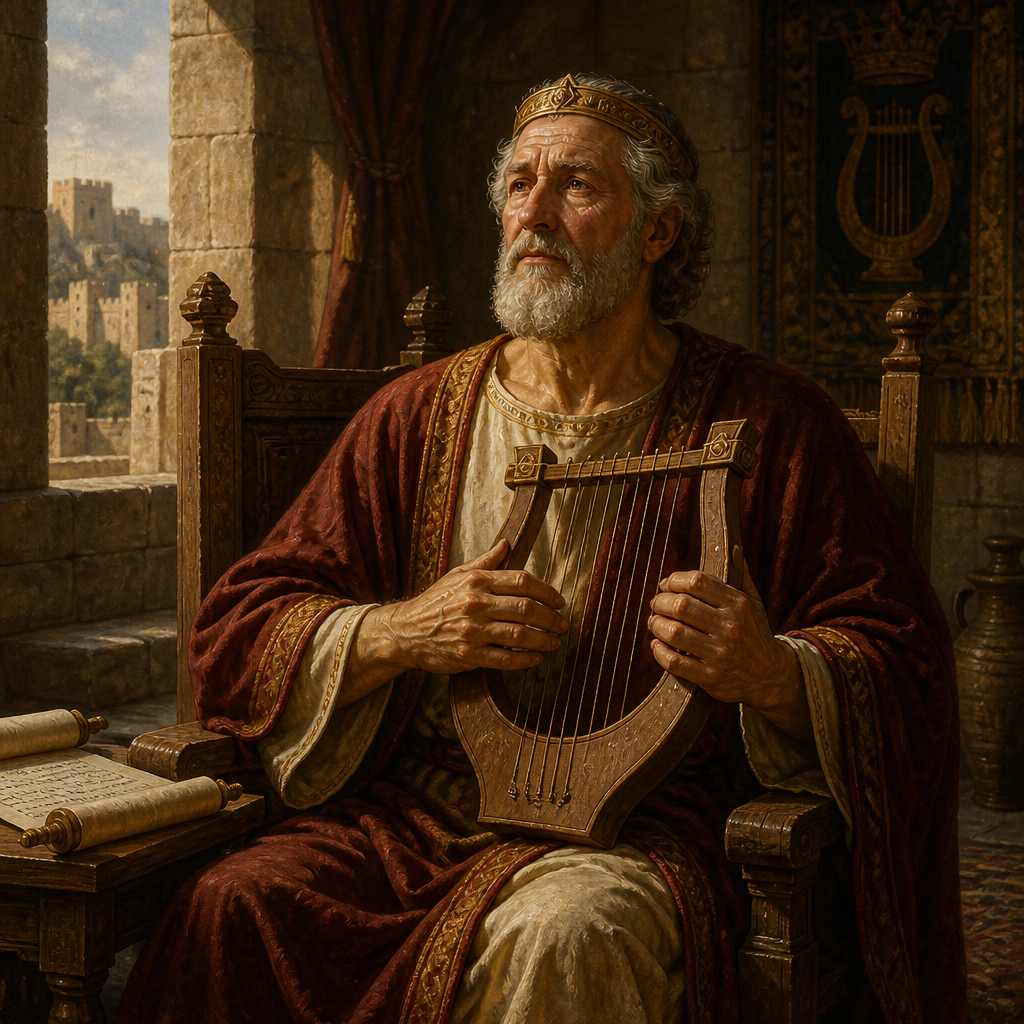
Asaph, the son of Berechiah, was a central figure in the musical and liturgical life of ancient Israel during the Divided Monarchy and the preceding United Monarchy. A member of the tribe of Levi, Asaph was not merely a singer but was designated as a 'seer,' implying a prophetic dimension to his musical ministry. He was one of three primary musical leaders appointed by King David to oversee the service of song in the house of the LORD, serving alongside Heman and Ethan (or Jeduthun).
Asaph's influence extended far beyond his own lifetime. He established a guild of musicians known as the 'sons of Asaph,' who continued his legacy of liturgical worship for centuries. His name is permanently etched into the biblical canon through the attribution of twelve psalms (Psalms 50 and 73–83), which reflect his deep theological insight and his role as a communal intercessor and teacher.
Background and Family
Asaph was a member of the tribe of Levi, specifically descending from the line of Gershon. According to the genealogical records in 1 Chronicles 6:39, he was the son of Berechiah, the son of Shimea. His lineage placed him within the hereditary class responsible for the spiritual and maintenance duties of Israel's central place of worship. Asaph was a contemporary of King David and King Solomon, and he appears to have been a man of significant stature within the Levite community.
He was the father of four sons who were directly involved in the musical ministry: Zaccur, Joseph, Nethaniah, and Asarelah. These sons served under their father’s immediate direction, continuing the family tradition of musical prophecy and service. The chronicler notes that these men were 'under the direction of Asaph, who prophesied under the direction of the king' (1 Chronicles 25:2).
Major Life Events
Asaph’s public ministry began in earnest when King David brought the Ark of the Covenant to Jerusalem. David directed the chiefs of the Levites to appoint musicians to play on harps, lyres, and cymbals to raise sounds of joy. Asaph was appointed alongside Heman and Ethan as the primary leaders of this ensemble (1 Chronicles 15:17-19). During the procession, Asaph was specifically tasked with sounding the bronze cymbals.
Once the Ark was settled in the tent David had pitched for it, Asaph was appointed as the 'chief' of the Levites who were to minister before the Ark regularly (1 Chronicles 16:5). On that day, David committed to Asaph and his associates the first song of thanksgiving to the Lord recorded in the Chronicles. This established Asaph not just as a performer, but as a curator and director of the nation's liturgical identity.
During the reign of Solomon, Asaph's role reached a pinnacle during the dedication of the Temple. The records in 2 Chronicles 5:12 describe Asaph, Heman, and Jeduthun standing on the east side of the altar, dressed in fine linen, leading a massive choir and orchestra during the induction of the Ark into the Holy of Holies. Even centuries later, during the reforms of King Hezekiah, Asaph was remembered as 'the seer,' and the king commanded the Levites to sing praises using the very words written by Asaph (2 Chronicles 29:30).
Relationship to Other Biblical Figures
Asaph worked in close partnership with two other master musicians: Heman the grandson of Samuel and Ethan (also called Jeduthun). While Heman often occupied the central position (serving at the right hand), Asaph served at his right hand, indicating a hierarchy of leadership among the three guilds.
His relationship with King David was one of mutual respect and spiritual collaboration. David, himself a musician and poet, entrusted Asaph with the responsibility of 'prophesying' through music. This suggests that Asaph was more than a technical musician; he was a spiritual advisor who could discern the move of the Spirit through melody and verse. In later generations, his descendants, the 'sons of Asaph,' remained a distinct and vital group, mentioned frequently in the books of Ezra and Nehemiah as those who returned from exile to restore the Temple worship according to the ancient 'command of David and Asaph.'
Spiritual Significance
The theological contribution of Asaph is preserved primarily in the Psalter. The twelve psalms attributed to him (Psalms 50, 73–83) are characterized by a 'prophetic' tone, often featuring God speaking directly to His people in the first person. Unlike many of David’s personal laments, Asaph’s psalms often address the community of Israel, grappling with national judgment, the prosperity of the wicked (Psalm 73), and the plea for God to remember His covenant during times of national distress (Psalm 74).
Asaph is one of the few figures in the Old Testament explicitly called a 'seer' (chozeh) who was not a traditional wandering prophet. This title elevates the role of the artist in the biblical worldview, suggesting that sacred music is a medium for divine revelation. His legacy underscores the importance of institutionalized worship and the role of the Levites in maintaining the spiritual temperature of the nation of Israel throughout the Divided Monarchy.
Spiritual Significance
Asaph represents the fusion of artistic excellence and prophetic revelation. He is significant for establishing the liturgical structures that defined Israelite worship for centuries, ensuring that the praise of Yahweh was conducted with both order and spiritual depth. His designation as a 'seer' highlights the biblical view that music and poetry are legitimate vehicles for the word of God, not merely aesthetic additions to worship.
Furthermore, Asaph's enduring legacy through his descendants—the 'sons of Asaph'—illustrates the importance of generational faithfulness. By training his children and subordinates in the service of the Lord, he ensured that the 'words of David and Asaph' would continue to guide Israel through its most turbulent eras, including the fall of Jerusalem and the eventual return from exile.
Frequently Asked Questions
Was Asaph a prophet or just a musician?
Asaph was both. While primarily known as a leader of the Levitical musicians, 2 Chronicles 29:30 explicitly calls him 'Asaph the seer.' Additionally, 1 Chronicles 25:2 states that he 'prophesied under the direction of the king,' indicating his music was divinely inspired.
How many Psalms did Asaph write?
Twelve psalms are explicitly attributed to Asaph in their superscriptions: Psalm 50 and the cluster of Psalms 73 through 83.
What tribe did Asaph belong to?
Asaph belonged to the tribe of Levi. He was a descendant of Gershon, one of the three sons of Levi, making him a member of the clerical class responsible for Temple service.
Who were Asaph’s musical partners?
Asaph served alongside two other primary musical leaders: Heman (a Kohathite) and Ethan/Jeduthun (a Merarite). Together, these three represented the three branches of the Levite tribe.
What instrument did Asaph play?
Biblical records specifically mention Asaph sounding bronze cymbals during the procession of the Ark (1 Chronicles 15:19) and leading the musicians with cymbals in the Tabernacle service (1 Chronicles 16:5).
Connected Figures
David
King who appointed him
Heman
Fellow musical leader
Berechiah
Father
Zaccur
Son
Jeduthun
Fellow musical leader
Categories
Mentions by Book
- Psalms12
- 1 Chronicles10
- 2 Chronicles5
- Nehemiah4
- Ezra2
Family & Relationships
Child
Zaccur, Levite Musician of the Divided Monarchy
1 Chronicles 6:39
Child
1 Chronicles 6:39
Child
1 Chronicles 6:39
Child
1 Chronicles 6:39
Parent
1 Chronicles 6:39
Others Named Asaph
Asaph, Father of Joah the Recorder2 Kings 18:18
Asaph was a high-ranking official's father during the reign of King Hezekiah, whose lineage was recorded amidst the Assyrian siege of Jerusalem.
Asaph, Keeper of the King’s ForestNehemiah 2:8
An official of the Persian Empire who oversaw the royal forests and was ordered to provide timber for the rebuilding of Jerusalem.
Asaph, Ancestor of Mattaniah1 Chronicles 9:15
A Levite of the tribe of Levi whose descendants served as liturgical leaders in Jerusalem following the return from the Babylonian Exile.