Pharaoh, Father-in-law of Solomon
Who was Pharaoh, Father-in-law of Solomon, in the Bible?
An Egyptian monarch of the 21st Dynasty who forged a strategic political alliance with King Solomon through marriage and the conquest of Gezer.
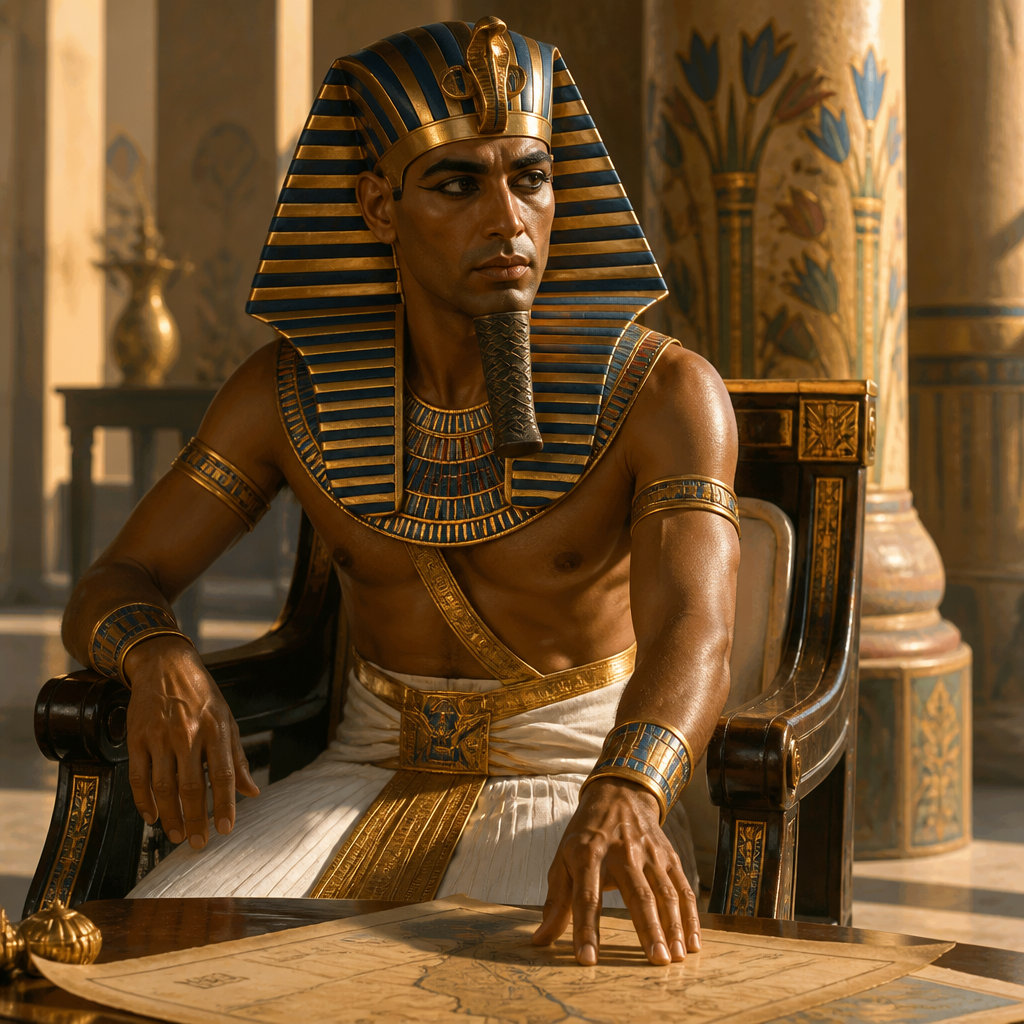
The Pharaoh of the United Monarchy era represents a significant shift in the geopolitical landscape of the ancient Near East. He is most notable for giving his daughter in marriage to Solomon, an act that signaled Egypt’s recognition of Israel as a peer power during the 10th century BC.
His reign is characterized by military activity in the Levant, specifically the capture of the Canaanite city of Gezer. Rather than occupying the territory, he utilized it as a diplomatic tool, presenting the city as a dowry for his daughter’s union with the House of David. Furthermore, his court served as a place of refuge for political exiles, such as Hadad the Edomite, reflecting the complex web of regional influence he managed from his capital in Egypt.
Background and Family
The Pharaoh mentioned during the reign of Solomon was a monarch of the late 21st Dynasty of Egypt. While the biblical text identifies him simply by his royal title, Pharaoh (Strong's H6547), his actions place him firmly in the mid-10th century BC. He was married to Queen Tahpenes, a figure of significant status whose sister was also given in marriage to the Edomite prince Hadad (1 Kings 11:19).
This Pharaoh’s primary familial legacy in the biblical record is his daughter, known simply as the 'daughter of Pharaoh.' Her marriage to Solomon was a landmark event, as it was highly unusual for Egyptian Pharaohs of the New Kingdom and Third Intermediate Period to give their daughters to foreign rulers. This suggests that the Pharaoh viewed the United Monarchy of Israel as a formidable and necessary ally.
Major Life Events
The Alliance with Solomon
The most pivotal action recorded of this Pharaoh is his alliance with King Solomon. 1 Kings 3:1 states that Solomon "formed an alliance with Pharaoh king of Egypt by marrying his daughter." This was not merely a romantic union but a grand state treaty. To house his bride, Solomon initially brought her to the City of David before constructing a specialized palace for her, separate from the Temple complex, due to her foreign status (2 Chronicles 8:11).
The Conquest of Gezer
In a rare instance of an Egyptian military campaign recorded during this era, 1 Kings 9:16 describes Pharaoh’s attack on Gezer. The city was a strategic Canaanite stronghold located between the coastal plain and the Judean hills. Pharaoh successfully captured the city, burned it, and executed its Canaanite inhabitants. However, instead of incorporating Gezer into the Egyptian Empire, he gave the city to his daughter as a wedding gift or dowry. This allowed Solomon to rebuild the city and integrate it into Israel's defensive network.
Relationship with Hadad the Edomite
Pharaoh’s foreign policy also involved managing political dissidents from Israel’s neighbors. When David and Joab devastated Edom, the young prince Hadad fled to Egypt. Pharaoh received him with great hospitality, providing him with a house, land, and food (1 Kings 11:18). The bond was so strong that Pharaoh permitted Hadad to marry his own sister-in-law. This relationship highlights Pharaoh’s role as a regional power broker who kept options open for future political leverage against the Davidic dynasty, despite his alliance with Solomon.
Relationship to Other Biblical Figures
Pharaoh’s primary interaction was with King Solomon. The relationship was one of mutual respect and formal treaty, though the biblical narrator notes that Solomon’s love for the daughter of Pharaoh was part of a larger pattern of marrying foreign women that eventually led to his spiritual decline (1 Kings 11:1).
Pharaoh also acted as a patron and surrogate father to Hadad of Edom. Even when Hadad wished to return to his homeland to oppose the remnants of David's house, Pharaoh’s response was one of concern, asking, "What have you lacked here with me that you suddenly want to go back to your own country?" (1 Kings 11:22). This reveals a personal, almost paternalistic side to the monarch.
Spiritual Significance
In the context of the United Monarchy, Pharaoh represents the temptation of worldly security. For Israel, an alliance with Egypt was a departure from total reliance on the LORD. The daughter of Pharaoh is the first mentioned of Solomon's foreign wives, signaling the beginning of the King’s entanglement with foreign gods and cultures.
However, the biblical text also treats this Pharaoh with a level of neutrality and even prestige. The mention of his chariots in Song of Solomon 1:9 ("I compare you, my darling, to a mare among Pharaoh’s chariots") indicates that his royal house was viewed as a standard of beauty, power, and excellence in the eyes of the Israelites. Ultimately, this Pharaoh serves as a marker of the height of Israel's international standing, where even the great power of Egypt sought peace rather than war with the throne of Jerusalem.
Theologically, this Pharaoh represents the era of Israel's greatest international prestige, yet his presence also marks the introduction of foreign religious influence into the royal court. By providing a daughter in marriage to Solomon, he unintentionally participated in the spiritual compromise that would eventually lead to the division of the kingdom. His capture of Gezer and subsequent gift of the city to Solomon serves as a historical fulfillment of the expansion of Israel's borders, albeit through secular diplomatic means.
Furthermore, Pharaoh’s role in harboring Hadad the Edomite illustrates the biblical theme of Egypt as a place of refuge that can simultaneously become a source of future trouble. While he maintained peace with Solomon, his support for Edomite royalty provided the seeds for the adversaries that would plague Solomon’s later years, demonstrating that human alliances are often fragile and multi-layered.
Frequently Asked Questions
Which Pharaoh gave his daughter to Solomon?
While the Bible does not name him, historical scholars often identify this Pharaoh as Siamun (c. 986–967 BC) or Psusennes II of the 21st Dynasty, based on the timeline of Solomon's reign.
Why did Pharaoh give Gezer to Solomon?
Pharaoh captured Gezer from the Canaanites and gave it to Solomon as a dowry for his daughter, providing a strategic territorial gift that strengthened the alliance between Egypt and Israel.
Was Pharaoh an enemy of Solomon?
No, the biblical record depicts them as allies who signed a formal treaty and shared a familial bond through marriage.
Who was Pharaoh's wife?
The Bible identifies his wife as Queen Tahpenes, who was a woman of high standing in the Egyptian court.
Did Pharaoh help Solomon's enemies?
Pharaoh provided refuge to Hadad the Edomite, an adversary of Israel, and even allowed Hadad to marry into his own family, showing that he maintained influence with Israel's rivals even while allied with Solomon.
Family & Relationships
 TahpenesWife1 Kings 11:18
Inferred
No verse names Tahpenes and Pharaoh together; the husband link is carried from the surrounding genealogy and is not stated in Scripture.Evidence: 1 Kings 11:18
 Pharaoh, Father-in-law of SolomonThis page
Connected Figures
Family
Wife · 1 Kings 11:18
Queen of Egypt during the 10th century BC and wife of the Pharaoh who sheltered Hadad the Edomite during the reign of King Solomon.
United MonarchyFirst: 1 Kings 11:197 versesQueen of Egypt
Categories
Mentions by Book
- 1 Kings10
- 2 Chronicles1
- Song of Solomon1
Scripture References
All 12 indexed verses, in canonical order, from the Berean Standard Bible.
1 Kings · 10
- 1 Kings 3:1Partial
Later, Solomon formed an alliance with Pharaoh king of Egypt by marrying his daughter. Solomon brought her to the City of David until he had finished building his palace and the house of the LORD, as well as the wall around Jerusalem.
- 1 Kings 7:8
And the palace where Solomon would live, set further back, was of similar construction. He also made a palace like this hall for Pharaoh’s daughter, whom he had married.
- 1 Kings 9:16
Pharaoh king of Egypt had attacked and captured Gezer. He had set it on fire, killed the Canaanites who lived in the city, and given it as a dowry to his daughter, Solomon’s wife.
- 1 Kings 9:24
As soon as Pharaoh’s daughter had come up from the City of David to the palace that Solomon had built for her, he built the supporting terraces.
- 1 Kings 11:1
King Solomon, however, loved many foreign women along with the daughter of Pharaoh—women of Moab, Ammon, Edom, and Sidon, as well as Hittite women.
- 1 Kings 11:18
Hadad and his men set out from Midian and went to Paran. They took men from Paran with them and went to Egypt, to Pharaoh king of Egypt, who gave Hadad a house and land and provided him with food.
- 1 Kings 11:19
There Hadad found such great favor in the sight of Pharaoh that he gave to him in marriage the sister of Queen Tahpenes, his own wife.
- 1 Kings 11:20Partial
And the sister of Tahpenes bore Hadad a son named Genubath. Tahpenes herself weaned him in Pharaoh’s palace, and Genubath lived there among the sons of Pharaoh.
- 1 Kings 11:21
When Hadad heard in Egypt that David had rested with his fathers and that Joab, the commander of the army, was dead, he said to Pharaoh, “Let me go, that I may return to my own country.”
- 1 Kings 11:22
But Pharaoh asked him, “What have you lacked here with me that you suddenly want to go back to your own country?” “Nothing,” Hadad replied, “but please let me go.”
2 Chronicles · 1
- 2 Chronicles 8:11
Solomon brought the daughter of Pharaoh up from the City of David to the palace he had built for her. For he said, “My wife must not live in the house of David king of Israel, because the places the ark of the LORD has entered are holy.”
Song of Solomon · 1
- Song of Solomon 1:9
I compare you, my darling, to a mare among Pharaoh’s chariots.
Others Named Pharaoh
Compare all 8 bearers →Pharaoh, Oppressor of the IsraelitesExodus 1:11
The Egyptian monarch who enslaved the Israelites, ordered the infanticide of Hebrew male infants, and unsuccessfully sought to execute Moses.
Pharaoh, Contemporary of AbramGenesis 12:15
An Egyptian monarch during the Patriarchal Period who briefly took Sarai into his palace before being afflicted by divine plagues.
Pharaoh, Father of Bithiah1 Chronicles 4:18
An Egyptian monarch whose daughter, Bithiah, married Mered of the tribe of Judah.
Pharaoh, Subject of Divine JudgmentJeremiah 25:19
An Egyptian monarch during the Divided Monarchy named by the prophet Jeremiah as a recipient of the cup of God's wrath among the nations.
Pharaoh, unreliable ally of Hezekiah2 Kings 18:21
An Egyptian monarch during the Divided Monarchy whom Judah mistakenly trusted for military protection against the Assyrian Empire.
Pharaoh, Patron of JosephGenesis 37:36
The Egyptian monarch who elevated Joseph from a dungeon to the second-highest office in the land after receiving divine warnings through dreams of a coming famine.
Pharaoh, King of the ExodusExodus 3:10
The stubborn monarch of Egypt who resisted the divine command to release the Israelites, ultimately succumbing after ten plagues and the destruction of his army.