Pahath-moab, Parent of Hasshub
A Jewish man during the Post-Exilic period whose son, Hasshub, participated in the rebuilding of the walls of Jerusalem under Nehemiah.
Pahath-moab is a figure identified in the Hebrew Bible primarily through the actions of his son, Hasshub. He lived during the era of the Exile and Return, a pivotal time when the Jewish people were transitioning from Babylonian captivity back to their ancestral homeland in Judah. While the personal details of Pahath-moab himself are not extensively recorded, his identity serves as a vital genealogical marker for his descendants who took an active role in the physical and spiritual restoration of Jerusalem.
His mention occurs within the context of the wall-building efforts directed by Nehemiah. This period was characterized by a communal effort to secure the holy city against surrounding adversaries. As a parent of a key laborer, Pahath-moab represents the generational continuity of the Jewish families who returned from exile to reclaim their heritage.
Background and Family
Pahath-moab is situated within the genealogical records of the Post-Exilic Period. His name, which can be translated as "Governor of Moab," suggests an ancestral connection to the region of Moab or perhaps a historical role held by his progenitors during the period of the monarchy or early exile. However, regarding the specific individual mentioned in Nehemiah 3:11, the biblical record focuses exclusively on his fatherhood of Hasshub. The text does not provide his specific tribe, though he is clearly counted among the returnees to Jerusalem who were committed to the city's restoration.
Major Life Events
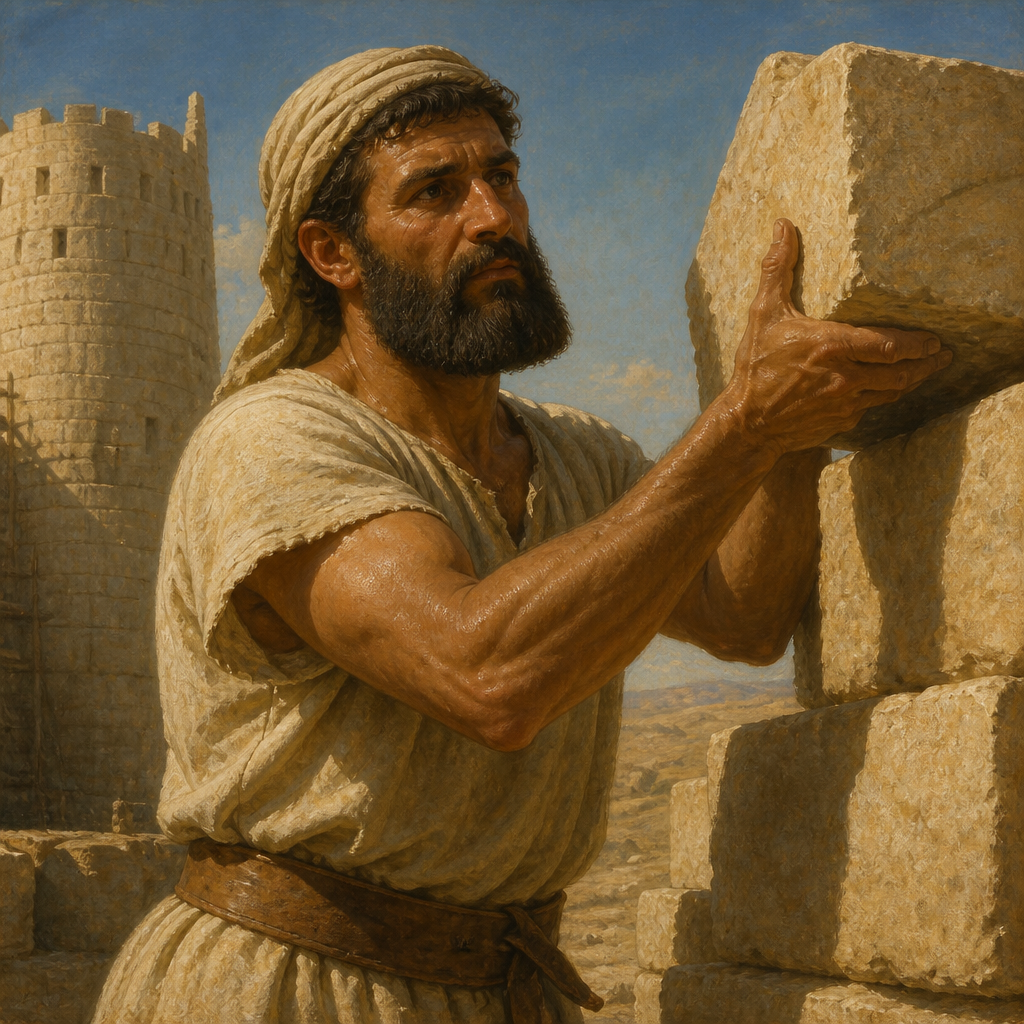
The primary significance of Pahath-moab in the biblical narrative is his role as the father of Hasshub. During the mid-5th century BC, Nehemiah arrived in Jerusalem to lead the reconstruction of the city's ruined walls. This project was organized by family groups and regional cohorts. Pahath-moab’s son, Hasshub, was assigned to a specific portion of the wall.
According to the text, Hasshub worked alongside Malchijah son of Harim. Together, they repaired "another section" of the wall, which included the significant landmark known as the "Tower of the Ovens" (Nehemiah 3:11). While Pahath-moab is not credited with the physical labor himself, the inclusion of his name identifies the family line responsible for this critical defensive structure. The Tower of the Ovens (Migdal ha-Tannurim) is believed to have been located on the northwestern side of the city, possibly near the Corner Gate, serving as a vital point in the city's fortification.
Relationship to Other Biblical Figures
Pahath-moab is directly linked to his son, Hasshub. Hasshub is depicted as a diligent worker and a collaborator with Malchijah son of Harim. This partnership indicates that the families of Pahath-moab and Harim were either neighbors in the city or shared a communal responsibility for that specific sector of the fortifications. The cooperation between these families highlights the unity required to complete the wall in only fifty-two days despite significant opposition.
Spiritual Significance
In the context of the book of Nehemiah, being named in the list of builders carries significant weight. It denotes faithfulness to the covenant and a commitment to the survival of the Jewish identity. By being recorded as the father of a builder, Pahath-moab is immortalized as part of the remnant that prioritized the sanctity of Jerusalem. The mention of his son’s work on the Tower of the Ovens connects his family name to the protection of the community and the restoration of the city where the Temple of God stood. His inclusion reinforces the biblical theme that the restoration of God's people was a collective effort involving specific, named families who were willing to invest their lives and resources into the divine mandate of rebuilding.
Spiritual Significance
Pahath-moab’s theological and historical significance lies in his role as a link in the post-exilic community. His name appears in the 'wall-builders' list, which serves as a roll of honor for those who returned to Zion. By providing the identity for his son Hasshub, he represents the preservation of the Jewish family unit through the trauma of the Babylonian exile. The record of his family’s contribution to the Jerusalem wall signifies their transition from captives in a foreign land to active participants in the sovereign restoration of Israel.
Frequently Asked Questions
What does the name Pahath-moab mean?
The name Pahath-moab is Hebrew for 'Governor of Moab,' potentially indicating that an ancestor of this family held a leadership position in the region of Moab.
What did the son of Pahath-moab repair?
His son, Hasshub, repaired a section of the Jerusalem wall and the Tower of the Ovens, working alongside Malchijah son of Harim.
Where is the only mention of this Pahath-moab?
This specific figure is mentioned only in Nehemiah 3:11, as the father of one of the wall-builders.
Which tribe did Pahath-moab belong to?
The Bible does not explicitly state Pahath-moab's tribe, though he was part of the Jewish community that returned from the Babylonian Exile.
Connected Figures
Hasshub
Son
Malchijah son of Harim
Co-worker of his son
Nehemiah
Leader of the wall-rebuilding project
Categories
Mentions by Book
- Nehemiah1
Family & Relationships
Child
Nehemiah 3:11
Others Named Pahath-moab
Pahath-moab, Leader of the Post-Exilic CovenantNehemiah 10:14
A leader of the Jewish people who signed the solemn covenant with Nehemiah to uphold the Law of Moses following the return from Babylon.
Pahath-moab, Ancestor of Jeshua and JoabEzra 2:6
An ancestral figure whose large family line was central to the restoration of Jerusalem and the Jewish community after the Babylonian Exile.