Elnathan, son of Achbor
An official in the court of King Jehoiakim who participated in the pursuit of the prophet Uriah and later pleaded with the king not to burn Jeremiah's scroll.
Elnathan, son of Achbor, was a prominent high-ranking official during the reign of King Jehoiakim in the late seventh century BC. Serving in the royal court of the Divided Monarchy, he appears in the Book of Jeremiah as a member of the Judean administrative elite. His father, Achbor, was likely the same individual who served King Josiah, suggesting Elnathan belonged to a family with a long-standing tradition of proximity to the Davidic throne.
Elnathan’s role in the biblical narrative is complex, characterized by two distinct actions. Initially, he acted as the king's agent in the extra-territorial apprehension of the prophet Uriah, who had fled to Egypt to escape royal wrath. Later, however, Elnathan is recorded as one of the few officials who displayed a measure of reverence for the prophetic word, unsuccessfully urging King Jehoiakim to refrain from destroying a scroll containing the prophecies of Jeremiah. His actions reflect the deep political and spiritual tensions within the Judean leadership during the final decades before the Babylonian captivity.
Background and Family
Elnathan was the son of Achbor (Jeremiah 26:22). While the biblical text does not provide an exhaustive genealogy for him, his father Achbor is generally identified with the high official mentioned in 2 Kings 22:12, who was part of the delegation sent by King Josiah to consult the prophetess Huldah. This heritage suggests that Elnathan was raised in a family of significant political influence and was likely educated in the protocols of the royal court of Judah. As an official under King Jehoiakim (reigned c. 609–598 BC), Elnathan was part of the inner circle of the Divided Monarchy's leadership during a period of intense pressure from both the Egyptian and Babylonian empires.
Major Life Events
Elnathan’s first appearance in the biblical record occurs in Jeremiah 26. Following the prophet Uriah’s fearful escape to Egypt—prompted by his prophecies against Jerusalem—King Jehoiakim dispatched a search party to retrieve him. Elnathan was chosen to lead this mission, traveling to Egypt with a group of men to arrest the prophet. Upon successfully capturing Uriah, Elnathan brought him back to Jerusalem, where the king subsequently executed the prophet (Jeremiah 26:22-23).
Years later, in the fifth year of Jehoiakim's reign (c. 604 BC), Elnathan appears again in a different context. Jeremiah’s scribe, Baruch, had publicly read a scroll containing all of Jeremiah's prophecies of judgment. When the officials heard of this, they requested a private reading in the scribe’s chamber. Elnathan is listed among the officials present, including Elishama the scribe and Delaiah son of Shemaiah (Jeremiah 36:12).
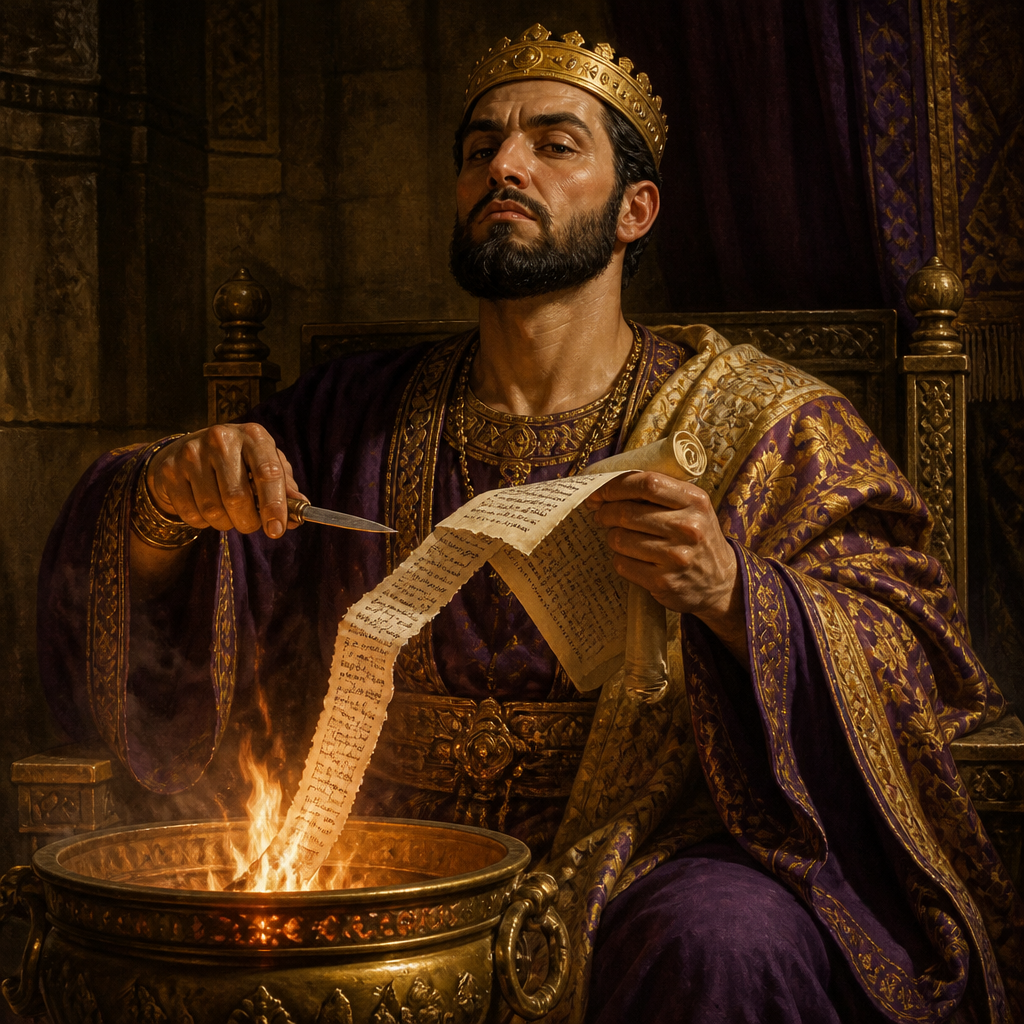
After the scroll was brought to the king and read aloud, Jehoiakim began to systematically cut and burn the manuscript in a brazier. In a notable moment of resistance against the king’s impiety, Elnathan, alongside Delaiah and Gemariah, "urged the king not to burn the scroll" (Jeremiah 36:25). Their plea was ignored, and the king proceeded to order the arrest of Baruch and Jeremiah, though they remained hidden.
Relationship to Other Biblical Figures
Elnathan’s primary relationships are defined by his service to the Judean crown and his interaction with the prophets. As a son of Achbor, he was a peer to the sons of Shaphan, such as Gemariah, representing a generation of officials who had seen the reforms of Josiah but now served under his less-pious son, Jehoiakim. While he initially acted as the king's enforcer against the prophet Uriah, his later alignment with those who respected Jeremiah's scroll suggests a possible internal conflict or a shifting perspective as the national crisis deepened.
Spiritual Significance
Elnathan serves as a literary and historical example of the moral ambiguity found within the Judean leadership. His participation in the arrest of Uriah highlights the complicity of the ruling class in the persecution of God's messengers. However, his subsequent attempt to save Jeremiah’s scroll provides a crucial detail regarding the diversity of thought within the palace. Though he remained a loyal official to a wicked king, Elnathan demonstrated a flicker of conscience and a recognition of the divine authority behind the written word of the prophets, even when he lacked the power to sway the king's final decision.
Spiritual Significance
Elnathan’s life illustrates the tension between professional duty and spiritual conviction. By attempting to stop King Jehoiakim from burning the scroll, he represents a minority voice within the government that recognized the gravity of God's warnings, even as the nation hurtled toward destruction. His presence in the text provides historical grounding for the administrative structure of the late Judean monarchy and the specific personalities involved in the conflict between the monarchy and the prophetic movement.
Frequently Asked Questions
Who was Elnathan's father?
Elnathan was the son of Achbor, an official who served under King Josiah.
What mission did Elnathan perform in Egypt?
King Jehoiakim sent Elnathan to Egypt to find and arrest the prophet Uriah, who had fled there to escape the king's wrath.
Did Elnathan support the burning of Jeremiah's scroll?
No. According to Jeremiah 36:25, Elnathan was one of the three officials who specifically urged King Jehoiakim not to burn the scroll, though the king refused to listen.
In which book of the Bible is Elnathan mentioned?
Elnathan, son of Achbor, is mentioned exclusively in the Book of Jeremiah.
Was Elnathan a prophet?
No, Elnathan was a royal official or prince (sar) in the court of Judah during the Divided Monarchy.
Connected Figures
Jehoiakim
King / Master
Achbor
Father
Uriah
Prophet he apprehended
Jeremiah
Prophet whose scroll he tried to save
Categories
Mentions by Book
- Jeremiah3
Family & Relationships
Parent
Achbor, Official of King Josiah
2 Kings 22:12
Others Named Elnathan
Elnathan, Teacher of the ReturnEzra 8:16
A Jewish teacher and man of insight who assisted Ezra during the return from Babylonian exile to the land of Judah.
Elnathan, Teacher of the ReturnEzra 8:16
A teacher and man of insight who assisted Ezra during the Jewish return from Babylonian exile to the land of Judah.
Elnathan, Leader of the ReturnEzra 8:16
A Jewish leader summoned by Ezra during the return from Babylonian exile to help secure Levites for temple service.
Elnathan, Father of Nehushta2 Kings 24:8
Elnathan was a prominent resident of Jerusalem during the Divided Monarchy and the maternal grandfather of King Jehoiachin.