Baruch, Scribe of Jeremiah
Who was Baruch, Scribe of Jeremiah, in the Bible?
A faithful scribe and assistant to the prophet Jeremiah during the final decades of the Kingdom of Judah and the Babylonian conquest.
This is one of 4 people named Baruch in the Bible. See all 4 →
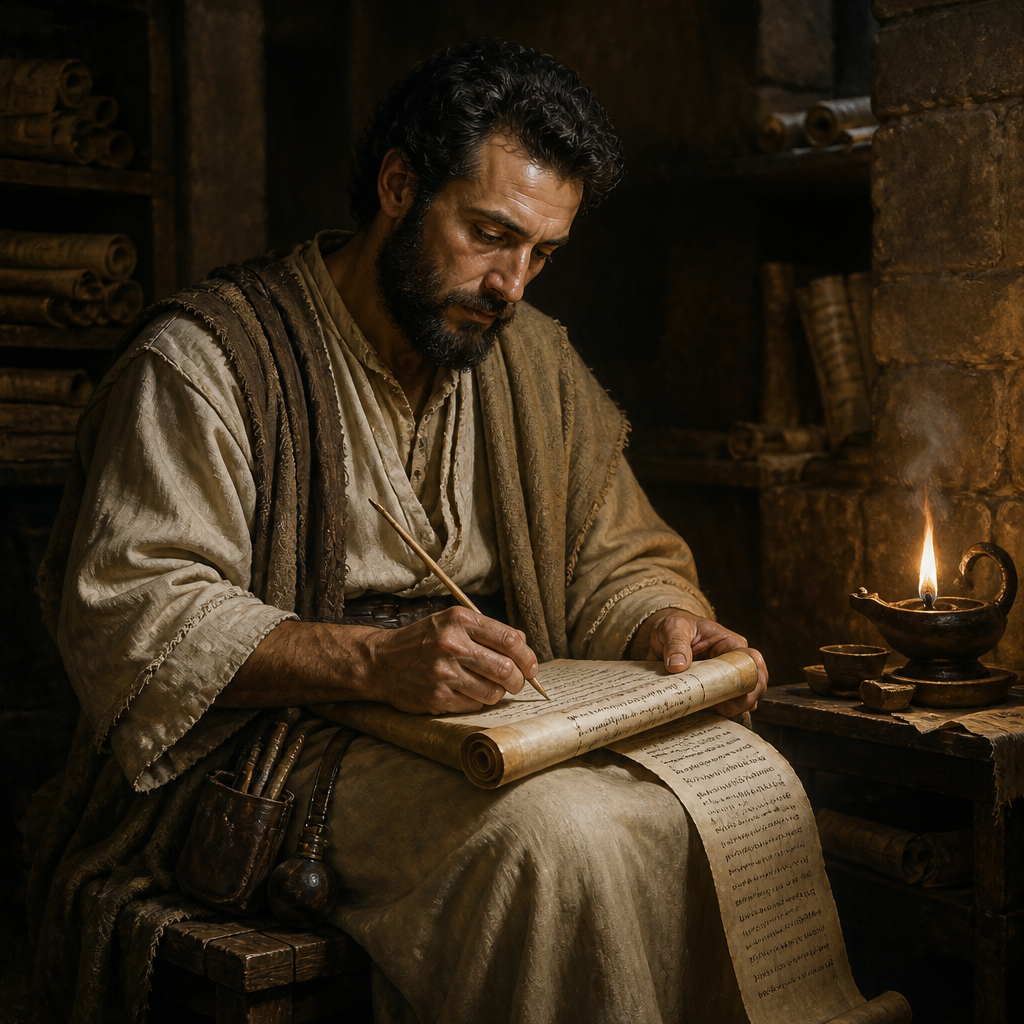
Baruch son of Neriah was a prominent scribe and the devoted companion of the prophet Jeremiah during the late 7th and early 6th centuries BC. Operating during the turbulent Divided Monarchy, Baruch served as more than a simple secretary; he was a trusted confidant and a public representative for Jeremiah when the prophet was barred from the Temple. His role was crucial in the preservation of the prophetic oracles that now comprise the Book of Jeremiah, as he was responsible for the physical transcription of the divine warnings issued to the kings and people of Judah.
Historically, Baruch is situated in the desperate final years of Jerusalem. As the Babylonian Empire rose to dominance, Baruch stood by Jeremiah through imprisonment, political persecution, and the eventual fall of the city. He is characterized in the biblical text by his unwavering loyalty to the prophetic word, even when doing so placed his life in jeopardy under the reigns of King Jehoiakim and King Zedekiah.
Background and Family
Baruch was the son of Neriah and the grandson of Mahseiah. The biblical record identifies his brother as Seraiah (Jeremiah 51:59), who served as a quartermaster under King Zedekiah. Given the high-ranking positions held by both Baruch and his brother, scholars generally conclude that Baruch belonged to a prominent, perhaps aristocratic, family of scribes in Jerusalem. In the Ancient Near East, the role of a scribe (Hebrew: sopher) was not merely that of a clerk but often involved significant administrative authority and legal expertise. This background explains his access to the Temple courtyards and his familiarity with the royal officials of the Judean court.
Major Life Events
The Writing and Reading of the Scroll
In the fourth year of King Jehoiakim (c. 605 BC), the Lord commanded Jeremiah to write all the prophecies he had received against Israel, Judah, and the nations on a scroll. Jeremiah summoned Baruch, who wrote down the dictation. Because Jeremiah was restricted from entering the Temple, he sent Baruch to read the scroll in the hearing of the people on a day of fasting (Jeremiah 36:4–6). Baruch showed remarkable courage by standing in the upper courtyard of the Temple and proclaiming words of judgment against the current administration.
When the officials heard of this, they summoned Baruch to read the scroll to them privately. Recognizing the gravity of the message, they advised Baruch and Jeremiah to go into hiding before the scroll was presented to King Jehoiakim. The king, upon hearing the words, famously cut the scroll with a scribe's knife and burned it. Undeterred, Baruch transcribed a second scroll at Jeremiah's dictation, adding even more words of warning (Jeremiah 36:32).
The Purchase of the Field at Anathoth
During the siege of Jerusalem in the tenth year of King Zedekiah (c. 587 BC), Jeremiah was imprisoned. During this time, the prophet performed a symbolic act of faith by purchasing a field in Anathoth from his cousin Hanamel, signifying that life would one day return to the land. Jeremiah entrusted the deeds of purchase to Baruch, instructing him to place them in an earthenware jar so they would last for a long time (Jeremiah 32:12–14). This act solidified Baruch's role as the legal executor and witness to Jeremiah’s prophetic hope.
The Remnant and Egypt
After the fall of Jerusalem, Baruch remained with Jeremiah among the remnant left in Judah under the governorship of Gedaliah. Following Gedaliah’s assassination, the remaining leaders feared Babylonian reprisal and sought to flee to Egypt. When Jeremiah prophesied against this move, the leaders accused Baruch of inciting Jeremiah against them to deliver them to the Chaldeans (Jeremiah 43:3). Despite this false accusation, Baruch was forcibly taken to Egypt along with Jeremiah, where the biblical record of his life concludes (Jeremiah 43:6).
Relationship to Other Biblical Figures
Baruch’s primary relationship was with the prophet Jeremiah. Their partnership is one of the most clearly defined examples of a prophet-scribe relationship in the Old Testament. Baruch acted as Jeremiah's voice, his hands, and his legal witness. He also interacted with the political elite of Jerusalem, including Gemariah son of Shaphan and other officials who sought to protect him from the king's wrath. His sibling, Seraiah, also plays a minor role in the narrative, suggesting that the entire household of Neriah was intertwined with the final days of the Judean monarchy.
Spiritual Significance
Baruch’s spiritual journey is highlighted in Jeremiah 45, a brief chapter addressed specifically to him. Exhausted and discouraged by the weight of the prophecies he was recording, Baruch lamented, "Woe is me! For the Lord has added sorrow to my pain." In response, God rebuked his desire for "great things" for himself during a time of national destruction. However, God offered a personal promise of protection: "I will give you your life as a prize of war in every place you go" (Jeremiah 45:5). Baruch represents the faithful remnant who suffers alongside the prophet, finding that their primary reward in a collapsing society is the preservation of their life and the integrity of the Word they serve.
Baruch is significant primarily as the preserver of the Book of Jeremiah. Without his scribal work and his willingness to risk his life to read the scrolls in public, much of the longest book in the Bible might not have been recorded. He serves as a model of the 'secondary' figure whose support is indispensable to the 'primary' prophetic calling. Historically, he provides a rare glimpse into the professional scribal practices of the late Divided Monarchy, illustrating how prophetic oracles were moved from spoken word to written document.
Theologically, Baruch’s story in Jeremiah 45 addresses the personal cost of ministry. It serves as a reminder that those who serve God's purposes are not exempt from the grief of their era, but they are sustained by divine providence. Baruch stands as a witness to the transition from the old kingdom of Judah to the reality of the Exile, bridging the gap between the destruction of the Temple and the preservation of the faith through the written text.
Frequently Asked Questions
What was Baruch's job?
Baruch was a professional scribe (sopher). In the context of the Divided Monarchy, this meant he was a highly educated official capable of writing legal documents, transcribing prophetic oracles, and navigating the complexities of the royal court.
Did Baruch write the Book of Jeremiah?
Baruch wrote the words of the book at the dictation of Jeremiah. While Jeremiah is the author of the prophecies, Baruch was the physical writer and compiler who likely arranged the materials into the format we recognize today.
Why did King Jehoiakim want to arrest Baruch?
Jehoiakim was enraged by the scroll Baruch read, which prophesied that the King of Babylon would destroy Judah. The king viewed Baruch and Jeremiah as subversives and sought to seize them, but the Bible records that the Lord hid them.
What happened to Baruch after the fall of Jerusalem?
After Jerusalem fell to the Babylonians in 586 BC, Baruch was eventually forced to go to Egypt with Jeremiah by the remnant of Jews who feared the Babylonians, despite Jeremiah's warnings against the move.
What promise did God give to Baruch?
In Jeremiah 45, God promised Baruch that while the nation was being destroyed, his life would be spared as a 'prize of war' wherever he went, essentially guaranteeing his survival through the crisis.
Family & Relationships
Parents
 NeriahFatherJeremiah 32:12Stated
 Baruch, Scribe of JeremiahThis page
 Seraiah, Quartermaster of JudahBrotherJeremiah 32:12
Inferred
Reconstructed through Neriah: Jeremiah 51:59 ties Seraiah to Neriah; Jeremiah 32:12 ties Neriah to Baruch. No verse states the brother link between Seraiah and Baruch directly.Evidence: Jeremiah 32:12; Jeremiah 51:59
Connected Figures
Family
Father · Jeremiah 32:12
A prominent Judean man of the late Divided Monarchy known as the father of Baruch the scribe and Seraiah the quartermaster.
Divided MonarchyFirst: Jeremiah 32:1210 versesPatriarch of a scribal/administrative family
Brother · Jeremiah 32:12
Seraiah was a high-ranking official under King Zedekiah who served as a royal quartermaster and acted as a messenger for the prophet Jeremiah during the Babylonian exile.
Divided MonarchyFirst: Jeremiah 51:594 versesQuartermaster
Categories
Mentions by Book
- Jeremiah23
Scripture References
All 23 indexed verses, in canonical order, from the Berean Standard Bible.
Jeremiah · 23
- Jeremiah 32:12
and I gave this deed to Baruch son of Neriah, the son of Mahseiah, in the sight of my cousin Hanamel and the witnesses who were signing the purchase agreement and all the Jews sitting in the courtyard of the guard.
- Jeremiah 32:13
In their sight I instructed Baruch,
- Jeremiah 32:16
After I had given the deed of purchase to Baruch son of Neriah, I prayed to the LORD:
- Jeremiah 36:4Partial
So Jeremiah called Baruch son of Neriah, and at the dictation of Jeremiah, Baruch wrote on a scroll all the words that the LORD had spoken to Jeremiah.
- Jeremiah 36:5
Then Jeremiah commanded Baruch, “I am restricted; I cannot enter the house of the LORD;
- Jeremiah 36:8
So Baruch son of Neriah did everything that Jeremiah the prophet had commanded him. In the house of the LORD he read the words of the LORD from the scroll.
- Jeremiah 36:10
From the chamber of Gemariah son of Shaphan the scribe, which was in the upper courtyard at the opening of the New Gate of the house of the LORD, Baruch read from the scroll the words of Jeremiah in the hearing of all the people.
- Jeremiah 36:13
And Micaiah reported to them all the words he had heard Baruch read from the scroll in the hearing of the people.
- Jeremiah 36:14Partial
Then all the officials sent word to Baruch through Jehudi son of Nethaniah, the son of Shelemiah, the son of Cushi, saying, “Bring the scroll that you read in the hearing of the people, and come here.” So Baruch son of Neriah took the scroll and went to them.
- Jeremiah 36:15
“Please sit down,” they said, “and read it in our hearing.” So Baruch read it in their hearing.
- Jeremiah 36:16
When they had heard all these words, they turned to one another in fear and said to Baruch, “Surely we must report all these words to the king.”
- Jeremiah 36:17
“Tell us now,” they asked Baruch, “how did you write all these words? Was it at Jeremiah’s dictation?”
- Jeremiah 36:18
“It was at his dictation,” Baruch replied. “He recited all these words to me and I wrote them in ink on the scroll.”
- Jeremiah 36:19
Then the officials said to Baruch, “You and Jeremiah must hide yourselves and tell no one where you are.”
- Jeremiah 36:26
Instead, the king commanded Jerahmeel, a son of the king, as well as Seraiah son of Azriel and Shelemiah son of Abdeel, to seize Baruch the scribe and Jeremiah the prophet. But the LORD had hidden them.
- Jeremiah 36:27
After the king had burned the scroll containing the words that Baruch had written at Jeremiah’s dictation, the word of the LORD came to Jeremiah:
- Jeremiah 36:32
Then Jeremiah took another scroll and gave it to the scribe Baruch son of Neriah, and at Jeremiah’s dictation he wrote on it all the words of the scroll that Jehoiakim king of Judah had burned in the fire. And many similar words were added to them.
- Jeremiah 43:3
Rather, Baruch son of Neriah is inciting you against us to deliver us into the hands of the Chaldeans, so that they may put us to death or exile us to Babylon!”
- Jeremiah 43:6
the men, the women, the children, the king’s daughters, and everyone whom Nebuzaradan captain of the guard had allowed to remain with Gedaliah son of Ahikam, the son of Shaphan, as well as Jeremiah the prophet and Baruch son of Neriah.
- Jeremiah 45:1
This is the word that Jeremiah the prophet spoke to Baruch son of Neriah when he wrote these words on a scroll at the dictation of Jeremiah in the fourth year of Jehoiakim son of Josiah, king of Judah:
- Jeremiah 45:2
“This is what the LORD, the God of Israel, says to you, Baruch:
- Jeremiah 45:5Partial
But as for you, do you seek great things for yourself? Stop seeking! For I will bring disaster on every living creature, declares the LORD, but wherever you go, I will grant your life as a spoil of war.”
Cited as a key verse; added so References, Key Verses and Mentions by Book share one index.
- Jeremiah 51:59Partial
This is the message that Jeremiah the prophet gave to the quartermaster Seraiah son of Neriah, the son of Mahseiah, when he went to Babylon with King Zedekiah of Judah in the fourth year of Zedekiah’s reign.
Cited as evidence on a family card; added so References, Key Verses and Mentions by Book share one index.
Others Named Baruch
Compare all 4 bearers →Baruch, Priest under NehemiahNehemiah 10:6
A Jewish priest during the post-exilic period who participated in the solemn covenant renewal under the leadership of Nehemiah and Ezra.
Baruch, Ancestor of MaaseiahNehemiah 11:5
A descendant of Judah through Shelah, whose lineage helped repopulate Jerusalem following the Babylonian exile.
Baruch, Son of ZabbaiNehemiah 3:20
A diligent Jewish worker who participated in the restoration of the walls of Jerusalem under Nehemiah following the return from Babylonian exile.